Concept
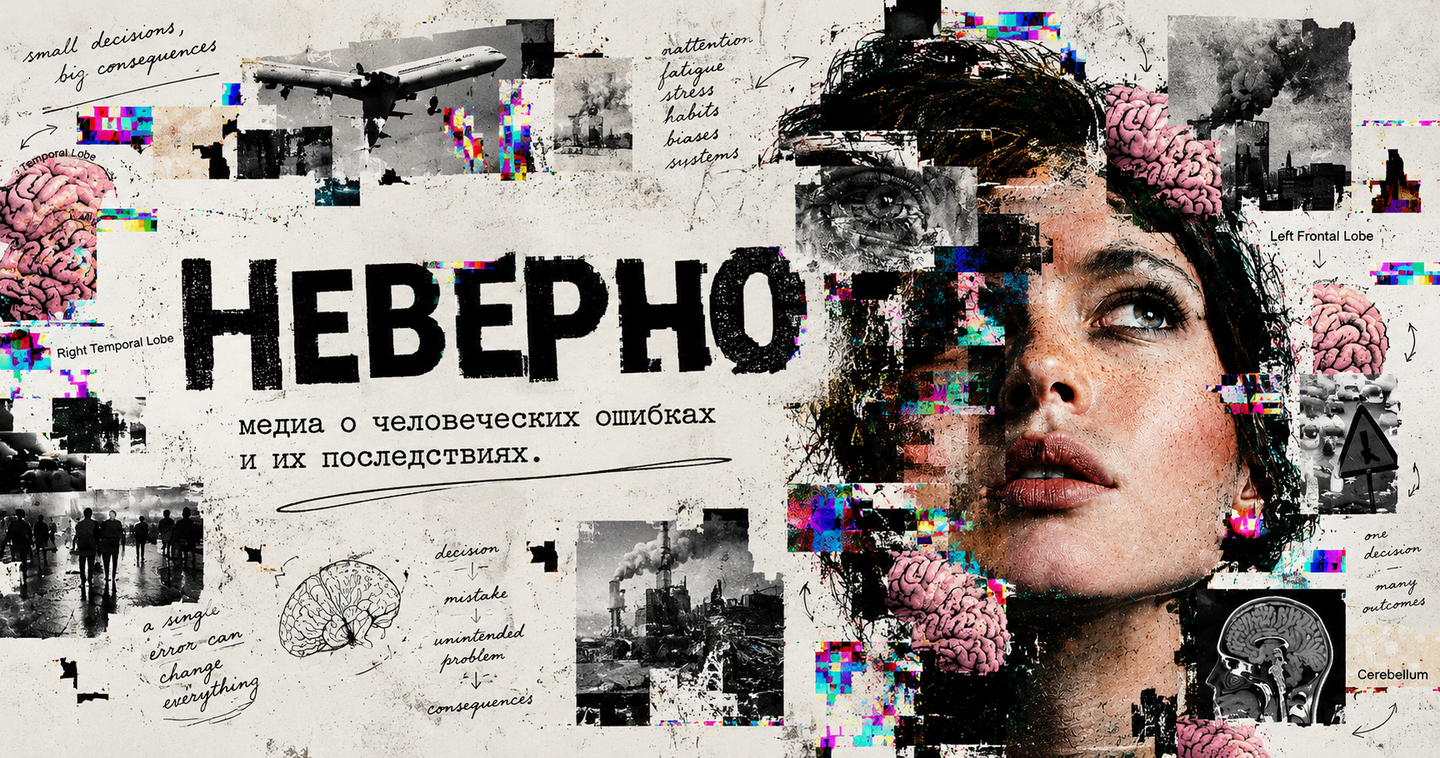
INCORRECT — a media outlet exploring human errors and their consequences. How the slightest miscalculation by an individual or a company influences historical processes and forges a new reality.
Media that explores how human error, flawed decisions, and small oversights lead to unexpected consequences—from humorous everyday incidents to major accidents, corporate failures, and engineering disasters. The core principle of this media is not «who is to blame?» but «how did this become possible?» The media does not ridicule the person who made a mistake; rather, it dissects the chain of decisions that led to the final outcome.
Goal
Media that explores human error through real-life stories, presenting them not as isolated failures, but as the result of an interaction between the individual, the system, and external circumstances. The focus is on how the error occurs, why it seems logical, and how it leads to consequences.
The media should transform complex cause-and-effect relationships into accessible, visual, and engaging content so that the audience doesn’t just learn about unusual failures, but learns to see the mechanisms behind them.
Themes
Focus Area: human error and its consequences.
Specific Topic: real-life stories where incorrect decisions, chance occurrences, or overlooked mistakes lead to unexpected outcomes.
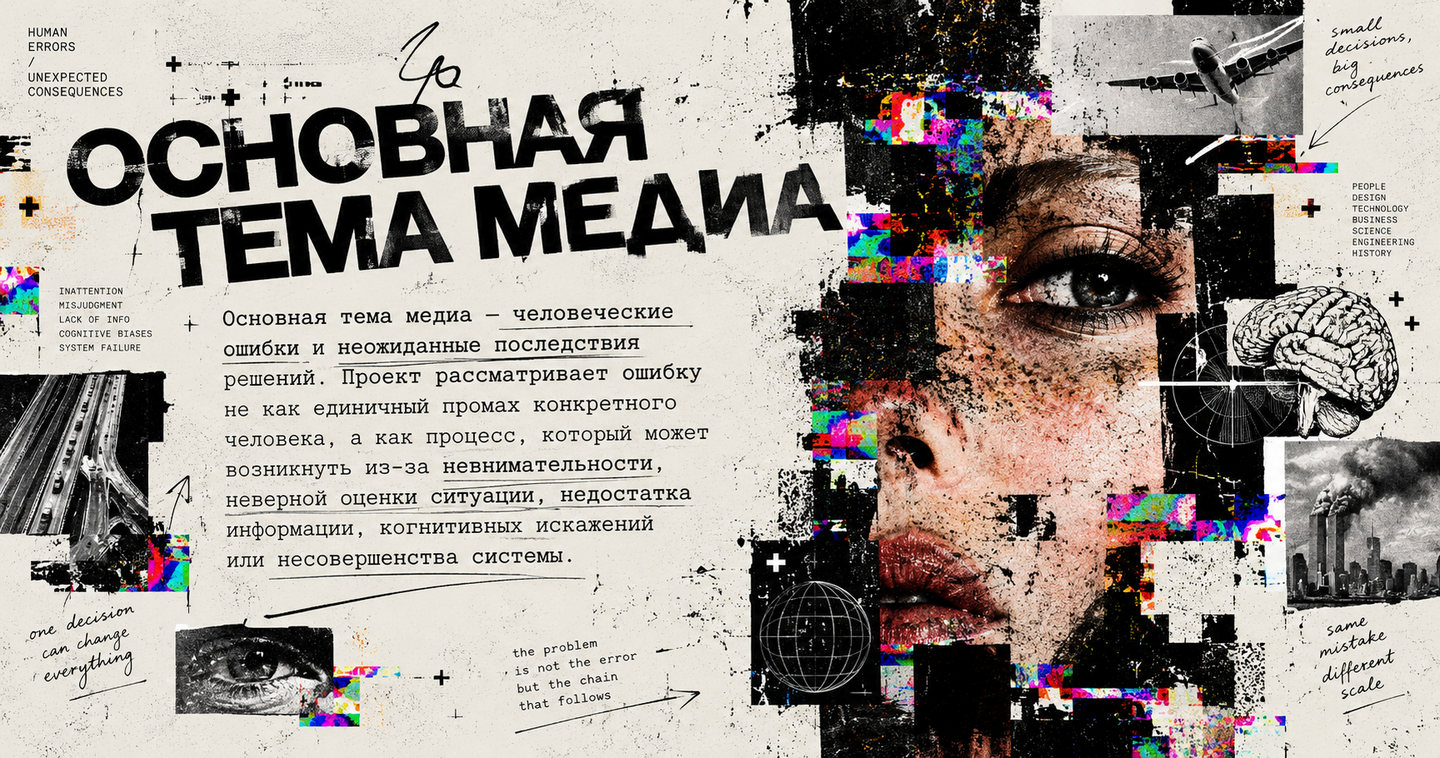
Media merges narratives from diverse fields: everyday life, psychology, design, technology, business, science, engineering, and history. This allows us to illustrate that the mechanism of error operates independently of scale: one poorly chosen button can cause a minor daily inconvenience, while a small calculation error can lead to a major accident.
Core publication themes:
- Micro-errors — a small action or decision that leads to an unexpected outcome.
- Systemic errors — chains of decisions and conditions that result in a serious failure.
- Design errors — how characteristics of interfaces, objects, and environments cause people to make mistakes.
- Business errors — incorrect corporate decisions, failed products, and projects.
- Human factors — cognitive biases, inattention, fatigue, and other causes of error.
- Catastrophic consequences — stories of accidents and incidents dissected through a sequence of decisions, not just the final event.
Who is this media for
The media outlet «NEVER TRUE» is created for curious audiences interested in unusual stories, psychology, and the reasons behind human error—for those who want to understand how small decisions lead to unexpected consequences, learn something new, test their attention to detail, and learn from the experiences of others.
Platforms and Distribution
The primary media channel is YouTube, where detailed breakdowns of real-life stories are published, running 8–20 minutes and utilizing archival footage, diagrams, and animation. Telegram serves as a hub for supplementary content, visual analyses, polls, and interactive elements, while VK Clips, YouTube Shorts, and Reels attract new audiences with short narratives and questions about common mistakes.Content is tailored for each platform: the in-depth analysis on YouTube is complemented by short videos, event-chain cards, and a «Spot the Mistake» interactive, which helps engage the audience and direct them to the main materials.
Thematic Plan
The core idea of the media is to demonstrate how a small mistake, a wrong decision, or a random action can lead to unexpected changes in the life of an individual, a company, or an entire society.
The semester-long thematic plan revolves around the sequential study of error: ranging from small, everyday mistakes to major technological failures, historical turning points, and systemic issues. Furthermore, the media does not simply report what happened; it dissects why the error occurred, what led to it, and how it changed the subsequent course of events.
These six tracks are not isolated categories. They form a single thematic line: from the cause of an error—through its development—to the consequences and conclusions. While the monthly themes set the primary focus, they do not prohibit publishing materials from other tracks if a relevant news item arises.
What problems does this system solve?— Media Cohesion. All publications are unified by one concept—the study of human errors and their consequences. — Content Diversity. The audience receives documentary stories, analytics, infographics, interviews, and interactive materials. — Platform Adaptation. Content is not mechanically copied; rather, it is recontextualized based on the audience’s behavior on each platform. — Efficient Resource Utilization. Research, fact-checking, and source material can form the basis for several independent publications. — Gradual Audience Engagement. Short videos introduce the media, YouTube delves deeper into the topic, and Telegram helps maintain interest and involve subscribers in discussion.
Content Samples
The rubrics must be recognizable and recur week after week, while the six thematic areas—micro-errors, human factors, system failures, chains of consequence, decisions made by individuals and governments, and the new reality—should define the specific topics covered within those rubrics.