
Media Concept

Goal: To explain how algorithms work and to provide a way for users to customize them. Topic: Technology/Science Pop → Everyday algorithms through the user’s perspective. Target Audience: SMM specialists and content creators (reach), parents (what children see), and students (a path into ML).
Unique Selling Propositions:
- Written by an engineer who personally creates the recommendations and advertising content.
- Every post concludes with a one-minute call to action.
- We analyze screenshots submitted by readers.
Thematic Plan for Six Months (November 2026 — April 2027)
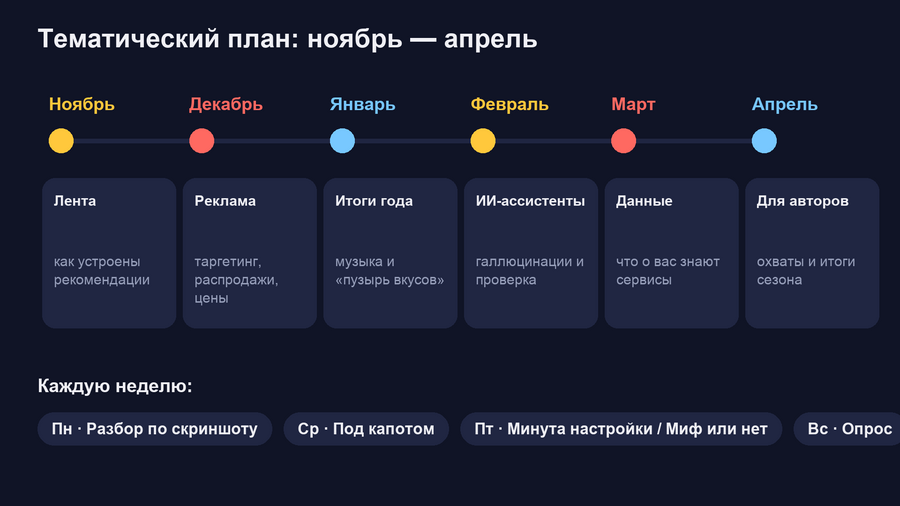
10 content samples
Myth or Not: «My phone is listening to me and serving me ads»

You discussed sneakers with a friend, and an hour later you see them in an ad. Sound familiar? Almost everyone thinks their phone is listening in.Verdict: probably a myth. Constantly recognizing all users' speech is expensive and noticeable (battery, data usage), and researchers searching for evidence of such data transfer have not found mass proof.So, why does the advertising seem to «guess»? :
- You were nearby. Your phones were on the same Wi-Fi network and in the same geolocation. The system knows you are connected and shows you what your friend was searching for.
- You searched already. Sometimes we forget that we ourselves Googled something yesterday.
- Similar people. Your age, neighborhood, and interests match those who are buying these sneakers right now.
- Survivor bias. You ignore a hundred misses, but you remember one hit for a week.What to do (1 minute): go to Settings → Privacy → Microphone and check which applications are even allowed to access it. Remove the unnecessary ones; it’s helpful either way.
Under the Hood: How a Recommendation System Selects 10 Videos from a Billion

It is impossible to view every video on the platform and select the best one for you—there are billions of them, and the system has only fractions of a second to respond. That’s why the funnel works.1. Candidate Selection. Fast, simple methods gather several thousand videos: those similar to what you’ve watched; those popular among people like you; new ones from your subscriptions.2. Ranking. A complex model evaluates each candidate: what is the probability that you will watch it all the way through, like it, subscribe, or click «not interested»? Hundreds of features are considered: time of day, device, your history, video recency.3. Re-ranking and Rules. Diversity is added to the final list (to avoid 10 cat videos in a row), and prohibited or already viewed content is filtered out.This means no single person chose this video for you. It is the result of thousands of small evaluations.What to do: If your feed is «stuck» on one topic, click «Not interested» directly on the cards instead of just scrolling past them. Skipping is a weak signal—a clear rejection is a strong one.
Screenshot Analysis: «I bought a stroller, and they show me strollers for a week»

Screenshot from a follower: «I bought a stroller last Saturday, but the stroller ads never stop.»
Why this happens: it’s retargeting, ads shown to people who have previously shown interest. The advertising system saw that you viewed strollers on various websites, but it doesn’t always know that you actually purchased them. The retailer might not pass purchase data, you might have bought it from a different store, or perhaps you purchased it in person.
For the algorithm, you are still classified as a «hot stroller buyer, ” and these ad placements are expensive—though they generally offer a good return on investment. On average, but not necessarily in your case.
Usually, this type of advertising fades within 1–4 weeks—interest has an „expiration date“ that the advertiser sets.
What to do: most ads have a „Hide“ or „Not Interested“ menu option. Click on two or three ads, and the system will catch on faster.
A Minute to Configure: How to «Reboot» Recommendations

Tired of the feed but don’t want to start a new account? Here are three reset levels:
Targeted. On an uninteresting video or track: «Not interesting» / «Do not recommend channel» / dislike. This works fast if you do it 10–15 times in a row.
Clear History. In YouTube, this is «History & Privacy»: you can delete individual videos that skewed the recommendations (for example, watching a children’s cartoon once for your niece).
Pause History. You can turn off the recording of your watch history. Drawback: recommendations will become noticeably worse and more generalized.
Life hack: If you want to watch something «off the radar, ” open it in Incognito mode or without logging into an account. That way, it won’t affect your recommendations.
Myth or Not: «The more I like, the better the feed.»
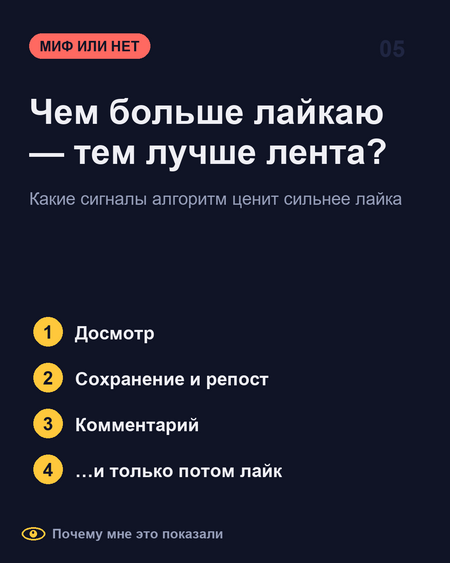
Verdict: myth. A like is just one signal, and not the strongest one. What the algorithm values more than a like:
- Full watch time. If you watch a video all the way through or rewatch it—that means you liked it, even without a like.
- Skipping after 1–2 seconds. This is a strong negative signal.
- Saving and reposting. These are valued higher than a like: you are willing to revisit the content or share it.
- Comments. This means the video struck a chord with you. However, the algorithm doesn’t always distinguish between delight and indignation. If you like everything indiscriminately, the signal becomes «diluted"—the system stops understanding what you genuinely enjoy.
What to do: only like what you truly want. Don’t watch boring content out of politeness.
Under the Hood: Why AI Assistants Confidently Lie

You asked an AI about a book, and it invented a non-existent chapter and quote. This is called hallucination.
Why does this happen? The language model does not search for an answer in a knowledge base. Instead, it predicts the next word—the continuation of the text that is most probable. Usually, what is probable aligns with the truth. But if there was little information about your book in the training data, the model will still generate smooth, confident text because that is how «good answers» appear.
A confident tone does not equate to accuracy. The model sounds equally confident whether it knows the information or not. The risk is highest with precise figures, dates, quotes, references, obscure names, laws, and medicine.
What to do:
- Ask for sources and open them. Ask: «Where could you be wrong?» This often uncovers weak points.
- Verify important facts using a search engine or the original source.
Screenshot Analysis: «Taxi during rain costs twice as much»

Reader screenshot: usually 450 ₽ before work, 920 ₽ in the rain.Why is it like this? It’s dynamic pricing. The algorithm compares demand (how many people opened the app in that area) and supply (how many free cars are nearby) in real time. Demand spikes sharply in the rain, but the number of cars remains the same, so the price increases. The higher fare is intended to attract more drivers to the area and filter out those who aren’t in urgent need.Popular myth: «It’s more expensive on an iPhone or with a low battery.» Aggregators publicly deny this, and journalistic investigations have shown no systematic price difference. Time, location, and weather have a much stronger influence.
What to do:
- Move 200–300 meters away from high-demand areas (subways, malls, concerts), and the price may drop significantly.
- Wait 10–15 minutes: the price increase is often temporary.
- Compare fares in two different applications.
Setup Minute: How to Know What the Service Knows About You
Under data privacy laws, you have the right to know what personal data the company stores about you. Many major services allow you to download this information yourself. Google: Google Takeout (takeout.google.com) allows you to download your search history, YouTube activity, geolocation data, and much more.
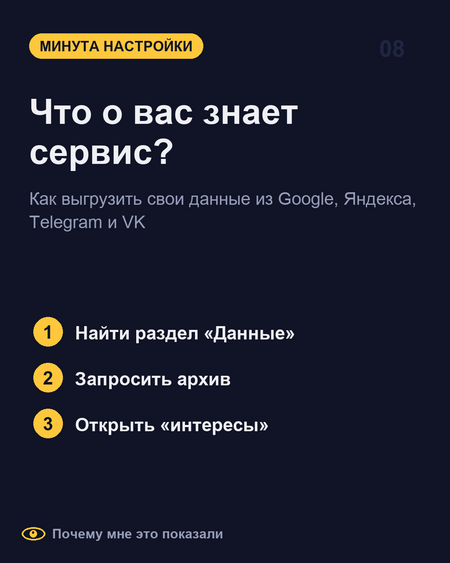
In the Yandex ID settings, there is a data management section where you can view and download service data or delete it. Telegram and VK: settings include data and history export.
What to expect: the archive will not arrive immediately—sometimes it takes several hours. The most interesting parts are usually in the location history and in the «advertising interests, ” which show you how the advertising system perceives you.
This week’s assignment: find the strangest entry in your advertising interests and post it in the comments. We will discuss the funniest ones on Monday.
Under the Hood: How the Music «Year-End Recaps» Are Assembled

In December, everyone shares their musical highlights: top artists, favorite genres, and «you are in the top 1% of dedicated listeners.» How is this calculated?
Minutes listened, number of plays, specific tracks—these are standard metrics derived from your listening history.
«Musical personality» and genres. Every track in the system is described by a set of numbers, an embedding: a coordinate within a «music space» where similar tracks are positioned nearby. Your taste is a cloud of points representing what you have listened to. The algorithm searches for areas where the cloud is densest and assigns human labels to those areas.
«Top 1% Listeners»: You are compared to everyone who listened to this artist based on the number of plays. The catch: if you played the music for sleep or for kids, it’s included in the totals too. The algorithm doesn’t know who was listening specifically.
Caveat: If you played music for sleeping or for children, it will also appear in your listening history. The algorithm cannot distinguish who was actually listening. What to do: Many services offer a «private mode» or a separate profile for kids. Enable these settings so you don’t skew your recommendations.