- Concept
- Historical and Artistic Context
- Frescoes in St. Panteleimon’s Church in Nerezi
- Frescoes in St. George’s Church in Kurbinovo
- Frescoes in Panagia tu Araka’s Church in Lagudere
- Conclusion
How does an artistic form become a means of expressing spiritual content?
Concept
The 12th century in Byzantine monumental painting is distinguished by frescoes depicting human figures with elongated proportions, expressive gestures, tense postures, and complex drapery rhythms. The corporeal form is perceived here as part of a visual language in which every line, movement, and position is subordinate to the meaning of the sacred image. Although conveying the significance of a holy event and revealing its spiritual dimension is far more important to Christians than anatomical accuracy, physicality does not entirely lose its meaning. Artists address volume, movement, and plasticity, but transform them in accordance with the demands of religious iconography. Therefore, the deliberate distortion of the natural body structure can be viewed as an artistic device that allows for different emphasis on meaning and enhances the image’s impact on the viewer.
These tendencies are particularly vivid in the style later dubbed «Late Komnenian Mannerism.» The stateliness and sublimity characteristic of Byzantine art traditions become increasingly imbued with gestural expression and emotional intensity, and the conventionality of the depiction acquires greater force. Elongated silhouettes, emphasized linearity, and the plasticity of the figures can evoke a sense of both swift motion and solemn stillness. Their expressiveness is further highlighted by the overall rhythm of the composition and their interaction with the temple’s architecture. Thus, the central question of this research is: how does the transformation of the physical form enable the artist to express spiritual meaning? Why, when familiar notions of bodily structure are disrupted, does this not destroy artistic harmony, but instead can form the basis of an order where the visual form aligns with the content of the sacred image?
How does the transformation of the human figure become a means of artistic expression and the conveyance of spiritual content in 12th-century Byzantine monumental painting?
Distorting natural proportions establishes a distinct order based on the rhythm of lines, the direction of movement, and the figure’s interaction with the architectural space. By distorting and hyperbolizing the image, the artist moves beyond a simple reproduction of physical reality, focusing the viewer’s attention on the meaning of the depicted event and its emotional experience.
Research Material
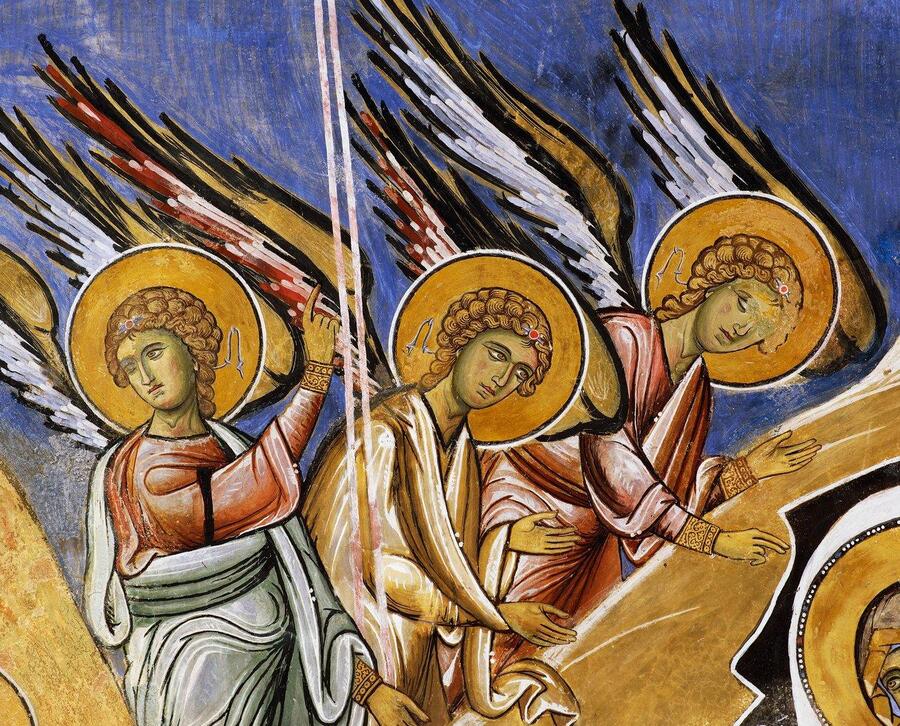
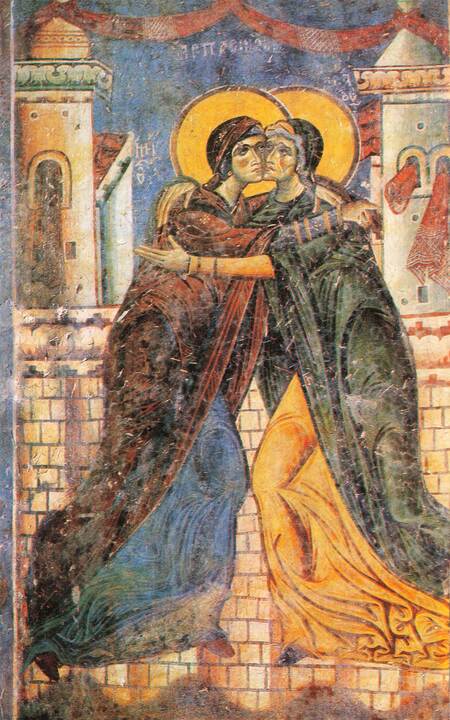
The primary focus is on the fresco ensembles of St. George’s Church in Kurbinovo and the Panagia tou Araka Church in Lagudere. These monuments allow for an examination of various facets of the Late Comnenian artistic language: ranging from a more expressive and dynamic rendering of the human figure to one that is restrained, ordered, and decorative. As an earlier context, the frescoes of St. Panteleimon’s Church in Nerezi are also examined. Particular attention is given to themes such as the «Lamentation of Christ, ” the „Dormition of the Theotokos, ” and the „Annunciation.“ Comparing these allows for an exploration of how the human figure conveys emotional states and reveals the significance of the events depicted. The image of Archangel Gabriel is also interesting for comparison—a close iconographic subject that allows one to observe similarities and differences in the depiction of proportions, gestures, and plasticity.
Research Methods
The primary method of study is comparative analysis, which is built around several visual components. The first is emotionality: facial expression and the nature of gestures. The second is proportion and plasticity: the ratio of body parts, the positioning of limbs, and postural characteristics. The third is line: the contours of the silhouette, the direction of the outlines, and rhythm. We also examine the figure’s interaction with the overall composition of the fresco and the temple’s architecture separately. Visual techniques are considered in relation to what the artist aims to convey through the silhouette and what role it plays within the sacred composition. Comparing these monuments will allow us to identify both the general principles of human body transformation and the differences in their artistic application.
Historical and Artistic Context
This period corresponds to the rule of the Komnenos dynasty and is marked by the tension between various worldviews in the culture of that era. On one hand, the 12th century is rich in monuments of the classical model, with its plastic and proportional perfection. On the other hand, toward the end of the century, other directions were gaining popularity, where the value of contemplation was replaced by a desire for the power of inner experience and its depiction in imagery. Artists began seeking emphasized, heightened expressiveness. Dynamics—even expression—became as much of an interest as harmony and serenity. Nevertheless, a common foundation for all artistic trends in the second half of the 12th century was the growing interest in expressing the spiritual essence of religious iconography. This manifested as open, intensified expression permeating all subjects”[5]. This style was named «dynamic» and became the precursor to «late Komnenian Mannerism, ” in which expression and refinement were exaggerated even further, forming their own visual system.
Frescoes in the Church of St. Pantelimon in Nerezi
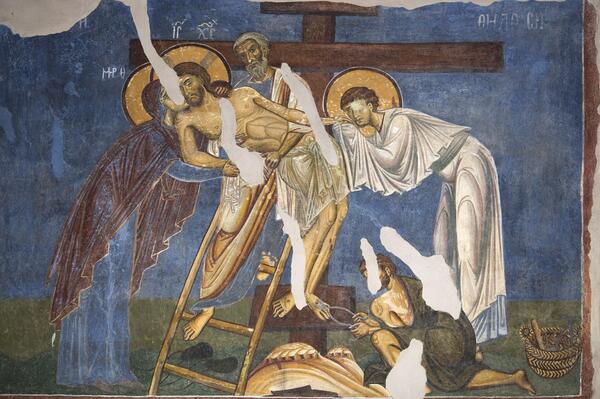
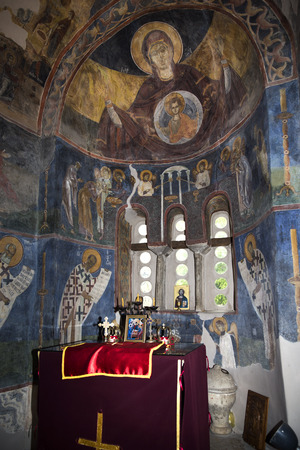
The frescoes in St. Panteleimon’s Church in Nerezi, dating from 1164, stand as a monument demonstrating features of a «dynamic style.» The frescoes are rich with detail—complex, wavy folds, variation in scale and proportion, elongation of the body form, and linearity as the primary principle for rendering volume. Here, the artist’s drive to convey a spiritual experience through plasticity and immerse the visitor in it is strikingly evident. We will examine the scene of the «Lamentation of Christ.»
Lamentations of Christ
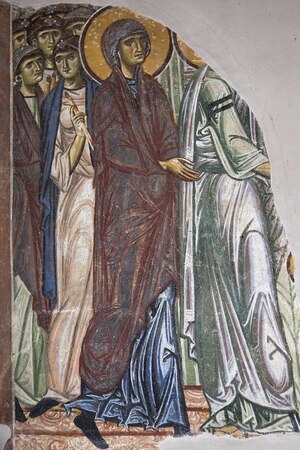
The scene of the «Lamentation of Christ» is built upon the interaction of figures unified by a shared emotional experience. Christ’s body serves as the compositional center; the figures of the other characters are oriented toward him and interact with him in some way. The silhouette of the Virgin Mary creates the emotional focal point: the direction of the surrounding bodies and their gestures form a complex movement that gradually guides the viewer’s eye toward the central group—Christ and Mary. The faces are filled with grief, yet the experience is not limited to facial expressions; it is literally manifested in the plasticity of the figures—the characters bend, curve, and press against one another. Their poses become an extension of their inner state. As a result, the scene is perceived not as a sequential depiction of individual participants in the event, but as a unified emotional space where sorrow unites everyone present.
The role of line is particularly noticeable. The smooth curves of the spines, the tilts of the torsos, and the direction of the folds in the clothing create a rhythm that connects the figures. Silhouettes flow into one another—for example, the bent figure of John forms an extended arc that directs the viewer’s gaze toward Christ. The lines of the clothing also adhere to the overall movement: they accentuate the lean of the bodies, amplify their plastic expressiveness, and help unify the composition. Christ’s body, however, is presented primarily as the body of the deceased, around which the sorrow of his loved ones unfolds. It is horizontal, which contrasts with the tilted figures of the surrounding characters, creating a semantic contrast between death and life.
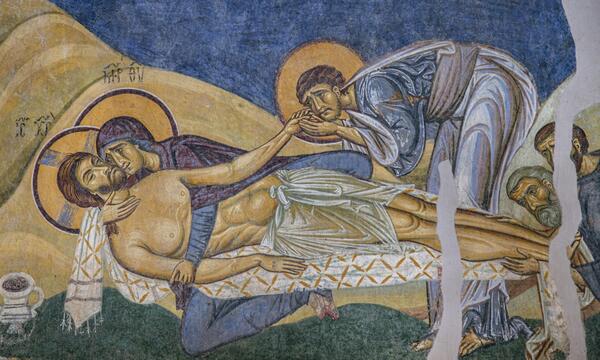
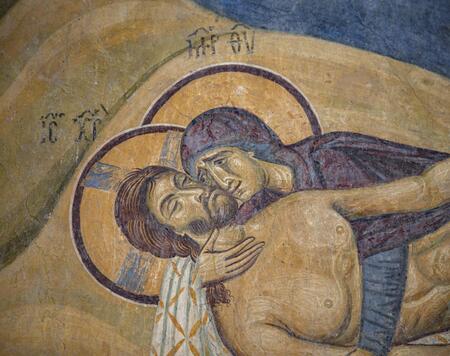
Thus, the expressiveness of «Mourning» arises from the interplay of several elements: elongated and plastic figures, emotional gestures, linear rhythm, and the compositional unity of the characters. The human experience of grief takes visible form. Sorrow becomes the organizing principle of the entire composition and a singular emotional space.
Frescoes in the Church of Saint George in Kurbinovo
The frescoes in the Church of St. George in Kurbinovo (1191) can be cited as a central monument of «Late Comnenian Mannerism.» Like the temple in Nerezi, this example is a model of Byzantine monumental painting in Macedonia, which may make them stylistically similar. However, the expression of emotion in the figures is manifested much more vividly here: the bodies take on even more fractured and elongated forms, and line and contrast become the primary tools for conveying volume; the folds are not merely undulating, but swirling. Dynamics prevail over statics, and the figures are assembled into complex, moving compositions. Alongside this, the frescoes are imbued with spiritual fervor and asceticism. We will examine the already mentioned theme of the «Lamentation» as an evolution in the use of figural transformation within Late Comnenian Mannerism.
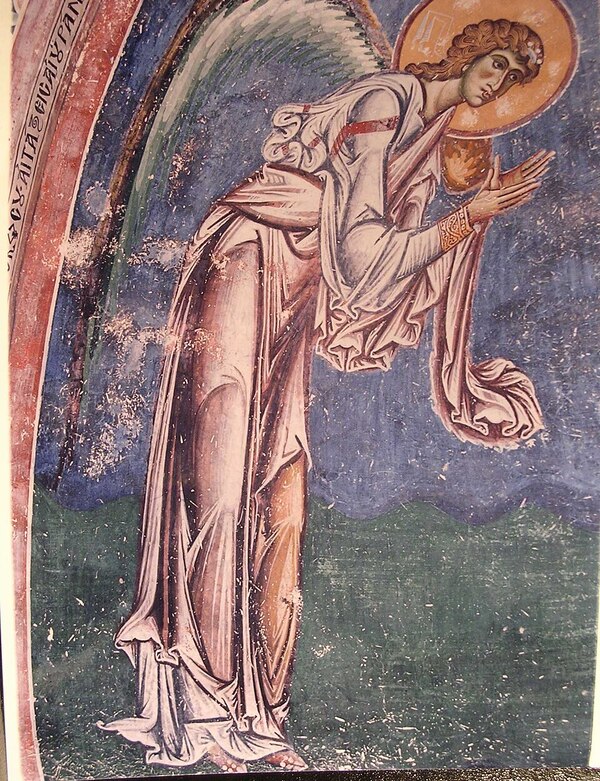
Lamentations of Christ
Much like at Nerezi, the Lamentation scene here is permeated by a universal tragedy, yet emotional expression is no longer necessarily overtly conveyed through facial features. Faces may remain reserved, and the primary expressive weight shifts to the silhouettes and gestures. The figures are curved—a quality emphasized by the lines of the drapery—and form a rhythmic sequence. Thus, through distortion and rhythm, the artist establishes a general direction and creates an illusion of movement directed toward Christ. In this way, the fresco conveys not only the collective sorrow but also the dynamics of a sacred ritual.