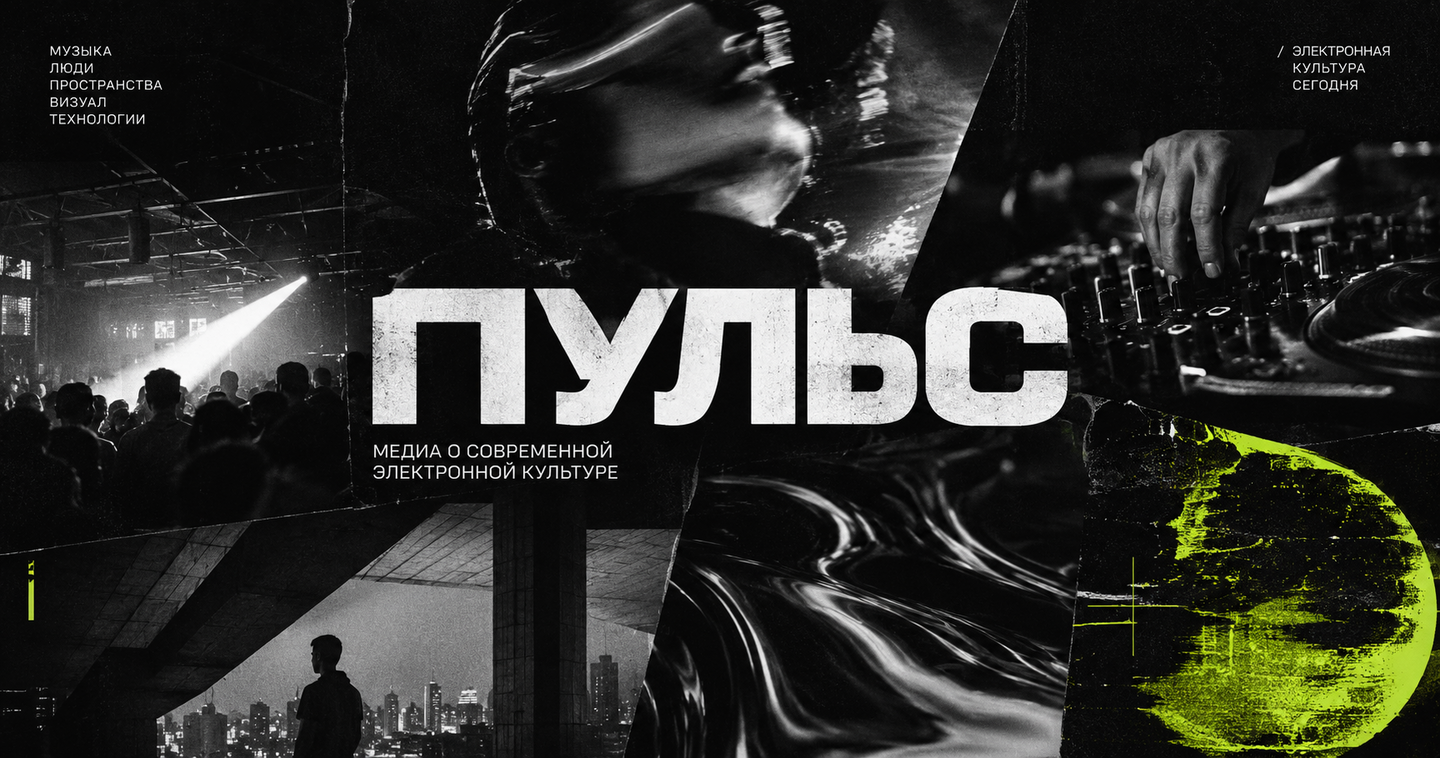
Media Concept
PULSE — an independent media outlet covering contemporary electronic music and club culture. The project explores not only musical genres and artists but also the people, spaces, technologies, and visual imagery that shape the electronic scene.
PROJECT GOAL
To create a media platform that helps the audience discover new music, meet figures from the electronic scene, and better understand the cultural context of electronic music.
TARGET AUDIENCE
1) Individuals who are just beginning to explore electronic music and want to understand its various genres.
2) Attendees of clubs and music events who are seeking new experiences and artists.
3) DJs, music producers, promoters, designers, and other participants in the scene.
4) People interested in contemporary culture, visual arts, and the urban environment.
Core Thematic Directions
Music. Genres, tracks, labels, musical discoveries, and the history of the electronic scene.
People. Interviews with DJs, producers, event organizers, photographers, and visual artists.
Spaces. Clubs, independent venues, music communities, and the urban environment.
Visual Culture. Release artwork, club posters, light installations, set design, and graphic design.
Technology. Music equipment, sound creation methods, DJ culture, and new tools for music production.
Distribution Channels
Telegram — the primary platform for publications, curated collections, short notes, polls, and audience engagement.
VK — for posting cards, clips, photos, and adapted editorial content.
YouTube — for interviews, video essays, documentary sketches, and music video formats.
Communication Style
The project’s tone of voice is friendly, curious, and informed. PULSE discusses complex musical and cultural phenomena in accessible language, without striving to demonstrate exclusive expertise or create an artificial sense of an exclusive community.
The visual style is built upon a combination of club photography, archival imagery, industrial architecture, high-contrast typography, grainy textures, and concise graphics.
The main principle: electronic music is not just sound—it is a culture that emerges around it.
THEMATIC PLAN FOR THE SEMESTER
Month 1. Introduction to Electronic Music
Objective: To introduce a new audience to the project and establish a foundational understanding of the electronic music scene.
Key Materials:
What is electronic music today?
How do techno, house, ambient, and jungle differ?
Five artists to start your journey into electronic music.
How is a DJ set structured?
Why does club music exist beyond nightclubs?
A curated selection of releases for a first introduction to the scene.
Audience poll: What electronic music do you listen to?
Formats: explanatory posts, cards, music playlists, polls.
Month 2. People of the Electronic Scene
Task: To showcase electronic music through the personal stories and experiences of its creators.
Key Topics:
What is a DJ, and how does their work differ from a producer’s?
How does an artist find their unique sound?
An interview with an emerging DJ.
A typical workday of a music producer.
How is a musical collection formed?
What happens behind the scenes of a party?
A curated selection of artists to follow.
Formats: interviews, portraits, short videos, and written narratives.
Month 3. The Club as a Space
Assignment: To explore club culture through architecture, urban environment, and social interactions.
Core materials:
Why does space affect the perception of music?
How does lighting change a party’s atmosphere?
What differentiates a club from a concert venue?
How is the visual concept for a music event created?
Photographs of club spaces and their details.
How does a promoter’s work operate?
How is the perception of music altered depending on time and location?
Formats: photo essays, interviews, visual compilations, video essays.
Month 4. Visual Language of Electronic Music
Challenge: To explore the connection between sound, graphic design, photography, and digital aesthetics.Key Topics:What does sound look like? Visual solutions in electronic music.Why do some music covers become iconic?The history of the club flyer as an independent design genre.How are the visual identities of music labels created?What is a VJ and how is the visual accompaniment to a DJ set created?A collection of interesting electronic release covers.How do grain, typography, and color shape an atmosphere?Formats: cards, visual essays, interviews with designers, short videos.
Month 5. Sound Technologies and Creation
Objective: To introduce the audience to the tools and processes of electronic music creation.Key Topics:How does a synthesizer work?What is a sample, and why is it important in electronic music?How is a drum track created?Analog vs. Digital Equipment: What is the difference?How does a DJ use a mixer during a performance?Home Studio: What is truly essential for a beginner producer?How does a single sound turn into a musical composition?Formats: Tutorials, diagrams, short sound demonstrations, video lessons.
Month 6. Today’s and Tomorrow’s Scenes
Objective: To summarize the first cycle of publications, attract scene participants, and build a community around the project.Key Content Topics:What directions of electronic music are interesting to explore today?Interviews with the local music community.How are independent labels shaping music scenes?How is the distribution of electronic music changing?A selection of artists and releases published over the past few months.Photographs and stories of musical spaces.Mid-year review: audience selection, favorite publications, and new themes.Formats: interviews, playlists, surveys, video essays, editorial summaries.
Regular Features
Throughout all six months, materials will be released to maintain regular interest in the project:Sound of the Week — one track and a short story about it.People of the Scene — interviews and portraits of participants in electronic culture.Visual Noise — covers, posters, photographs, and graphic design.Behind the Booth — equipment, mixing technology, and DJ experience.Point on the Map — music spaces and local communities.Where to Start — clear explanations of genres, instruments, and cultural phenomena.
Ten content samples
Example 1. Media Introduction
Format: Telegram text post.Section: PULSE / Kickoff.Headline: Electronic Music is More Than Just Music.There is an infinite depth to explore in the electronic scene. Behind every track lie people, equipment, spaces, visual imagery, and entire communities.Some enter electronic music through clubs. Others—through vinyl collecting, home sound experiments, or an interest in graphic design. Everyone has a different entry point, but gradually, it all weaves into one large cultural tapestry.PULSE is the media dedicated to exploring that tapestry.Here you will find musical discoveries, artist stories, club spaces, visual experiments, and discussions about how electronic music is created.No need to know all the genres and names beforehand. A genuine interest in sound is a great start.How did you first discover electronic music?Visual accompaniment: a dark photograph of a dance floor, a close-up of a vinyl record, or an abstract light pattern. The image features bold typography reading «PULSE.»
Sample 2. Explanatory Material
Format: Text + Cards.Section: Where to Begin.Title: House, Techno, Jungle, and Ambient: Four Ways to Listen to Electronic Music.Electronic music encompasses numerous genres. To start orienting yourself within them, you don’t need to memorize every subgenre. It is sufficient to hear a few fundamental differences.01. HouseRhythmic music with a steady, danceable pulse. It often features groove, repetitive bass lines, vocal snippets, and characteristic percussion.02. TechnoMusic where repetition, timbre, mechanical precision, and the gradual evolution of sound layers play a significant role. The sound can be minimalist, harsh, or atmospheric.03. JungleA style of British electronic music characterized by fast, chopped breakbeats, deep bass, and the use of samples. Reggae, dub, and British club culture have played a significant role in its history.04. AmbientMusic focused on space, timbre, and atmosphere. The rhythm may be barely perceptible or entirely absent.These descriptions are only a starting point. Within each genre, there are many different approaches, and the boundaries between genres are often blurred.What to listen to next: choose one track from each genre and compare what captures your attention—is it the rhythm, the bass, the melody, or the sound texture.Visual accompaniment: four cards showcasing different visual approaches—warm club photography for house, industrial architecture for techno, dynamic typography for jungle, and abstract, blurred graphics for ambient.
Sample 3. Music Playlist
Format: text + music links.Category: Sound of the Week.Title: Five Tracks to Explore Different Facets of Electronic Music.Sometimes it’s easier to begin exploring a genre not with theory, but with several precise musical examples.01. Juan Atkins — Clear (Cybotron, 1983)An early example of electronics where mechanical rhythm meets a futuristic conception of sound.02. Frankie Knuckles feat. Jamie Principle — Your Love (1987)One of the pivotal tracks in house music history: a repetitive rhythm, an emotional melody, and vocals that gradually become part of the dance movement.03. Jeff Mills — The Bells (1996)A composition built on repetition and gradual tension build-up. A fine example of how a minimal set of elements can create a powerful effect.04. Goldie — Inner City Life (1994)Jungle and drum and bass intersecting with complex rhythms, bass, and emotional vocals.05. Aphex Twin — Rhubarb (1994)The more contemplative side of electronic music: soft timbres and slow development of sonic space.Five different approaches, but one common idea: electronic music can be simultaneously physical, emotional, experimental, and almost weightless.Which track resonated with you the most?Publication Note: Before release, the editorial team will add verified links to official or legal listening pages.Visual accompaniment: five square cards featuring the artists' and tracks' titles, unified by a shared typography yet differentiated by texture.