MEDIA CONCEPT
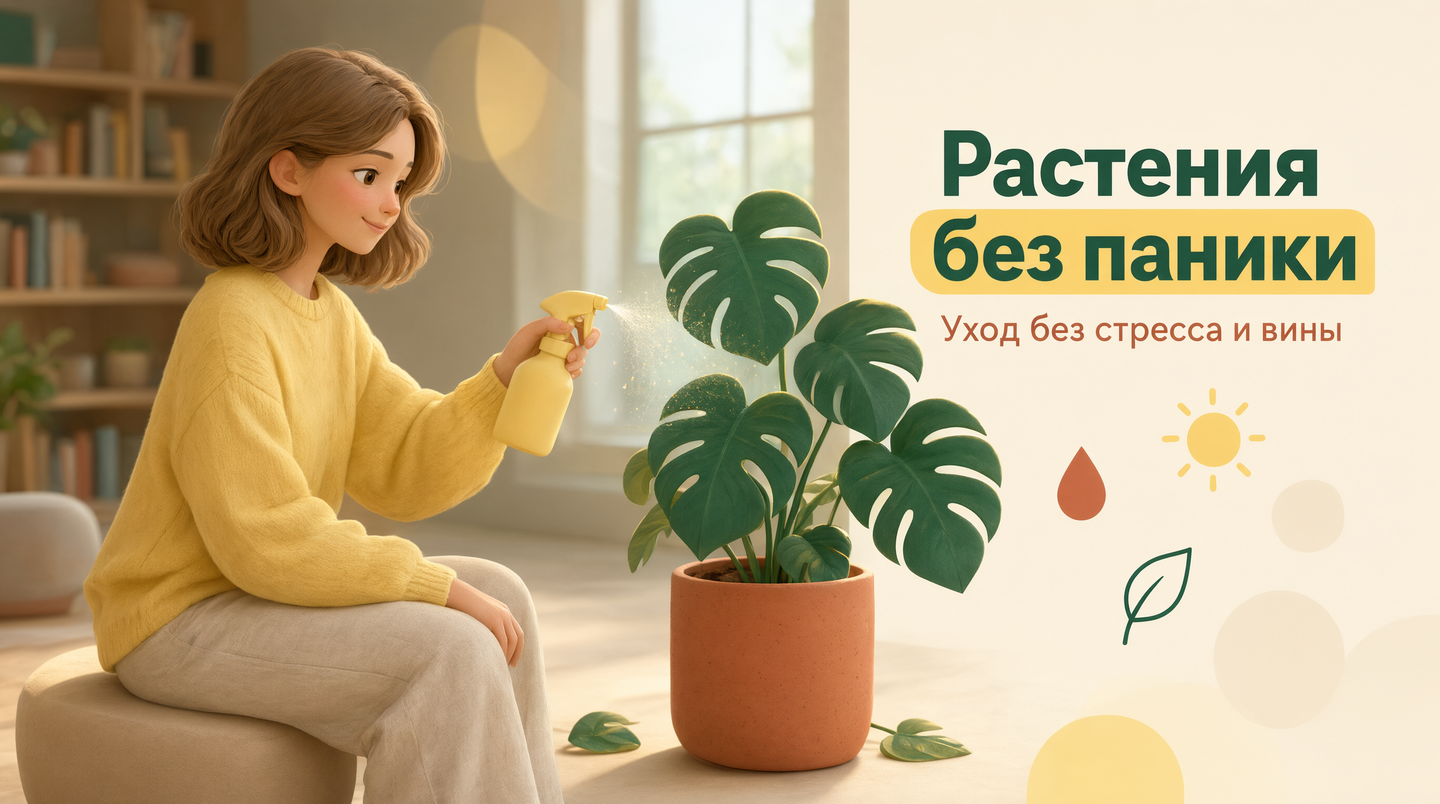
The goal of «Plants Without Panic» is to help plant enthusiasts—from beginners to experts—care for houseplants and engage in floristry without stress, guilt, or the fear of making a mistake. The aim is to make a «green» lifestyle simple, aesthetically pleasing, and joyful.
We propose introducing an educational blog format focused on visual aesthetics, practical advice, and community support. The mission of «Plants Without Panic» is to convey the idea that caring for plants is a form of self-care, and that everyone can find their own way into the «green» world without guilt over mistakes.«Plants Without Panic» falls under the segment of: hobbies and interests / home and interior / conscious consumption. We offer niche topics such as modern houseplant care and floristry—from selecting a first plant and troubleshooting issues to creating stylish interior arrangements and following trends.
SEMESTER THEMATIC PLAN
The curriculum is structured on a «simple to complex» principle: we begin with foundational topics for beginners, gradually introducing aesthetics, trends, and advanced material. Each month focuses on a specific theme.
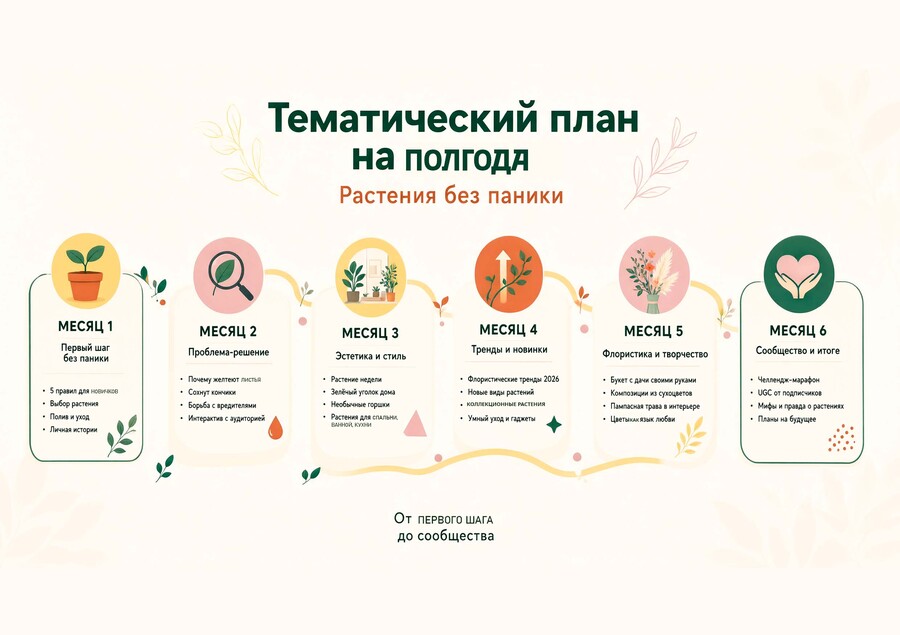
Month 1 (Start): -Monthly Focus: «Taking the first step without panic» -Key Topics and Segments: «You are not a plant killer»: 5 rules for beginners; «Which plant to choose if there is little light»; «Watering: how to know when it’s time?» (infographic); «My first monstera: a failure story» (personal post). -Platform Formats: Telegram: Guide posts, polls («What scares you the most?»). VK: Duplication + video. Shorts: «3 beginner mistakes».
Month 2: -Monthly Focus: «Problem–Solution» -Key Topics and Features: «Why leaves turn yellow: 7 causes»; «Tipsy tips drying out? It’s not always the air»; «Mealybugs: your rescue guide»; «Show us your plant—I’ll tell you what’s wrong» (interactive). -Platform Formats: Telegram: Photo posts of «before/after, ” question collection; Shorts: „Emergency Care“ (resuscitation); Zen: Article „The complete guide to plant diseases.“
Month 3: -Monthly Focus:«Aesthetics and Style» -Key Topics and Segments:«Plant of the Week: Monstera» (trends, care); «Green Corner: How to Style Plants in Interior Design»; «Unusual Pots: 2026 Trends» (review); «Plants for the Bedroom, Kitchen, and Bathroom.» -Platform Formats:Telegram/VK: Beautiful collections, «Plant of the Week»; Shorts: «Before/After» corner transformations; Podcast: «The Psychology of the Parent Plant.»
Month 4: -Month Focus: «Trends and Novelties» -Key Topics and Sections: «Floristry Trends 2026: Dried Flowers, Mono-bouquets» (based on media reports); «New Stars: Philodendron ‘Florida Green’, Calathea orbifolia, Ceropegia»; «Collectible Plants: Should You Chase Rarity?»; «Smart Care: Grow Lights and Humidity Sensors» -Platform Formats: Telegram: Review Posts, Polls («What Are You Buying?»); Zen: «Guide to Trending Plants 2026»; Shorts: New Arrivals Review.
Month 5: -Monthly Focus:«Floristry and Creativity» -Key Topics and Segments:«How to create a bouquet from garden produce»;“Dried Flowers: Preserving Beauty Forever»;“Pampas Grass: The Main Trend»;“Flowers as the Language of Love: What to Gift». -Platform Formats:Telegram/VK: Workshops, bouquet photography; Shorts: Bouquet assembly process (ASMR); Podcast: Interview with a florist.
Month 6: -Monthly Focus: «Community and Outcomes» -Key Topics and Features: «The ‘7 Days to Green Friend’ Marathon» (wrap-up); «Most Resilient Plants, According to Subscribers» (UGC); «What We Learned in Six Months: Plant Myths and Facts»; «Future Plans: What’s Next?» -Platform Formats: Telegram: UGC collection, story contest; VK: Voting for the Best «Green Nook»; All Platforms: Announcement of the New Season.
10 CONTENT EXAMPLES
Example 1. Telegram text post (Topic: «Green Start»)
Headline: You’re not a plant killer. You just haven’t learned these 5 rules yet.Body: «I remember buying my first Monstera. Two weeks later, it started yellowing, and I was convinced I had „the green thumb of a zombie.“ Sound familiar? Spoiler: it’s not you. It’s these five things that stores usually keep quiet about.1. Scheduled watering is harmful. A plant doesn’t know it’s Tuesday. Check it with your finger: dry to 2–3 cm—then it’s time. 2. Drainage is everything. Without it, water stagnates, and roots rot. This isn’t a preference; it’s physics. 3. Light is food. „Low-light tolerant“ doesn’t mean „thrives in darkness.“ Most plants need at least some diffused light. 4. Drafts are more dangerous than cold. Monsteras and Calatheas cannot handle sudden temperature swings. 5. Repotting immediately after purchase is stressful. Give the plant 2–3 weeks to acclimate.Save this post and reread it when you feel the urge to criticize yourself again. You’ve got this.Question for comments: Which rule was a revelation for you?»
Example 2. Post-infographic for Telegram/VK (Problem-Solution Feature)
Visual: A card titled «Why are leaves turning yellow? 7 Reasons» complete with icons.Caption: «A yellowing leaf isn’t a sentence—it’s a signal. Let’s figure out what it means.Check the list:1. Overwatering (the most common reason) — soil is wet, leaf is soft. 2. Underwatering — soil is dry, leaf is dry and crispy. 3. Draft — the leaf yellows on one side. 4. Lack of light — lower leaves yellow, the plant stretches out. 5. Crowding — roots are visible from the drainage holes. 6. Pests — check the underside of the leaf. 7. Natural aging — one or two lower leaves yellow, the rest are healthy.What to do? Find your cause and act precisely. Do not water „just in case”—that’s a path to problems.Save this so you don’t panic next time.“
Example 3. Video script for Shorts/Clips (The «Aesthetics» Segment)
Topic: «One Watering Mistake That Kills a Monstera» Duration: 20–30 seconds.Scene 1 (0-3 sec) Visuals: Close-up: a hand pouring water into a pot with a Monstera plant. Audio/On-Screen Text: Sound of pouring water. On-screen text: «Don’t do this.»Scene 2 (3-8 sec) Visuals: The same shot, but water is pooling in the saucer. Audio/On-Screen Text: Text: «Monsteras don’t like ‘swamps.’»Scene 3 (8-15 sec) Visuals: A hand checks the soil with a finger. Audio/On-Screen Text: Text: «Check: is it dry 2–3 cm down?»Scene 4 (15-22 sec) Visuals: A hand waters moderately; the water is being absorbed. Audio/On-Screen Text: Text: «Water moderately, let the soil dry out.»Scene 5 (22-30 sec) Visuals: Beautiful shot: a healthy Monstera plant. Audio/On-Screen Text: Text: «Less water = more life.» Music: calm, lo-fi.
Sample 4. Podcast Audio Script (Segment: Psychology)
Topic: «Imposter Syndrome in the Plant World»Duration: 5–7 minutes.Script (excerpt): (Soft music plays)Host: Hi. This is «Plants Without Panic, ” and today we’re talking about something that isn’t typically discussed in glossy blogs: guilt. Does this ring a bell? You buy a plant, it wilts, and you think, „What is wrong with me? Everyone on these photos has lush Monsteras, but I just have three sticks.“ And it starts—self-flagellation, the fear of buying new plants, the feeling that you are a „bad plant parent.“(Pause)Host: Let’s agree on something right away: you don’t have to be perfect. Plants are living organisms, and sometimes they die. Even experts have them happen. Even in botanical gardens.Guest (Florist): Exactly. I’ve been working with flowers for 10 years, and I once lost a calathea at home because I forgot to water it before a vacation. That’s normal.Host: Precisely. We don’t say, „Don’t be upset.“ We say, „This is an experience.“ Every plant that passes away is a lesson, not a sentence.(Music fades)Host: In the next episode, we’ll break down how to choose a plant that is guaranteed to survive, even if you forget about it for a week. Subscribe so you don’t miss it.(End of recording)
Example 5. Text post for Zen (Category «Trends»)
Title: 2026 Floral Trends: Why Dried Flowers Have Captured the World
Text: «If you think dried flowers are ‘a relic of the past, ’ you are very mistaken. In 2026, they are experiencing a true renaissance.
What’s happening? Florists are highlighting a trend toward naturalness and authenticity. Bouquets look „as if they were just cut from the garden.“ Soft, natural tones are in vogue: cream, powder pink, terracotta, and olive green.
Key Stars: 1. Pampas Grass — the leading trend of recent years. 2. Baby’s Breath — light, airy, and perfect for winter bouquets. 3. Stabilized Roses — one rose at the center, surrounded by dried flora.
Why is this important for you? Dried flowers are not just beautiful; they are practical. They don’t wilt, they don’t need water, and they can last for years. Plus, they are eco-friendly: less waste, more life.
Tip: If you want to try them, start with a simple bouquet of baby’s breath and lagurus. It will last in your home for months and remind you of summer.
Do you love dried flowers or do you prefer fresh blooms? Share your thoughts in the comments.