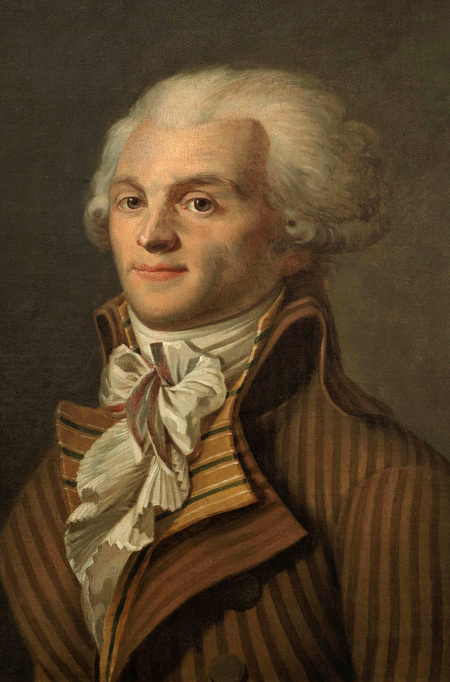
In 1789, a thirty-year-old lawyer arrived in Versailles from the provincial town of Arras, dressed in a flawlessly powdered wig and an impeccably buttoned coat. He was neither noble, nor rich, nor famous—only a graduate of the Sorbonne in law, a practicing attorney, and a copy of Rousseau that he knew by heart. His name was Maximilien Robespierre. In the capital, he quickly drew attention—not with brilliant oratory, but with stubborn principle that soon earned him the nickname The Incorruptible. He demanded freedom of the press, civil equality, and the abolition of the death penalty—no one at the time could have suspected that this meticulous provincial would become the chief architect of the revolutionary Terror in four years.
I am of the people
Robespierre did not storm barricades or command the insurgents. He spoke—from the rostrum of the National Assembly, from the podium of the Jacobin Club, from the pages of his newspaper. With each month, his voice grew louder. When the monarchy fell in 1792, he demanded the king’s execution—and Louis XVI headed to the guillotine. When a conflict erupted between the Jacobins and the Girondins in the Convention, Robespierre succeeded in having his opponents expelled from the assembly. By the summer of 1793, he effectively headed the Committee of Public Safety—an body that consolidated all power in France. «I am not a courtesan, nor a tribune, nor a defender of the people, ” he once declared. „I am the people myself.“ Within these words lay both pride and fatal self-aggrandizement—a man who considered himself the embodiment of the nation’s will believed he could not err.
Republic of the Guillotine
The ultimate goal of the Robespierre revolution was to build a new society founded on «republican virtue.» He chose terror as the means to achieve this end. From September 1793, the guillotine worked almost nonstop—the victims included Girondins, then moderate Cordeliers led by Danton, and later radical Hébertists. Robespierre sincerely believed that fear purified the nation, and blood was the necessary fertilizer for the shoots of a new morality. The pedantic lawyer from Arras, who had only recently argued against the death penalty, was now signing hundreds of death sentences with the same precision he once fastened the buttons of his coat—thus, the champion of human rights, in the name of those rights, had become a merciless executioner.
Cult of the Supreme Being
Robespierre wasn’t limited to politics—he decided to radically restructure religion as well. In his view, Catholicism was a relic of the old world, and he proposed replacing it with the «Cult of the Supreme Being”—a civic religion inspired by the ideas of Rousseau. On June 8, 1794, a grand festival took place on the Champ de Mars in Paris: Robespierre, dressed in a blue frock coat, burned effigies of Atheism and Egoism, and then lit the torch of Truth. Thousands of Parisians applauded their idol. That was the peak of his glory—and the beginning of the end. Too many in the Convention saw this spectacle not as a triumph of virtue, but as personal dictatorship. Too many feared that the guillotine would come for them the next day.
What you fight for, that’s what you get…
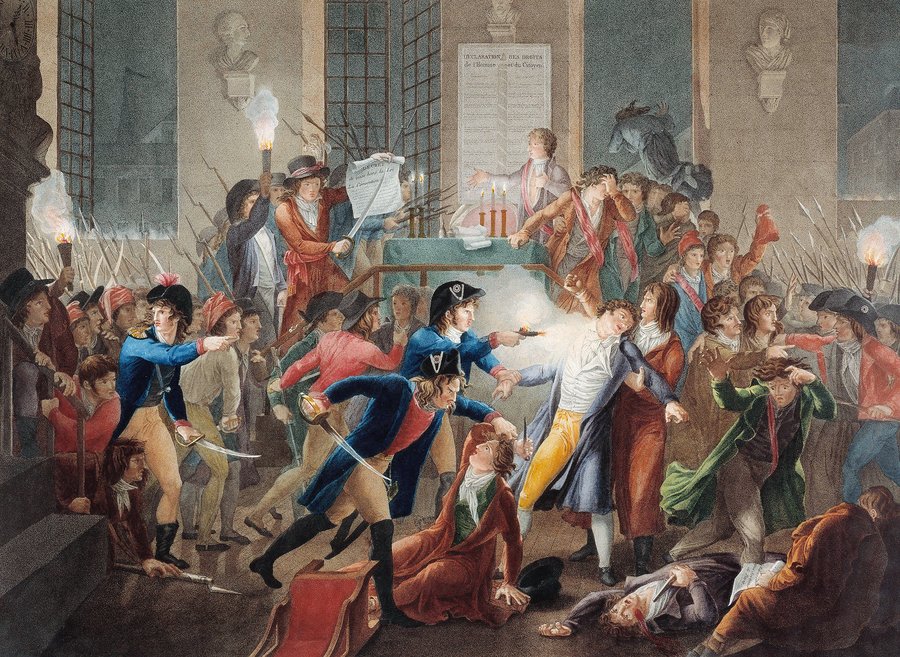
On July 26, 1794, Robespierre took the rostrum of the Convention again with a lengthy speech in which he justified the Terror and hinted at new purges. The deputies, glancing at each other in panic, realized that their own heads could be next. The following day, July 27 (9 Thermidor in the revolutionary calendar), conspirators led by Tallien and Barra arrested Robespierre right in the Convention. His supporters attempted to organize resistance at the Paris City Hall, but to no avail. At dawn on July 28, Maximillian Robespierre, aged 36, climbed the same guillotine upon which he himself had sent thousands of others. Legend has it that the executioner ripped off his blindfold as the blade began to fall—and the Place de la Révolution echoed with Robespierre’s final cry, this time filled with terror.
Servant of the People
Who was this man? An incorruptible idealist dreaming of a kingdom of justice? A paranoid dictator who drowned the revolution in blood? Robespierre himself seemed to see himself only as an impeccable servant of the people—it was precisely this immaculate conscience that made him so ruthless. He did not steal, nor did he take bribes, nor did he live in luxury—he truly believed in every word he spoke. But the belief in his own infallibility proved far more terrifying than any corruption.
France and the Revolution witnessed Robespierre, and the world took a lesson from his life: virtue, when devoid of self-doubt, devolves into vice and crime.