Media Concept
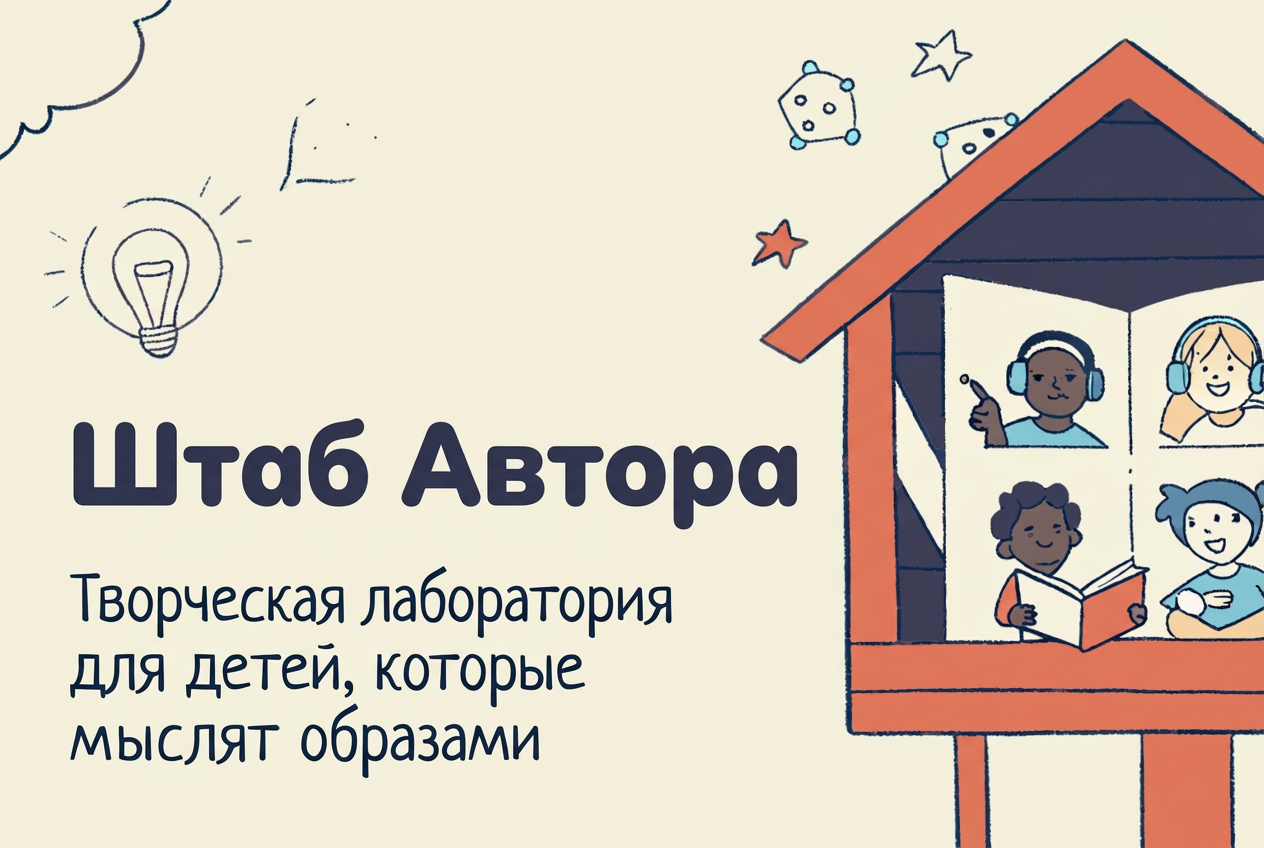
Author’s HQ is a new space for children’s leisure and creativity—a place where a child doesn’t come to learn a predetermined curriculum, but to create something entirely their own. It is not a writing school, a correctional center, a standard extracurricular club, or merely entertainment. It is an environment of authorship—a place where a child first experiences: «My ideas have value. I can create something of my own. I can be an author.»
We created a community in a messenger application where kids can share their ideas and join teams to bring creative visions to life.
Six-Month Thematic Plan
Month 1: «I Am the Source»
Goal: To alleviate the fear of the «blank slate» and demonstrate that every child’s idea holds inherent value. To dismantle the mindset, «my idea is stupid.» Week 1: Inventory of Meaning. We launch the segment «Weird Questions.» Kids answer absurd prompts (for example, «If gravity only worked on Tuesdays, how would we build houses?») via voice or text. The objective is to show that there are no unconventional answers. Week 2: The Search for «What If?». Kids gather ideas from everyday life. Assignment: find an object in your neighborhood or home that could be used for an unintended purpose, and submit a photo and description to the chat. Week 3: Bazaar of Wild Hypotheses. Kids form micro-groups of 3–4 people based on shared interests in each other’s ideas. Week 4: The Author’s Manifesto. Each team formulates one guiding rule for their future creative work. We compile the «Squad Codex, ” which the children wrote themselves. Monthly Feature: Introduction of „Meaning Currency“ (virtual badges in the bot’s profile for the most unexpected ideas).
Month 2: «The Anatomy of the Spark»
Goal: To provide methods (without labeling them as «tools») for developing a raw idea into a concept. Week 1: Moodboard. We learn to assemble a visual and conceptual series. The Kids post collages of 5 images/sounds in the chat that describe their project idea, but without words. The others try to guess the meaning. Week 2: Interview with Self. The Kids receive an «Author Questionnaire» template where they ask themselves unconventional questions («What childhood memory do you want to bring to life?», «What injustice do you want to correct?»). We share the answers in the thread. Week 3: The Frankenstein Method. We take 3 completely different ideas from the chat and try to merge them into one project. We learn to see hidden connections. Week 4: «Elevator Pitch.» Teams record a voice message exactly 60 seconds long in which they must «sell» their idea to the others. The others respond with emoji reactions. Feature of the Month: «Idea Evolution» segment. We show how the same idea changed from Monday to Friday.
Month 3: Synthesis (Teamwork and Co-authorship)
Objective: To learn how to collaborate within a team without losing one’s «unique voice, ” and how to reach consensus. Week 1: Role Assignment. We introduce the concept of „Team Roles“ (Generator, Critic, Visionary, Engineer). Students take a test and discover their role within the creative process. Week 2: Conflict as Fuel. We analyze case studies (presented as comics or audio skits) where creators have differing opinions. We discuss in the chat: „How do you determine whose idea is better when both are good?“ Week 3: Blind Collaboration. Teams receive a „semi-finished product“ idea from another team and must complete it, preserving the original meaning while adding their own contribution. Week 4: Creating the „Team Avatar.“ Each team designs a visual or auditory symbol to represent them across different media. Feature of the Month: Launching „The Secret Author“ (anonymous support for chat participants, providing encouragement and insightful input).
Month 4: «Voice and Format»
Objective: To demonstrate that authorship extends beyond text—it includes sound, code, video, performance, and game design. Week 1: Format Roulette. Teams draw a «blind» format (e.g., a podcast interview with an inanimate object, a Zine journal, a text-based quest in a messenger app, or city sound design). Week 2: Zine Lab. We learn to create mini-magazines. The Kids create pages that we will later compile into one large digital PDF anthology for the Headquarters. Week 3: Audio Environment. Challenge: record three sounds around you and edit them into a wordless story. We share our voices. Week 4: Interactivity. We create text-based quests or maze-style surveys for other chat participants. Feature of the Month: A «Guest Author» (an adult creator, artist, or developer) joins us for an AMA (Ask Me Anything) session, answering the Kids’ questions about how they found their creative niche.
Month 5: «Shield and Sword»
Goal: To learn how to receive criticism constructively, manage burnout, and overcome the fear of «this is useless.» Week 1: Museum of Failures. Students submit their «failed» ideas or flawed work. We host an exhibition where we discuss why these concepts didn’t work and what value they provided. Week 2: The Art of Feedback. We learn how to give feedback using the «Sandwich» or «I-Message» methods. We practice this on team project drafts. Week 3: Battling the «Inner Critic.» A meditative and reflective week. We discuss how to distinguish the voice of the «inner critic» from the voice of a «healthy perfectionist.» Week 4: The Defense Manifesto. Teams develop arguments for their projects: «Why is this important right now?» Feature of the Month: The «No Zone» segment. We discuss the importance of knowing how to reject poor ideas in favor of better ones.
Month 6: «Artefact» (Staff Festival)
Goal: To legitimize the outcome. To show kids and parents that they have created something tangible and valuable. Week 1: Final polish. Teams finalize their half-year capstone projects. The chat becomes a collaborative workspace—everyone helps each other with advice, resources, and testing. Week 2: Premiere. Each team uploads their project to the chat (link, file, video, text). Week 3: Public Voting and Reflection. We vote not for the «best» project (which kills motivation), but for nominations: «Boldest Idea, ” „Best Team Chemistry, ” „Most Useful Artifact, ” and „Half-Year Insight.“ Week 4: Time Capsule. Each student writes a „Letter to Future Self“ to be opened in six months. We release a final Zine (digital journal) featuring all the work, which can be downloaded and shared with parents. Monthly Highlight: An online presentation for parents where the kids themselves explain WHAT they learned (not skills, but states of mind: „I realized my ideas matter, ” or „I learned to listen to others“).
Content Samples
Example 1. Morning Trigger («Idea Hunt» Feature)
Format: Text + Image + Button Text: Good morning, Authors. Ideas don’t just appear in your head. They hide in reality. Today, we are hunting for the «Accidental.» Look around you right now. Find an object that is out of place, a shadow that looks strange, or a crack in the pavement that resembles a river. Take a picture of it. Don’t think—just press the button [Button: Submit Discovery to Thread] [Button: See What Others Found] Analysis:
- Goal: To break the «blank page» block and shift focus from the inner critic to external observation.
- Why it works: There is no judgment. You don’t need to invent genius; you just need to notice. This builds the habit of seeing the world as a collection of materials.
Sample 2. Philosophical Post (Series: «Anatomy of the Spark»)
Format: Text + Poll Text: What does your idea eat? Imagine your current idea (or the one you want to bring to life) is a living creature. What does it feed on? If it’s a game—does it feed on other people’s mistakes? If it’s a comic—does it feed on secrets? If it’s a podcast—does it feed on silence? Describe your idea as a pet in three sentences. Let’s start the thread! [Button: Post to Thread] Analysis:
- Goal: To teach kids metaphorical thinking and help them gain a deeper understanding of their project’s essence.
- Why it works: It moves beyond the boring question, «What is your idea?» It is simpler and more engaging for a child to describe an idea as a character. This helps it «come alive» in their mind.
Example 3. Error Legitimization (The «Museum of Errors» Feature)
Format: Curator Voice Message + Text Text: Artifact of the Week: The Beautiful Failure. (30-second voice note: The Curator recounts how they spent a week developing an awesome mockup, only to realize they forgot to save the file, which ultimately led them to an even cooler, completely different idea.) Authors, we are used to showing only successes. But here at the Hub, we know: a mistake is just an idea that decided to take a different path. Share your «flawed» drafts, broken projects, or deleted pieces of text in this thread. Task: Under each of another author’s artifacts, write one thing you liked about it, even if everything else didn’t work out. [Button: Add Artifact] Analysis:
- Goal: To alleviate the fear of making mistakes and teach constructive feedback.
- Why it works: The Curator shows vulnerability (their blunder). The Kids see that it is safe to make mistakes. The task of writing «what you liked» in a failure teaches mutual support.
Example 4. Format Shift (The «Voice and Format» Feature)
Format: Text + Audio Sample Text: An audio snapshot. An author is not just someone who writes text or draws. An author is someone who manages attention. Right now, record 15 seconds of ambient sound around you on your voice recorder. Don’t say anything. Let the refrigerator, the street, the cat, a dripping faucet, or your own breathing speak. Send this voice note to the chat. Let’s listen to what sounds make up your reality today. [Button: Record Sound] Analysis:
- Goal: To demonstrate that media is more than just text and images. To broaden the concept of «format.»
- Why it works: Voice notes are a native messenger format. It is a very simple action that creates a strong sense of presence and brings the community closer.
Sample 5. Team Mechanics (Synthesis Section)
Format: Text + Reaction Buttons Text: Blind co-creation. The «Foxes» team started a story but got stuck. They need your help to continue, but with one condition: you cannot use the words «suddenly,» «later,» or «said.» Start: «The old elevator in building number 4 moved neither up nor down, but…» We write the continuation in the thread, one sentence at a time. Read the previous entry so you don’t repeat yourself. Let’s go! [Button: Support the Foxes] [Button: Read the Result] Analysis:
- Goal: To learn how to work collaboratively, hear another person’s context, and adhere to constraints (frameworks).
- Why it works: Constraints (banning specific words) incredibly accelerate creativity. The «one sentence at a time» format teaches you not to interrupt, but to supplement.
Sample 6. The Art of Refusal (Shield and Sword Feature)
Format: Text Text: The Art of Subtraction. The weak author tries to cram everything they’ve come up with into their project. The strong author knows that for the main idea to resonate, extraneous elements must be eliminated. Think back to your own project. Which of your «brilliant» ideas did you have to discard because it undermined the entire concept? In the thread, tell us what you gave up. Let’s create an «Idea Cemetery» and treat those discarded concepts with respect. [Button: Add to Cemetery] Analysis:
- Goal: To teach students critical thinking and editing. To help them understand that saying «no» to an idea is also a form of authorship.
- Why it works: It alleviates the pain of removing one’s own work. It transforms the editing process into a meaningful—and even slightly ironic—ritual.