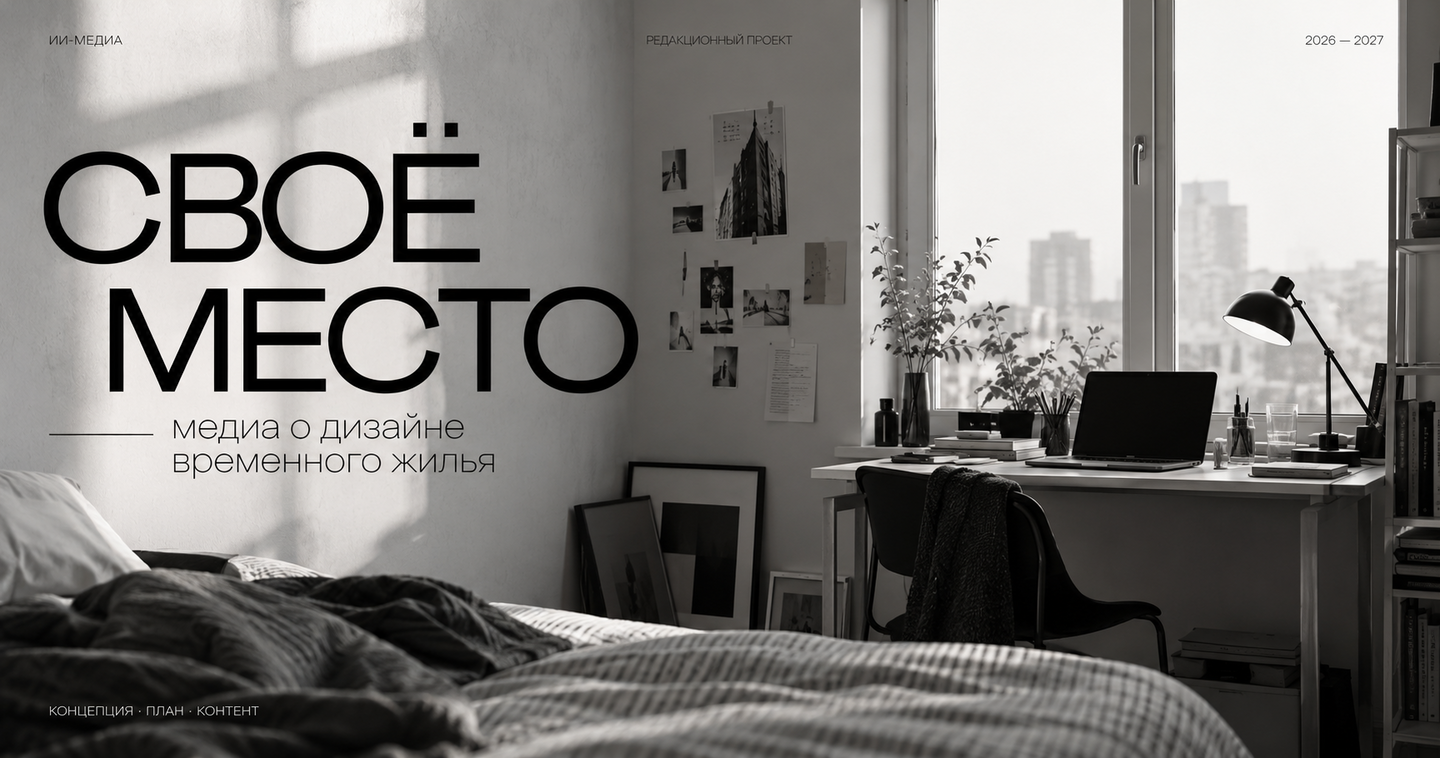
YOUR PLACE
Designing Temporary, Unrenovated Housing
AI media exploring how to transform a rented apartment, dorm room, or small temporary space into a place you want to live in.
Designing spaces for real-life living conditions.
AI Media · Editorial System · 2026–2027
1. MEDIA CONCEPT
What is «YOUR SPACE»?
«YOUR SPACE» is a digital media platform dedicated to making temporary living spaces comfortable, functional, and personal without requiring major renovations or large expenses. The project focuses on the spaces where young generations live—dorm rooms, rented apartments, and small studios. Often, their residents cannot change the finishes, drill into walls, buy large furniture, or invest money in renovating someone else’s property. Yet, the desire to live in a beautiful and convenient space remains.
«YOUR SPACE» offers practical solutions that account for real-world constraints: limited budget, small square footage, rental agreements, and potential relocations. The project’s unique feature is the use of artificial intelligence to visualize interior design ideas and adapt solutions to a specific space.
The core idea: temporary housing does not mean a temporary life.
2. PROJECT GOAL
To help young people create comfortable and personalized living spaces, regardless of room size, budget, or ability to renovate. Media doesn’t just showcase beautiful interiors—it explains how to adapt design ideas to real-life conditions. Every piece of content must offer the reader tangible value: solving a daily problem, saving money, organizing space more effectively, or finding a way to express their individuality through their interior design.
3. CLASSROOM ISSUE
Most inspiring interior photos showcase perfect spaces created through renovations, expensive furniture, and professional design. However, a person living in a dorm or renting an apartment often cannot replicate these solutions.
They don’t just need pretty pictures; they need clear answers to specific questions:
— How to arrange a room if you cannot drill into the walls?
— How to organize storage in a small space?
— How to make an interior personal without major expenses?
— How to furnish a place when you know you’ll have to move in a year?
— How to determine what changes are truly necessary for my specific room?
«FINDING YOUR PLACE» translates interior inspiration into solutions applicable to real life.
4. THEMATIC DIRECTIONS
What does the media cover?
The content is built around five main areas.
01. Space and Functionality Storage organization, zoning, small rooms, workstations, and multifunctional furniture.02. Interior Design Without Renovation Solutions that don’t require major structural changes: textiles, lighting, mobile decor, and wall treatments.03. Budget Design Affordable items, smart purchasing, repurposing objects, and ways to refresh an interior without excess spending.04. Identity and Space How to reflect one’s personality, interests, and visual preferences in an interior, even when the space itself cannot be altered.05. Artificial Intelligence and Interior Design Room visualization, creating alternative staging scenarios, and adapting concepts to specific square footage, budget, and constraints.
5. EDITORIAL PRINCIPLES
Realism. We work with genuine life constraints, not idealized interiors straight from catalogs.
Practicality. Every material must offer a concrete solution that the reader can verify or apply.
Accessibility. We do not assume that a beautiful interior requires a large budget.
Individuality. There is no single correct interior. Design decisions must consider the person’s lifestyle and needs.
Responsible AI Use. Artificial intelligence assists in generating ideas and visualizations, but the results must be verified for feasibility, safety, and adherence to the specific room’s requirements.
6. INDEX
7. SEMESTER PLAN
Six Months of Content: From Introduction to Personal Space
Planning Period: November 2026 — April 2027.
The editorial plan is designed for two main publications per week. Depending on the topic, the material can be presented as a long-form article, a collection/curation, a card series, a short video, an interactive post, or an AI visual experiment.
The plan is structured to gradually explore the theme of temporary housing—from simple everyday solutions to an individualized approach to interior design and creating mobile spaces.
NOVEMBER
This Month’s Main Theme How to understand the needs of your room and take the first step toward a comfortable space. Week 1 • Why a rented apartment can also be a home. • Five common problems in dorm rooms and how to solve them.Week 2 • How to figure out what your room is lacking. • Small room breakdown: three problems and three solutions.Week 3 • What you can change in a rented apartment without renovations. • One corner—three ways to furnish it.Week 4 • How AI helps uncover the potential of a room. • Interactive session: show us your corner and tell us what you want to change. Monthly Goal: to introduce the audience to the concept of media, demonstrate its practical benefits, and gather initial reader requests.
DECEMBER
This Month’s Theme How to change the feeling of a space without spending money on major renovations.Week 1 • How to refresh a room for 3,000–5,000 ₽. • Seven items that help make a room cozier.Week 2 • Light instead of renovation: how to change a room’s atmosphere. • Before and after: transforming a desk.Week 3 • What to buy for a rented apartment and what to avoid. • DIY decor without damaging walls.Week 4 • How to make a room cozier in the winter. • Subscribers showcase their cozy corners.Monthly Challenge: To show that interior improvement does not necessarily require large expenditures, and to provide the audience with concrete ideas to apply.
JANUARY
Theme of the Month Organizing space and habits after a move or at the start of a new year.
Week 1 • Room reset in a single day. • How to eliminate visual clutter.
Week 2 • Organizing storage in a small room. • AI suggests three layouts for one space.
Week 3 • How to set up a home workspace. • What to do if you cannot rearrange the furniture.
Week 4 • A minimal collection of items for a cozy room. • Reviewing the room after a self-directed update.
Monthly Goal: To teach students how to analyze space and find solutions before purchasing new items.
FEBRUARY
Theme of the Month How to organize a small space to meet diverse needs.
Week 1 • How to zone a room without partitions. • Six ways to organize storage in a dorm.
Week 2 • One room—four lifestyle scenarios. • How to visually enlarge a small room.
Week 3 • Furniture that serves multiple functions. • How to organize a wardrobe without a separate closet.
Week 4 • AI room layout for a 12 m² space. • Analysis of failed design solutions for small rooms.
Monthly Challenge: To explore the expert dimension of media and show how functionality impacts the quality of daily life.
MARCH
Theme of the Month How to create a personalized interior without changing the actual space.Week 1 • How to make your interior personal without expensive decor. • What your belongings say about you.Week 2 • How to combine vintage items with standard furniture. • The creative person’s room: spatial analysis.Week 3 • How to use art in a rented apartment. • AI selects an interior based on mood.Week 4 • How to choose a color palette for your room. • Stories of people who created their own space.Monthly Challenge: Enhance the emotional component of the media and show how interior design can reflect individuality even within constraints.