MEDIA CONCEPT
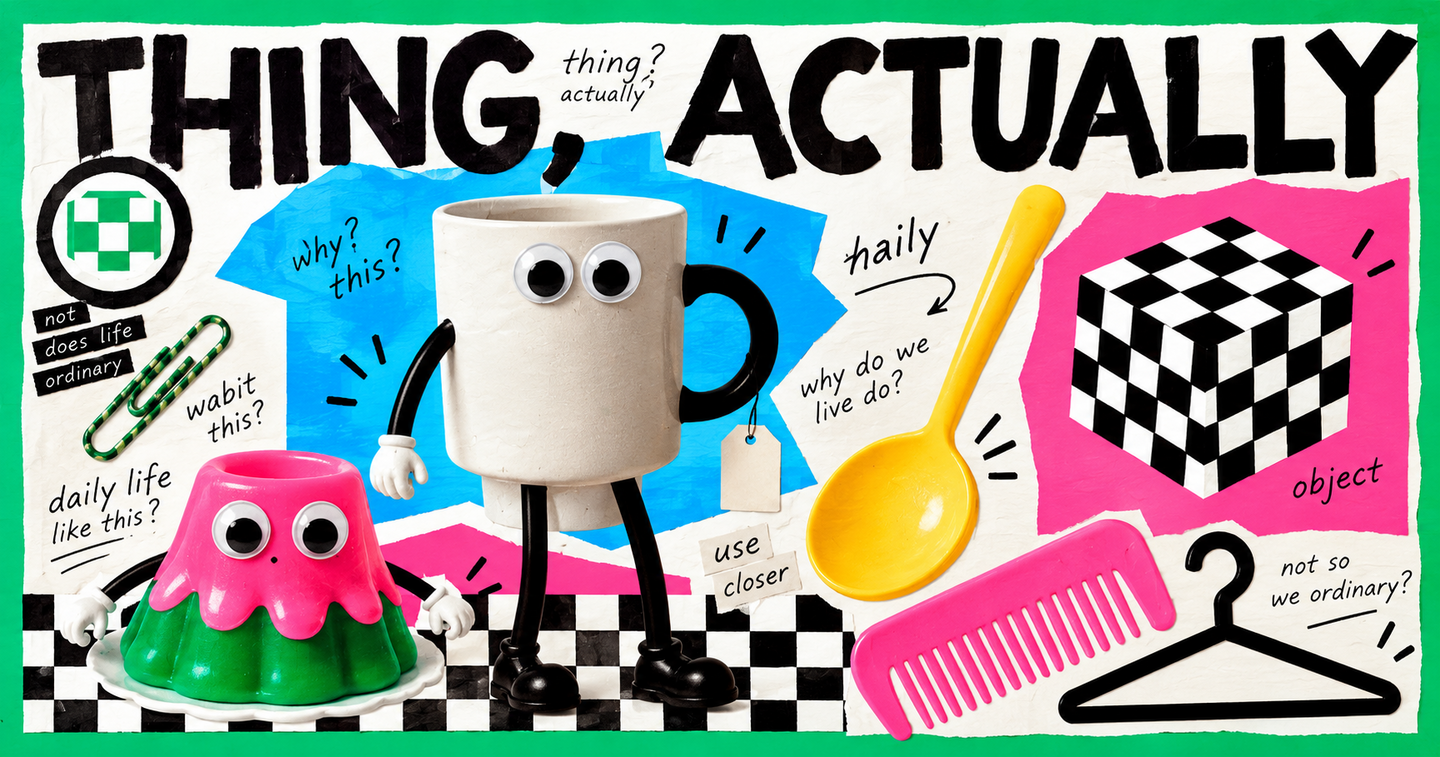
THING, ACTUALLY — a cultural media platform focusing on everyday objects and the meanings they acquire in a person’s life.
We interact with dozens of objects every day, rarely pausing to consider why they are designed the way they are or what habits, norms, and relationships underpin their use. Media offers a way to view familiar objects from a different perspective—not just as functional items, but as artifacts of culture.
Key Question: What can ordinary objects reveal about a person and society?
Objective: To explore everyday objects through their connection to human behavior, social norms, values, and cultural practices.Key Feature: Every graduation project begins with a specific object but gradually expands into a broader question about the human experience. For instance, headphones can prompt a discussion about personal boundaries, pockets can lead to themes of autonomy and social roles, and a chair can explore hierarchy and etiquette.
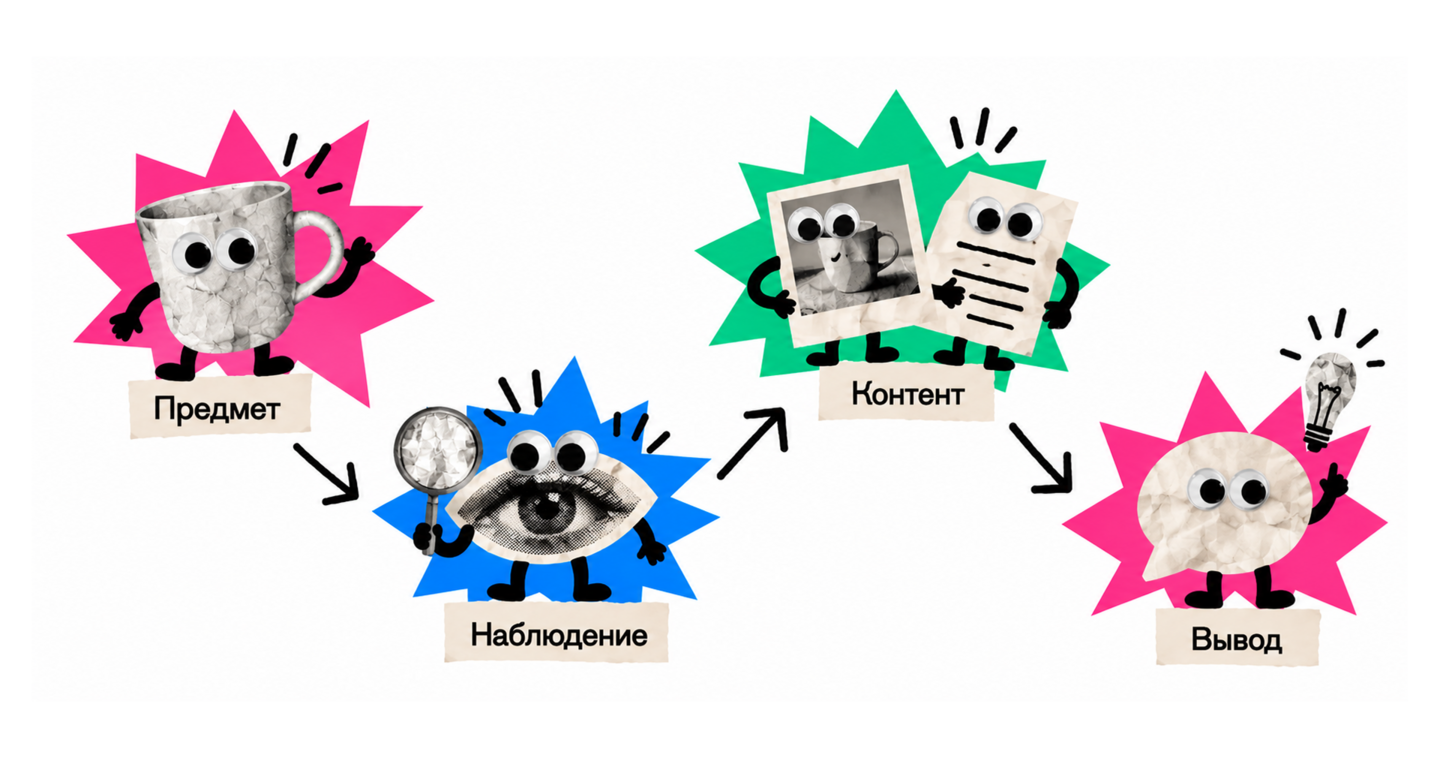
EDITORIAL PRINCIPLE
The media is designed for a B2C audience: students and creative industry professionals, humanities enthusiasts, active cultural consumers, and individuals interested in discovering the extraordinary within the ordinary.
THEMATIC PLAN
The semester is divided into six thematic cycles. Each month explores a different aspect of the relationship between humans and objects, and individual issues can be read independently.
November — Personal Boundaries
How objects help separate one’s space from another’s: headphones—can you close a door that doesn’t exist? A key—who is allowed entry? A door—what does the boundary of a home look like? A lock—why do we trust things to protect our space?December — Everything We Carry With Us
Personal belongings as an extension of the self—one’s habits and identity: a pocket—who has access to carrying belongings with them? A bag—what do we bring into the world? A wallet—what does its contents reveal? A phone case—why personalize identical devices?January — Objects and Social Roles
How objects signify belonging, status, and relationships between people: a chair—why does everyone have their own place? A mug—when does an object become territory? A table—who sits at the head? A badge—how does an object tell us who we are?February — Consumer Culture
What happens to objects when we buy, gift, and discard them: a bag—when does trash become memory? Gift wrapping—why conceal a present? A price tag—how does an object acquire value? A disposable cup—what does a culture of convenience look like?March — Rituals of Daily Life
Objects that participate in daily actions and concepts of normalcy: a mirror—for whom do we look at ourselves? A comb—why has personal grooming become a ritual? A toothbrush—how personal can an object be? An alarm clock—who owns our morning?April — Things That Remain
Why do we keep certain objects even after they have lost their function: a receipt—why do we keep proof of purchases? A ticket—can a slip of paper hold a memory? A souvenir—why bring a piece of another place home? An old t-shirt—when does a worn-out item become indispensable?We plan to release two major research pieces, two card series, four Telegram posts, and two short videos monthly.
In total, this amounts to 60 publications over six months, created from broader research and adapted for various platforms.
10 CONTENT SAMPLES
Sample No. 1. «Can you close a door that doesn’t exist?»
Type: ArticleImagine a typical subway ride. There are dozens of strangers around you—conversations, station announcements, the sounds of trains. You put on headphones, and although the physical space hasn’t changed, your presence within it takes on a different character. Headphones allow you to create a personal space where, literally, none exists.Researcher Michael Bull, who studied the use of personal audio devices in urban settings, viewed music as a way to manage environmental perception. A person cannot change a bus route or the behavior of other passengers, but they can choose what they listen to on their way.Furthermore, headphones affect not just the wearer. They become a visible signal to those around them. A person wearing headphones may be perceived as less open to casual conversation—even if they aren’t listening to anything at that moment.Thus, an ordinary device acquires a social function. It designates a boundary that cannot be seen or touched, but which others can take into account.Of course, headphones don’t always mean a desire to avoid interaction. Sometimes they are simply playing music or helping to concentrate. But the very possibility of using them as a sign of personal distance demonstrates how important managing attention has become in public space.It turns out that personal space is not always a place. Sometimes it is a way of signaling to others how available we are for interaction.And one of the most commonplace things in the modern city helps us create it.Sample #2. «The Key. Who is allowed inside?»
Type: PostA key seems like a purely utilitarian object: a small piece of metal that opens a lock.But it also serves another function—it distributes access. A key to an apartment means you can enter without an invitation. A key to an office signifies that a certain space is entrusted to you. A spare key given to a friend sometimes becomes a sign of intimacy stronger than any words.Conversely: when a relationship ends, asking for the key back can define a very specific social boundary.It turns out the key doesn’t just open a door. It materializes trust and the right to be present.Whom would you entrust with the key to your home?Sample #3. «The Pocket. A Small Space of Freedom»
Type: EssayWhy is a pocket more than just part of a garment?
A phone, keys, headphones, loose change. Pockets allow us to carry necessary items without a second thought.
But what seems like an obvious function of clothing today actually has its own social history.
In 17th–19th century Europe, women widely used separate pouch-pockets, which were tied at the waist and concealed beneath their skirts. They stored money, letters, sewing tools, and personal or valuable items. Men’s clothing already featured sewn-in pockets during this period.
This doesn’t mean women never had pockets. The way items were stored—their placement, accessibility, and dependence on the prevailing silhouette—changed.
As women’s clothing became more fitted, capacious hidden pockets gradually lost their utility. Eventually, in many types of women’s apparel, pockets became small and decorative, or disappeared altogether.
Why is this important from a cultural perspective?
A pocket is a private space that a person carries with them. The ability to conceal a letter, money, or keys signifies the capacity to manage one’s own belongings, maintain privacy, and move more freely.
This is why the history of pockets is tied not only to fashion but also to issues of autonomy, gender roles, and daily mobility. The modern situation is instructive as well: for some people, the ability to put a phone in a pocket is standard, while for others, it depends on the cut of the clothing or the presence of a bag.
It turns out that even such a small detail of clothing can reveal much about how freely an individual is permitted to interact with the surrounding world.
Sample #4. «The Bag. A Portable Version of Us»
Type: Shorts / Reels · 35–40 sec.Voiceover Script
Phone. Keys. Gum. The charger that’s inexplicably always with you. Receipts, tissues, and things for when something goes wrong.
A bag isn’t just a way to move items from one place to another.
Its contents reveal a person’s habits, needs, and perceptions of what they need to be prepared for.
Some carry a book. Some carry a first-aid kit. Some carry three chargers.
In essence, by packing a bag, we are packing a miniature version of our daily lives.
Sometimes, our belongings say more about us than we intended.
Sample #5. «The Chair. Why does everyone have their own place?»
Type: Cards
CARD 1
Everyone has their own place
How can a simple chair speak to power?
CARD 2
A chair is needed for sitting. But sometimes, who is sitting on it is just as important.
In a waiting room, a manager’s office, or around a family table, places can be unequal.
CARD 3
In formal settings, seating arrangements often emphasize participants' status.
A seat at the head of the table, a distinct armchair, or a specially designated chair can convey a person’s position without a single word.
CARD 4
Differences are also visible in everyday life.
A familiar scenario: you visit someone and ask where you can sit. Even if the chairs look identical, not every spot feels available.
CARD 5
It turns out that furniture does more than just organize space.
It helps to define roles, distribute attention, and reinforce established social rules.
CARD 6
A chair is not just a place for the body.
Sometimes, it is a person’s place in society. Do you have a chair at home that everyone feels belongs to someone else?
Example #6 «Mug Club. When does an object become territory?»
type: postWhy does it feel awkward to drink from someone else’s mug?
In an office, there might be ten completely identical cups. But as soon as someone claims, «This is mine, ” one of them stops being communal.
Its shape doesn’t change. What changes is the rule for how it must be treated.
A personal mug is a small example of how we assign meaning to everyday objects. It might be a gift, a souvenir, or simply a favorite item you want to use every day.
In shared spaces, such objects help to delineate boundaries: what belongs to a specific person and what is intended for everyone.
Sometimes, you don’t need walls to establish a personal territory. One cup is enough.
How comfortable are you with someone using your mug?
Sample #7. «The Bag. When Trash Becomes Memory?»
Type: Cards
CARD 1
The Bag You Don’t Want to Throw Away
Why do we keep things that were intended for carrying purchases?
CARD 2
A plastic bag is one of the symbols of mass consumption.
It is often perceived as single-use packaging that is no longer needed immediately after the purchase.
CARD 3
But at home, the bag can begin a completely different life.
People store other bags in it, carry things, collect trash, or save it for when it might be needed again.
CARD 4
Sometimes even its appearance gains value.
The logo of a vanished store, old advertisements, or a familiar design transforms ordinary packaging into a reminder of a time and a place.
CARD 5
It turns out that one object can be simultaneously packaging, waste, a useful item, and an object of nostalgia.
Its meaning depends not only on the material but also on how people use it.
CARD 6
A bag doesn’t have a single meaning.
And perhaps the most interesting part of its life begins after it leaves the store.
Do you keep pretty bags?
Sample #8. «Packaging. Why Hide the Gift?»
Type: CardsCARD 1Why wrap a gift?We spend time on packaging that will be ripped open within a minute.CARD 2From a practical standpoint, gift wrap isn’t needed all the time.However, its function isn’t limited to protecting the item. Packaging creates anticipation.CARD 3It distinguishes a gift from a regular purchase.The same item, handed over in a store bag or neatly wrapped in paper, can be perceived differently.CARD 4Giving a gift is a social ritual.Anthropologist Marcel Mauss demonstrated that the exchange of gifts relates to human relationships, not just the transfer of material objects.CARD 5The packaging becomes part of this interaction.By choosing the paper, tying the ribbon, and watching the unboxing, a person transforms a simple handing-over of an item into a distinct event.CARD 6The gift begins before it is opened.It turns out that sometimes the packaging speaks volumes about the relationship, almost as much as the item itself.And is packaging important to you?Sample #9. «The Mirror. Who are we looking at?»
Type: Shorts / Reels · 35–40 sec.Voiceover Script
How many times a day do you look in the mirror?
Before leaving the house, in the elevator, in a cafe restroom, or just passing a reflective surface.
Usually, we don’t just check our own face. We assess how we appear to others: does our hairstyle suit the situation, is our clothing fitting correctly, what impression might we make?
It turns out the mirror helps us view ourselves through the eyes of an imagined observer.
An object that reflects our face simultaneously reminds us of the gazes of other people.