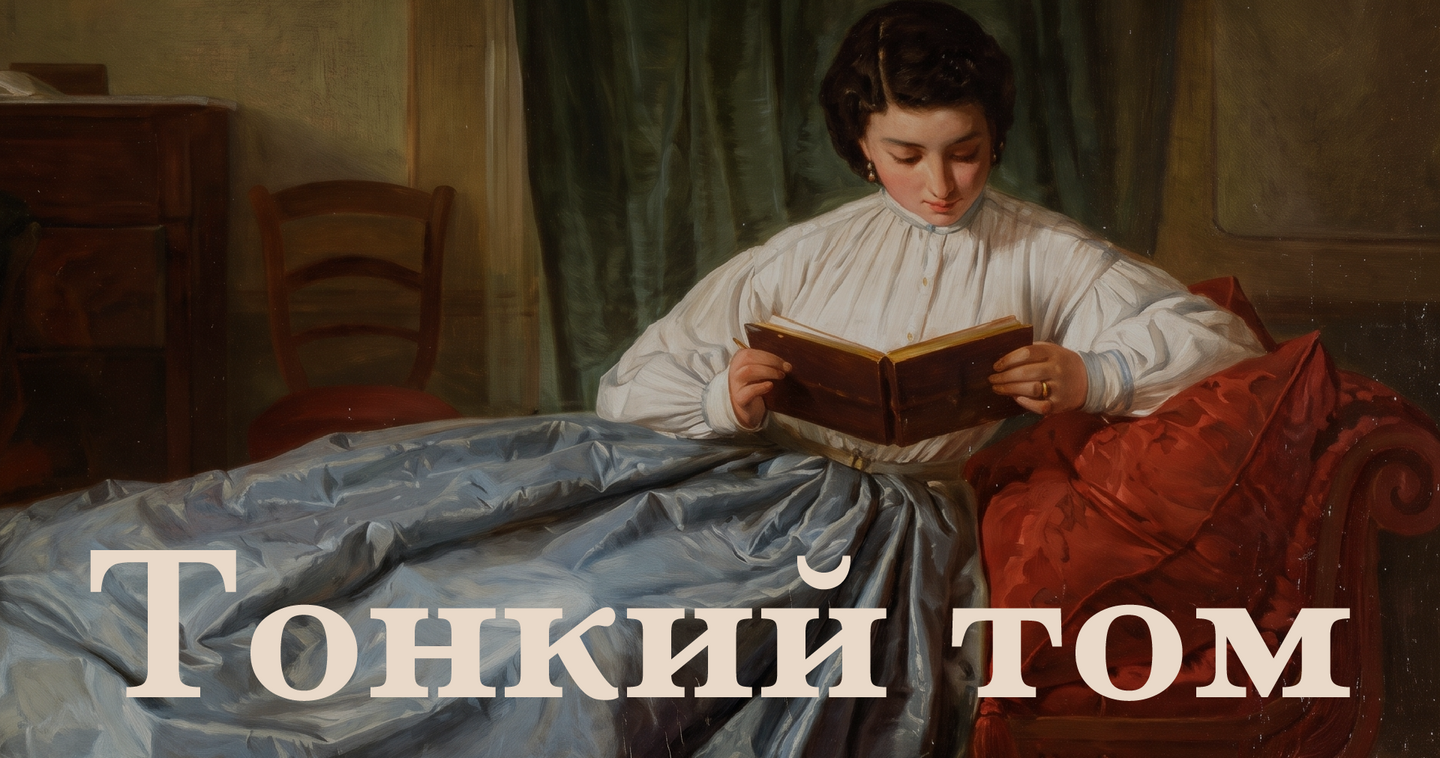
Concept
«Thin Volume» is a book-based Telegram media focused on short Russian and translated fiction. Each week, the editorial team selects one book under 200 pages, explains who it might appeal to, highlights textual features, and invites discussion about what has been read.
Media Goal — to help individuals select the right short book and gradually make reading a regular part of their lives.
Core Audience — individuals looking to return to reading after a hiatus or seeking to fit reading into their busy schedules of studies and work.Secondary audience — readers who discover new authors through short works, and people interested in shared reading experiences.
Description
In every issue, the reader will learn: — What the book is about and why the editors selected it. — Its pace, mood, and complexity. — Who it will suit and who might not enjoy it. — Which edition meets the size constraint. — What question to focus on while reading.
Semestermatic Plan for Six Months
The plan is designed for 26 editorial weeks from launch. Each month is unified by a central theme, within which the mood of the works and the reading difficulty vary.
Month 1. Return to Reading
In its first month, Media introduces readers to its concept and helps them select their first short book. The publications focus on various ways to approach reading—through a small scene, recognizable relationships, or a character they wish to understand. The first week features Patrick Süskind’s «The Fight» and a discussion on other people’s expectations; the second week presents Françoise Sagan’s «Hello, Sadness!» and explores the themes of freedom and responsibility; the third week covers Albert Camus’s «The Stranger» and questions our relationship with those unlike us. The final week is dedicated to a calmer story about everyday life. Each week, a book recommendation, a short piece on the text’s features, and a final discussion are provided. Over the course of the month, readers sample different works and determine which themes and narrative paces resonate most with them.
1. Patrick Süskind’s «The Perfume»
2. Françoise Sagan’s «Bonjour Tristesse.»
3. Albert Camus’s «The Stranger.»
Month 2. People
The second month focuses on interpersonal relationships: family, friendship, love, and solitude alongside others. Each week explores a distinct theme through a short book. The month begins by examining the boundary between care and control within the family, followed by the friendship between people with different personalities and experiences, then the mismatch of expectations in love, and concludes with the difficulties of mutual understanding. In addition to recommendations, publications appear discussing how writers reveal relationships through dialogue, everyday details, silence, and contradictions between words and actions. Readers are invited to compare the characters' motivations in the discussions and explain which scenes influenced their connection to the characters.
1. «Reunion» by Fred Ullman
2. «Do You Love Brahms?» by Françoise Sagan
3. «The Stranger’s Letter» by Stefan Zweig
4. «Monsieur Ibrahim and the Flowers of the Koran» by Eric-Emmanuel Schmitt.
Month 3. The Place Where We Live
The third month explores how space influences characters and becomes an integral part of the narrative. Five weeks are dedicated to the big city and encounters with strangers, the small town and dependency on the opinions of others, the home as a sanctuary, returning to a transformed location, as well as the journey and ephemeral connections. For each theme, a short piece is selected where the setting plays a significant role. Supplemental readings explain how landscape generates mood, familiar routes reveal character, and objects preserve memories of the past. In final discussions, students reflect on whether the story could have taken place elsewhere and what might have changed along with the setting.
1. «Breakfast at Tiffany’s» by Truman Capote
2. «The Pearl» by John Steinbeck
3. «The House on Mango Street» by Sandra Cisneros
4. «Mashenka» by Vladimir Nabokov
Month 4. When the familiar becomes strange
The fourth month introduces readers to short prose where the mundane is disrupted by an unusual event, an absurd rule, or an inexplicable change. The weekly themes gradually move from the intrusion of the impossible into everyday life toward stories that allow for multiple interpretations. Special attention is paid to the blend of humor and unease, human behavior within an incomprehensible system, and the boundary between reality and the character’s imagination. In the «In the Margins» column, the grotesque, repetition, and the understated tone of tales about the unbelievable are broken down in plain language. These discussions help readers formulate their own interpretations and support them with details from the work.
1. «The Metamorphosis» by Franz Kafka
2. «Animal Farm» by George Orwell
3. «The Rose Eggs» by Mikhail Bulgakov
4. «First-Person Narratives» by Haruki Murakami, a collection of short stories.
Month 5. Selection and its Consequences
The fifth month focuses on situations where characters must make difficult decisions. Each week examines a specific conflict: intervene or look away, choose personal gain or loyalty to another, admit a mistake or continue to justify it, take a second chance or maintain the familiar lifestyle. The recommendations are accompanied by materials explaining how the author portrays character motivations, conceals important circumstances, and reveals the consequences of actions. Discussions concentrate on the options available to the characters and the cost of each decision. Readers are encouraged to distinguish between understanding a character’s motives and agreeing with their actions.
1. Vasily Bykov’s «Sotnikov»
2. John Steinbeck’s «Of Mice and Men»
3. Friedrich Dürrenmatt’s «The Accident».
4. Gabriel García Márquez’s «No One Writes to the Colonel».
Month 6. Memory and Change
The sixth month features books concerning coming of age, saying goodbye to a former life, the unreliability of memory, and the possibility of starting anew. During the first four weeks, readers watch as characters re-evaluate their past and change their self-perception. Additional publications delve into the distinction between childhood and adult perspectives, shifts in narrator tone, and the role of the final scene. In the fifth week, subscribers choose a book from two options provided by the editors that align with the month’s theme. The semester concludes with a discussion of the reading experience: which works resonated most, which formats aided comprehension, and whether book selection became easier. This feedback is used to prepare the next thematic plan.
1. «Jamila» by Chingiz Aitmatov
2. «Oscar and the Rose Lady» by Eric-Emmanuel Schmitt
3. «Cafe of Lost Youth» by Patrick Modiano
4. «The Old Man and the Sea» by Ernest Hemingway.
Telegram Post Examples
Post 1. Introduction to Media
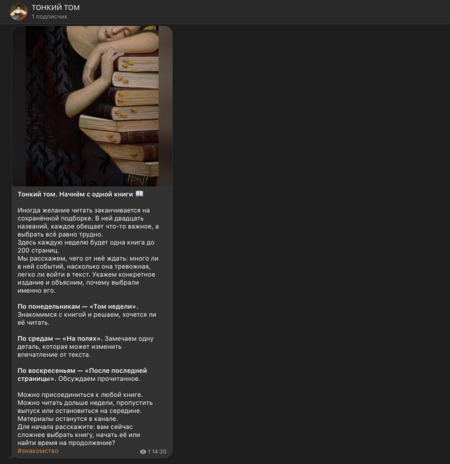
A Thin Volume. Let’s Start with One Book
Sometimes the desire to read ends up in a saved list. There are twenty titles, each promising something important, yet choosing is still difficult.
Here, we will dedicate one book—up to 200 pages—each week.
We will tell you what to expect from it: whether it’s action-packed, how evocative it is, and how easy it is to get into the text. We will specify the exact edition and explain why we chose it.
On Mondays—"The Volume of the Week.» We introduce a book and decide whether we want to read it.
On Wednesdays—"In the Margins.» We notice one detail that could change the reader’s impression of the text.
On Sundays—"After the Last Page.» We discuss what we’ve read.
You can join any book. You can read beyond the week, skip an issue, or stop halfway. The materials will remain available in the channel.
To start, tell us: is it harder for you right now to choose a book, start it, or find the time to continue?
#introduction