Concept
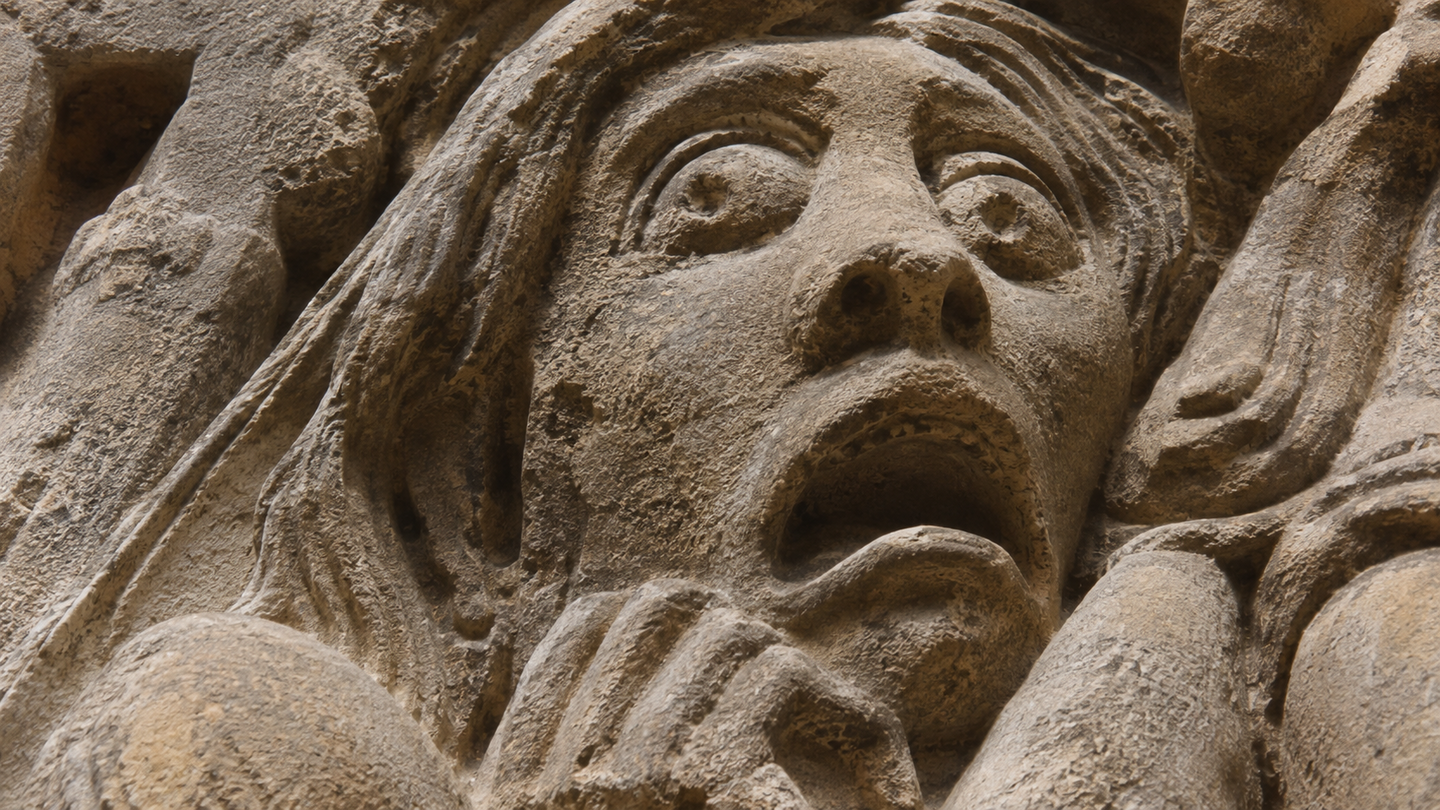
Fear manifests in various visual forms. It can be conveyed through character expressions and gestures, the distortion of the human body, the menacing appearance of fantastic creatures, composition, or by contrasting humanity with a superior force.
For this research, I selected the period of the 12th–14th centuries in Western European art. These centuries allow for a comparison of Romanesque and Gothic artistic traditions, as well as Trecento Italian painting. During this period, masters employed various approaches to representing the human body, space, and emotion, which reveals the diversity of artistic solutions.
In my research, I intend to examine various forms of depicting fear, dividing them into several thematic groups: the fear of death, physical suffering, the unknown, terrifying creatures, and others. Within each group, I will compare works united by a common narrative or motif, paying close attention to composition, facial expressions, gestures, figure plasticity, and other artistic elements.
The central question of my research is why the same subject or image can convey fear differently.
By comparing works from the 12th–14th centuries, I aim to identify which artistic techniques were preserved, which evolved, and how the differences in their application influenced the nature of the depicted fear.
Chapter 1. Expressing Fear Through Facial Expressions and Gesture
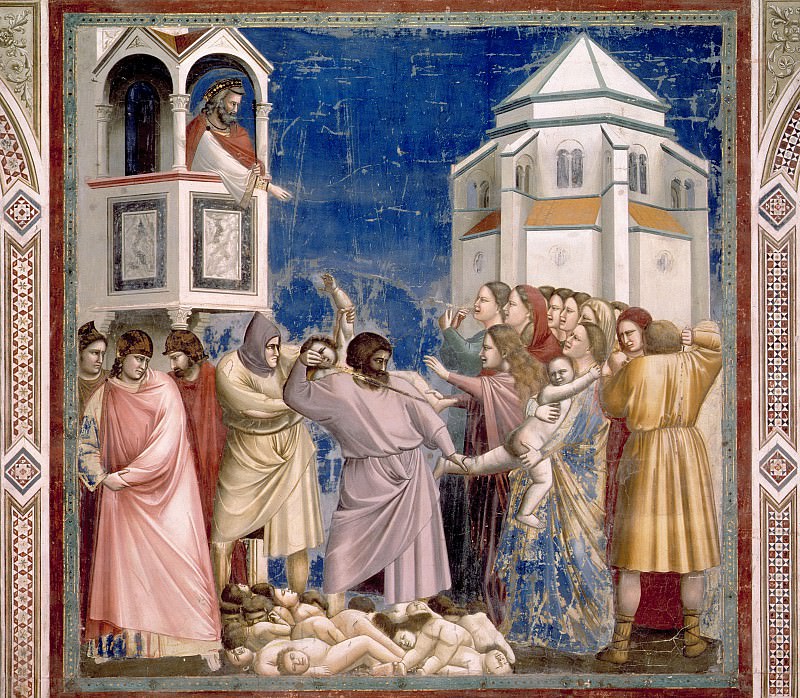
Giotto di Bondone. «The Beating of the Infanta.» c. 1303–1305. Fresco. Cappella Scrovegni, Padua.
Fear can be expressed in art through the emotional state of the depicted figures. Facial expressions, gestures, and body posture allow for the conveyance of terror, despair, and helplessness in the face of threat.
In this chapter, I will examine how artists of the 12th–14th centuries portrayed fear through human emotion, comparing their representations across various works.
1.1 Concern for Others
«Beating of Infants.» Sculptural frieze of the King’s portal of the Chartres Cathedral, 12th century.
In «The Beating of the Infants» at Chartres Cathedral, the narrative unfolds as a sequence of scenes depicting violence and resistance. The mothers press the children close to them, attempting to shield them from armed soldiers or reaching out to the infants who have already been taken away. Fear is primarily conveyed through the characters' actions: defensive gestures, the collision of figures, and the juxtaposition of armed men against vulnerable women and children. The repetition of such episodes along the frieze enhances the sense of scale and the continuous nature of the events.
«The Beating of Infants.» Notre-Dame de Paris, north transept portal. Circa 1258–1270. Stone relief.
In the relief of Notre Dame Cathedral, emotional tension is created primarily through the interaction between the characters. Armed soldiers are contrasted with helpless children and mothers. On the right, a woman holds a child; terror and fear are etched on her face, while the soldier’s face displays indifference and mockery. However, the characters' expressions remain relatively restrained. Fear and helplessness are conveyed not so much through their faces as through the posture of their bodies, protective gestures, and the nature of the figures' interaction. Thus, the emotional expressiveness of the scene is achieved primarily through the depicted action.
In the relief of Notre Dame Cathedral, the scene «The Beating of the Infants» is included in the cycle of scenes depicting Christ’s childhood. Unlike the extended frieze of Chartres Cathedral, here the action is confined to a limited section of the portal’s sculptural decoration. This difference allows for a comparison between two ways of organizing the narrative: the sequential unfolding of the story along the architectural frieze versus its depiction within a sectional composition.
Duccio di Buoninsegna. «The Beating of the Innocents.» 1308–1311. Tempera, gold, wood. Siena Cathedral Museum.
In Duccio’s work, fear and despair are conveyed through the contrast in the emotional reactions of the characters. The mothers are grouped tightly together: their raised arms, bowed heads, and figures turned toward one another express sorrow and absolute helplessness. In contrast, the soldiers' movements are cooler and more dispassionate, which creates a sharp contrast with the women’s tense gestures. Through this juxtaposition, the artist underscores the difference between the suffering of the victims and the actions of the perpetrators of violence.
Giotto di Bondone. «The Beating of the Innocents.» c. 1304–1306. Fresco. Cappella Scrovegni, Padua, Italy.
In Giotto’s fresco, «The Massacre of the Innocents,» fear and despair are conveyed through the immediate emotional reactions of the characters. Women attempt to protect their children, reaching out hands to the soldiers, weeping, and crying out. Open mouths, strained faces, and gestures directed toward one another make their suffering particularly expressive. The composition is built upon the contrast between the soldiers and the mothers. Unlike the more restrained expressions seen in Parisian relief sculpture, Giotto places special emphasis on the external manifestation of human grief and terror.
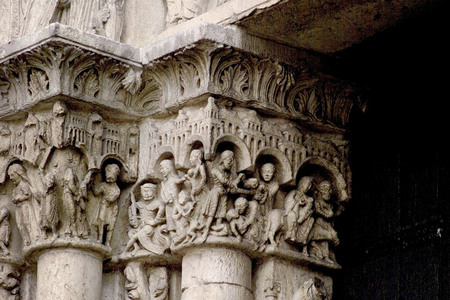
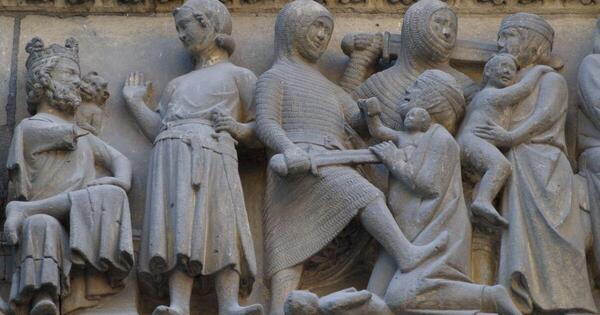
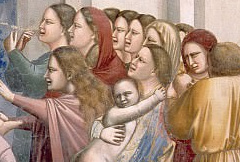
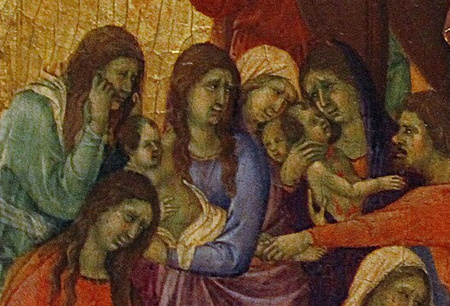
Comparing four interpretations of the «Beating of the Infants» narrative reveals differences in how human emotions are conveyed. In the sculptural reliefs of the 12th-century Chartres Cathedral and the 13th-century Cathedral of Notre Dame in Paris, fear is expressed primarily through composition, gestures, and the interaction among characters. The figures' expressions are relatively restrained; therefore, the emotional tension becomes most apparent when viewing the scene as a whole, within the context of the action taking place. In the works of Giotto and Duccio in the 14th century, emotions receive a more explicit expression directly on the characters' faces. Open mouths, furrowed brows, tense gazes, and tilted heads allow the viewer to read suffering and despair even in isolated fragments, separate from the overall composition. Thus, the comparison of these works illustrates a shift in expressive emphasis—moving from narrative action and figure interaction toward a more individualized depiction of emotional states. At the same time, gesture and composition do not lose their significance; rather, they are complemented by more expressive facial features. Fear becomes not only a part of the depicted event but a distinct subject of artistic representation.
1.2 Fear for one’s own life
Unlike the fear for another person, the fear for one’s own life arises when the character faces an immediate threat. In art, this state can be conveyed through tense postures, distorted facial expressions, defensive gestures, and attempts to evade danger.
In this section, I will examine how artists of the 12th–14th centuries depicted a person’s fear of their own demise or punishment and what artistic devices they employed to convey helplessness in the face of threat.
«The Last Judgment.» Circa 1130–1145. Stone relief, tympan of the Saint-Lazare cathedral portal, Autun, France.
In the tympanum of Saint-Lazare Cathedral, the fear of one’s own fate is conveyed through the plasticity of the human figures. Christ stands in the center, his size conveying his power and might, which inspires both awe and terror. To his right (the viewer’s left) are the righteous, and to his left (the viewer’s right) are the condemned sinners. Those on our right are depicted in tense poses: their bodies curve, hands are raised to their faces, and their movements create a sense of helplessness before inescapable punishment. Those on the left, however, stand upright and calmly. The figures interacting with the demons gain particular expressiveness. Their gestures and body postures emphasize the imbalance of power between humanity and the entities that determine their final destiny. Thus, fear is expressed not only through facial expressions but also through the physical vulnerability of the depicted characters and, of course, the contrast between the sinners and the righteous. The theme of justice holds a special place in this work—it is what truly instills fear. If the frightening appearance of the sinners were the only concern, we would not worry about our own fate while viewing the relief. Because of Christ’s scale and the contrast between the righteous and the sinners, we worry not only for the characters but for ourselves.
Niccolò Pisano. «The Last Judgment.» c. 1260. Marble relief from the Baptistery of San Giovanni, Pisa, Italy.
In Niccolò Pisano’s relief, «The Last Judgment,» the fear of punishment is also conveyed through the contrast between the righteous and the sinners, but the composition is structured differently. Christ still holds the central position, but the human figures are arranged much more densely. On the viewer’s left, the saved form a relatively ordered group with stable bodies, whereas on the right, the bodies of the condemned intertwine, writhe, and seem to lose balance. Demons seize the sinners, intensifying the sense of helplessness and chaos. Unlike the tympanum of Saint-Lazare Cathedral, where fear is largely built on the contrast in scale between Christ and the people, Niccolò Pisano makes the distinction between the two groups of characters particularly pronounced. The order and tranquility of the saved are set against the chaotic movement of the condemned. Thus, the fear of one’s own fate is expressed not only through individual gestures but through the very organization of space: order becomes the image of salvation, and chaos—the image of punishment.
Giotto di Bondone. «The Last Judgment.» c. 1303–1305. Fresco. Scrovegni Chapel, Padua, Italy