
Logotype Stray
Navigation
- Research Concept
- Research Apparatus 2.1 Objective and Research Question 2.2 Hypothesis
- The Human Through Material Heritage
- The Human Through Cultural Heritage 4.1 Inheritance of Social Practices
- The Human Through the Nonhuman Perspective 5.1 The Cat as Mediator Between Player and Environment 5.2 B-12 as a Carrier of Human Memory
- Conclusion
- Bibliography
- Image Sources
Concept
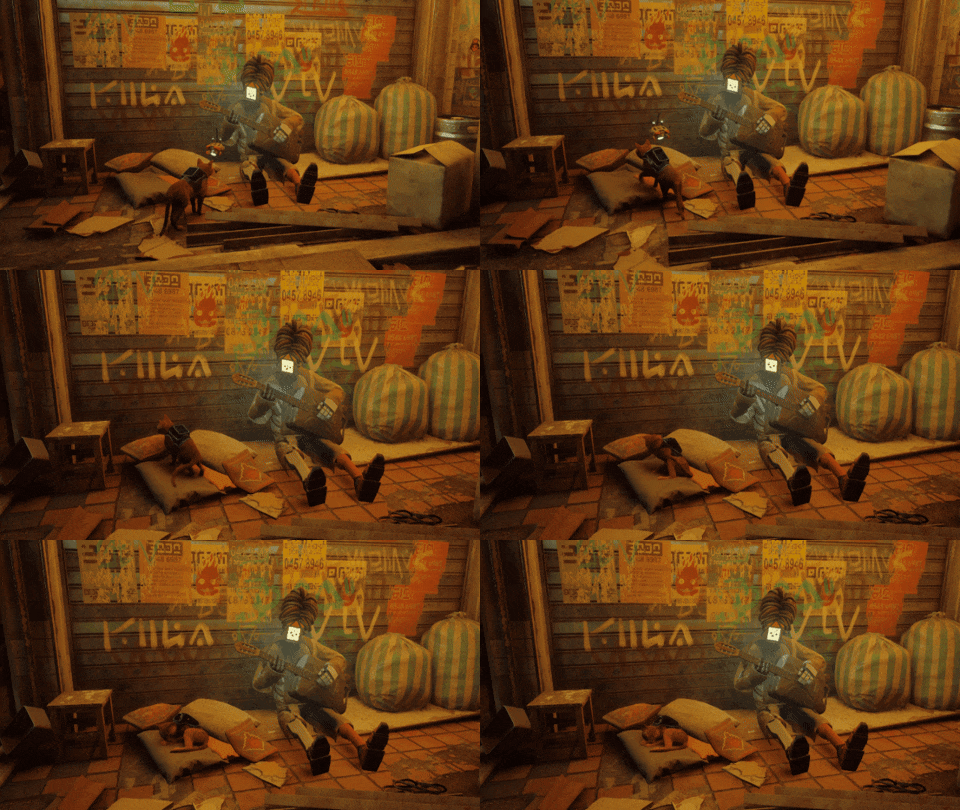
Stray (2022) // Game Excerpt
Stray weaves a narrative around a paradox: humans have vanished from the game world, yet almost everything the player encounters continues to speak of them. The underground city preserves the infrastructure created by humans, and the living quarters are filled with objects of human daily life. Companion robots wear clothing, make music, work, trade, form families, and reproduce social institutions—in other words, they imitate the lives of their creators.In this study, the absent human is understood as the totality of perceptions of humanity that the player reconstructs through the traces of their activity and through life forms that have survived their original bearers.This approach aligns with the very way the story is presented in the game: BlueTwelve Studio emphasized that exploring the environment is a key part of Stray [1].
The absence is considered not only a part of the plot but also a philosophical problem of the game. For Fink, a game is understood as a specific way in which human existence can enact its own fundamental phenomena. Therefore, the question is not just about what information Stray preserves about the deceased, but why a world without people remains recognizably human through the forms of labor, power, love, and the relationship to death.
Stray (2022) // Screenshot from the game
The study distinguishes between three types of evidence: material trace, cultural reproduction, and personal memory. The first type is present in architecture and artifacts; the second—in the behavior of robots and the structure of their society; and the third—in B-12's recollections.
Every trace of human activity is examined through four aspects:1. What the player sees; 2. How the player gains access to this evidence; 3. What human condition it relates to and what can be asserted about humanity from it; 4. Which part of the conclusion arises at the level of interpretation.For example, while exploring the area of The Slums, the player encounters the robot Babushka, who says that she loves knitting. The player learns about this practice through observing and interacting with the character. The scene itself does not convey specific facts from human history, but the combination of the name Babushka and the recognizable domestic activity evokes associations with human cultural practices. At the level of interpretation, these elements can be considered traces of human heritage surviving in the daily lives of the robots. Consequently, humanity is present in the scene not as a character or a memory, but as a cultural association that arises from recognizing a familiar image.
Research Apparatus
Key Question:
How does Stray, by exploring fundamental human experiences—labor, power, love, and death—in a world devoid of people, allow the player to reconstruct the image of humanity through non-human characters and material traces?
Hypothesis:
In Stray, the image of humanity arises not so much from direct accounts of the lost civilization, but from the re-enactment of the structures of human existence within a non-human world. The physical environment preserves conditions of labor and social order; companions reproduce and transform relationships of power and love; and the memory of B-12 links these forms to the finitude and disappearance of humankind. Therefore, three incomplete sources—material trace, cultural practice, and memory—become meaningful only through the player’s interactive experience and comparison.
Methodology
The research is grounded in the philosophical anthropology of play by Evgeny Fink. His examination of play in relation to the core phenomena of human existence—labor, power, love, and death—is used as an analytical framework for selecting and comparing methods to reconstruct a lost civilization.Humanity through material heritage
Stray (2022) // City Layout Scheme
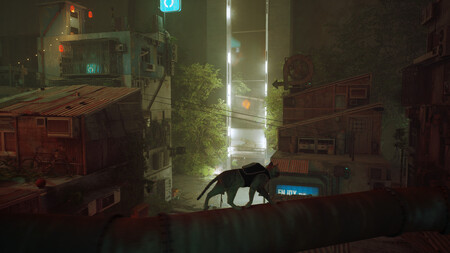
Stray (2022) // Screenshots from the game
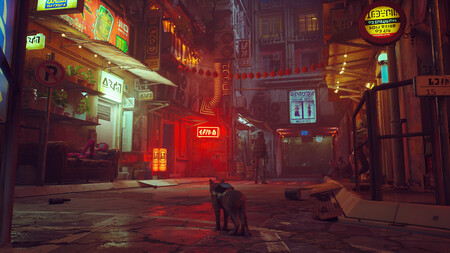
For the research, it is important that people are physically absent, yet the city continues to depend on decisions made by them previously: even if the player does not encounter a person, they constantly interact with infrastructure, familiar interiors, technical systems, and signage designed for human society.
Architecture: Testament to Human Presence.
The first layer of this testament is the structure of a *Walled City*. The internal environment is organized as a closed, multi-level system: the lower quarters are hemmed in by high walls, above them are more affluent and controlled districts, and at the very top lies the *Control Room*. The authors of the paper The Architecture of the Video Game Stray (2022) argue that the spatial narrative of Stray is built upon transitions between urban, architectural, and interior scales, and the verticality of space defines both movement and the world’s social structure [2].Within Finke’s philosophy, these traces can be examined through the phenomenon of labor: humans transform the surrounding world, create objects, and organize space for activity. Even after the human disappears, the result of such transformation persists [9].
It is also worth mentioning Tim Ingold’s concept: he suggests understanding the landscape as the accumulated result of the activities of those who lived within it—the space preserves not an abstract past, but the traces of the work, routes, and habits of previous inhabitants [3].
Stray (2022) // Renders by Kime Honma
Stray (2022) // Renders by Kime Honma
Landscape tells a story—or, more accurately, it is a story itself.
Stray (2022) // Renders by Kime Honma
In Stray, the city’s architecture allows the player to deduce the types of human activity that shaped its original organization. Residential spaces, transport infrastructure, and industrial zones indicate areas designed for living, moving, and working. The player reconstructs the possible lifestyle of a vanished civilization based on external and interior details.
Thus, labor is not presented through the direct depiction of a working individual, but through the results of that activity: built structures, transportation systems, and industrial infrastructure.
In the The Slums area, the residual presence of humans in residential spaces is particularly noticeable. Rooms are filled with familiar household items—beds, mattresses, tables, lamps, fans, books, screens, curtains, and plants. While the robots inhabit these spaces, their mechanical nature does not suggest direct interaction with many of these objects. This allows the space to be perceived as a possible testament to a human past that continues to exist and evolve after people have disappeared.
Thus, the space presents a collection of indirect evidence that the player uses to form a hypothesis about past society.
Stray (2022) // Renders by Kime Honma
Material environment as a carrier of information about the past.
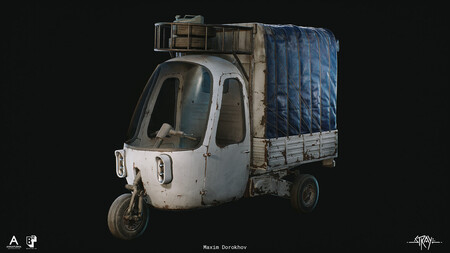
Objects of daily life illustrate the everyday script for organizing existence: they function as cultural signifiers that allow one to infer social processes, habits, and algorithms of daily life that are not always apparent. In apartments and public spaces, Stray constantly features books, photographs, televisions, bowls, bottles, desk lamps, keyboards, musical instruments, and clothing. Some of these objects serve merely as set dressing, while others participate in the game’s actions.
Through these objects, the player gains insight into the outcomes of human labor.

Props by Maxim Dorokhov