Concept
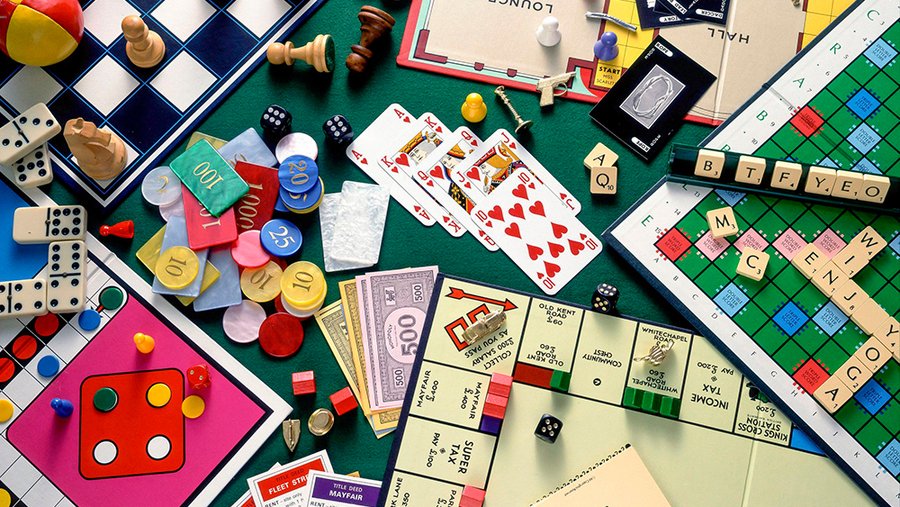
Game tokens of all colors and sizes
This study is a visual exploration of the role of figures in board games and investigates its possible relationship with the evolution of the piece icon. It examines why virtually any object can become a resource, a territorial marker, a character, or something that a player will associate with themselves. Using examples from historical and contemporary board games, it explores the connection between an object’s material form, its function, and its perception by players.
The goal of the research is to examine how an ordinary object becomes part of a game world and to trace the connection to the evolution of the tokens themselves.
The philosophical foundation for this study is rooted in Johan Huizinga’s concept presented in his book Homo Ludens (The Playful Human, 1938). Huizinga posits that play creates a distinct space with its own rules and order—within this space, ordinary objects can acquire new meanings defined solely by the agreement among participants. Building upon this idea, the research examines game pieces not merely as physical components of board games, but as carriers of conventional meaning. I will pay particular attention to how the visual representations of these pieces have evolved: from the abstract stones and tokens of antiquity to the anthropomorphic figures and detailed miniatures of modernity.
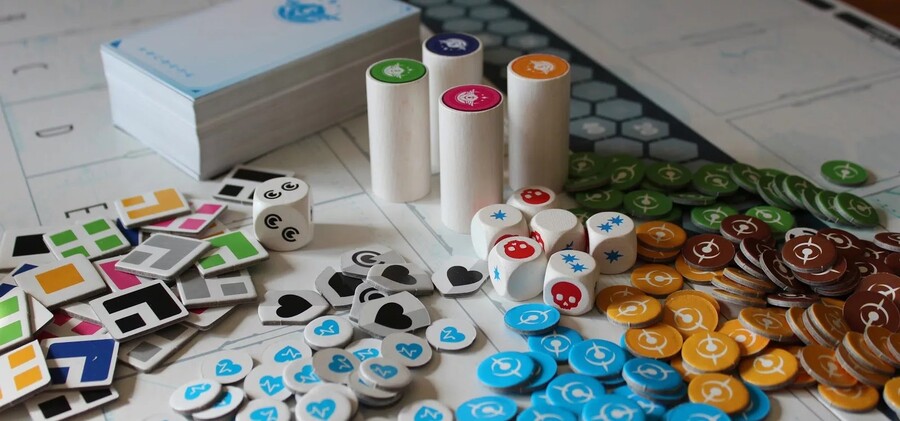
Contemporary Paper Tokens
The relevance of this work stems from the significance of material components in shaping the player experience. Despite the vast diversity of forms, materials, and modes of representation that have reached us—both ancient and recently created—game figures serve a singular, common function: representing objects imbued with specific meaning within a constructed reality.Examining their history and evolution allows us to trace how a person transforms one object or another into a symbol and utilizes it within the game process. Furthermore, comparing abstract and figurative components is an important area of study, demonstrating that an object’s appearance is not a prerequisite for a token.
My hypothesis is that an object becomes a game piece not because of its form, but because of the meaning assigned to it by the rules and the players. Its external appearance does not determine its ability to participate in a game, but it does influence the perception of its role, its symbolic significance, and the participant’s emotional connection to it.
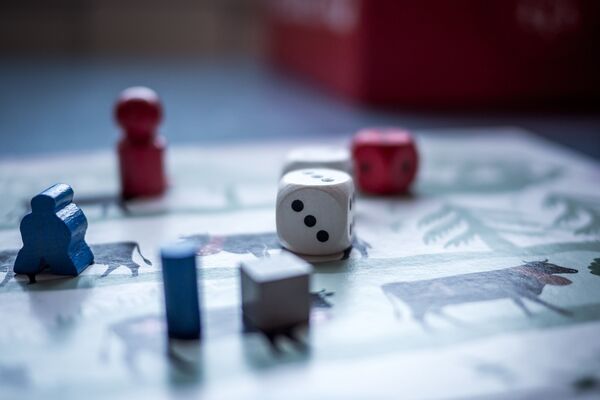

Game Tokens
The novelty of this research lies in examining game pieces not merely as elements of board games, but as objects acquiring conventional meaning within the game space. Unlike previous scholarly articles, which have focused primarily on the origin and essence of individual games, this study is not confined to a specific chronotope; it encompasses games from different eras to trace their evolution.In this work, I focus on analyzing historical and contemporary board games—their components and visual characteristics—utilizing comparative and historical methods to track the evolution of the pieces. The philosophical and historical analysis is grounded in part of Johan Huizinga’s concept concerning the attribution of conventional meaning to game objects. Through visual analysis, it is possible to compare abstract and figurative components and identify the relationship between their appearance and their roles within the game.
Origins of Game Pieces
from subject to feature
Any subject can become part of the game.
To begin, in everyday life, objects possess functions and meanings to which we are accustomed. However, within a game, these elements can transform: a stone might become a warrior, a token might represent territory, and a small figurine could become a model of the player themselves.According to Johan Huizinga’s philosophy, play creates a special space with its own rules and order. For this research, it is crucial that within this space, familiar objects acquire new meanings—meanings defined solely by the participants and the rules.
From this, we can conclude that the gameplay mechanic is not so much a specific type of object as the role it assumes within the conceptual reality.
Let’s look at the appearance of game pieces in the origins of games: in various countries, materials of a round shape were used—materials that were easy to obtain or manufacture: carved stones (Go), bones (Ura game), and shells (Pachisi).
In the ancient Russian game of Ura (circa 2600 BCE), small figurines moved across the game board, designating the participants, much like in «Monopoly.» Ancient Egyptian Senet utilized conical and spindle-shaped elements, which symbolized «dancers"—a sacred representation of the traveling soul.
Thus, even in antiquity, there were diverse ways to represent game elements: from simple geometric shapes to figurines with recognizable imagery.
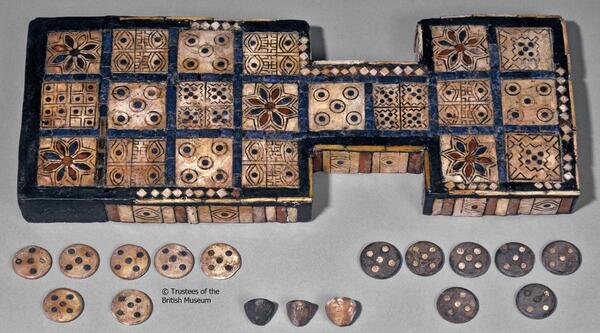
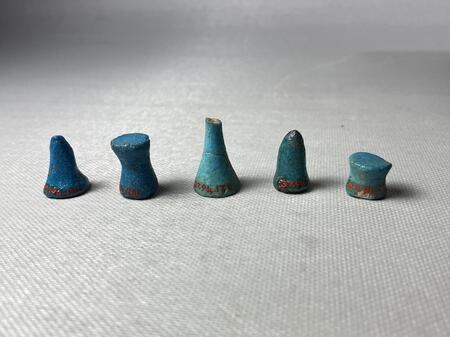
The field of the royal game from Ur and the figurines from Senet
For the next example, we will look to the East: in the ancient Chinese game Go, black and white round stones are placed on the intersections of lines on the game board. Each piece gains meaning through its position relative to the others; together, they form groups, territories, and boundaries. Furthermore, in Go, the stones indicate occupied positions and denote control over territory.
In the games I have examined, the components do not depict specific characters or objects; they are abstract. Their meaning is determined by color, placement, and interaction with other elements—a similar principle is used in backgammon, where checkers are used to track each player’s score. These examples show that ancient game pieces were not striving for the representation of a specific image; they were needed primarily for practicality—so that players could visually assess the game situation, understand where each team was positioned, how many resources they had, and what they still needed to do to win. In other words, in early board games, the piece was first and foremost a tool for organizing the game space, and only rarely a kind of sacred symbol.
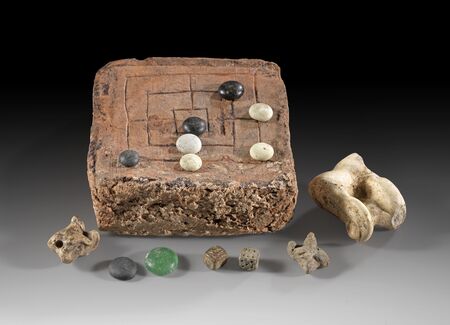
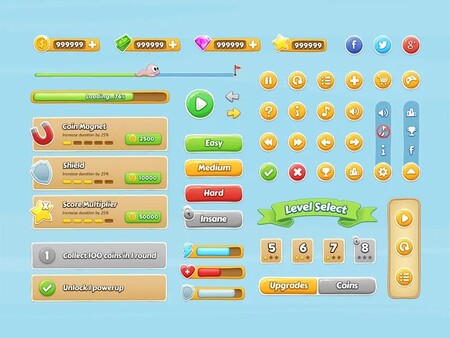
A game board from Ludus latrunculorum and an interface example from a casual mobile game
The practical role of ancient tokens can be compared to the role of modern user interfaces and UI in video games: several simple indicators that do not distract from the process, but help the player navigate the game—only their physical and less vibrant counterpart.
From Abstraction to Image
Emergence of game roles
If game pieces initially served the participants merely as functional elements, over time some began to acquire additional meaning. Figurines started to represent people, animals, and objects, allowing players to perceive the game units not only as abstract symbols but also as specific actors in the events. Take the ancient Egyptian game «Hounds and Jackals» as an example: it used sticks topped with heads of dogs and jackals. Their appearance allowed for the differentiation of two sides, and the figurines moved along the game path. It is worth noting that the emergence of figural representations did not replace abstract forms; both methods existed in parallel.
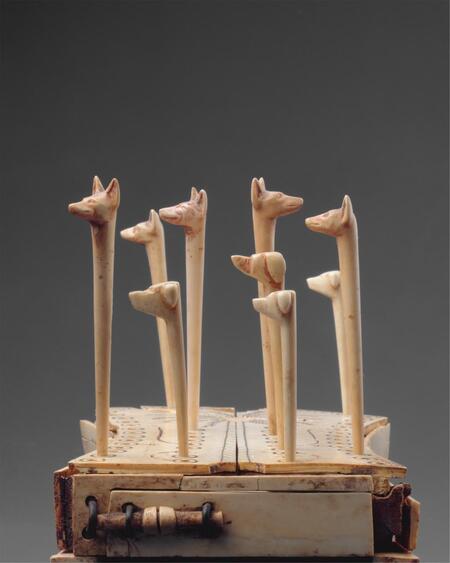
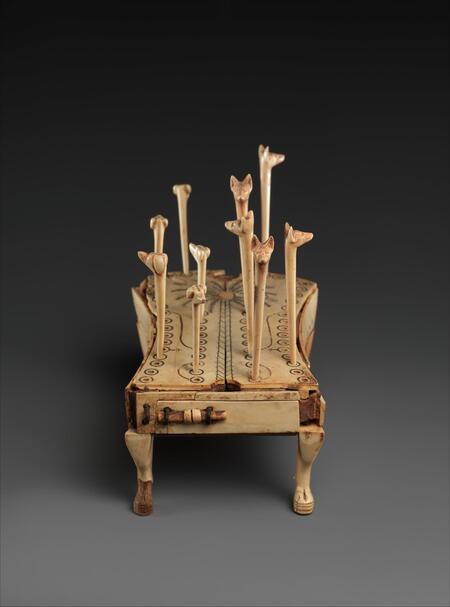
Highlights from «Dogs and Jackals»
Thus, the feature gained a representational function in addition to its practical one—a fact easily demonstrated through a thought experiment: if you replace the «hyena» and «hound» sticks with red and blue sticks or pebbles, the game does not become impossible, meaning that form is not necessary.
It became important how the figure looked; its imagery began to occupy a space separate from its function, and something in how people understood game pieces changed.
The transition from symbolic representation to concrete image was particularly evident in chess, although this is directly linked to its mechanics. The game originated in India around the 6th century and subsequently spread through Persia and the Islamic world into Europe. The pieces themselves changed alongside this spread.The initial forms gradually adapted to new cultures: the Indian elephant became the European elephant (later the bishop), the ruler’s advisor transformed into the queen, and the chariot became the rook. In different regions, the pieces might retain their original appearance or adopt a more symbolic form. In Islamic chess, for example, the pieces were based on symbols: the king might be depicted as a throne, and the knight as an animal’s head.