Concept
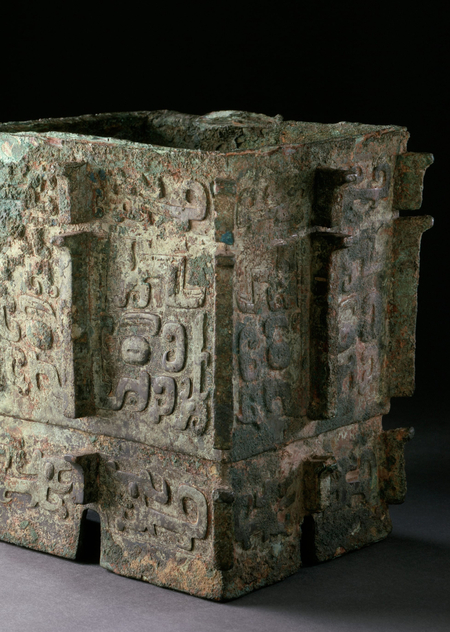
This work sparked interest because the Taoist motif appears on the most diverse bronze objects: ritual vessels, bells, and even weapons. When comparing these items, the precision of the mask construction, its axial symmetry, and the complexity of the decorative details are particularly striking. The fine background ornamentation is no less interesting. On some objects, it emphasizes the contours of the animal snout, while on others, it becomes so dense that it almost merges with the main image, as if obscuring the mask itself. It is especially interesting to trace how recognizable animal features gradually transform into a geometric zoomorphic motif, sometimes becoming so abstract that they are difficult to distinguish. The relief warrants special attention: on certain bronze artifacts, large projecting elements are combined with delicate background patterns, making the image significantly more three-dimensional and expressive.
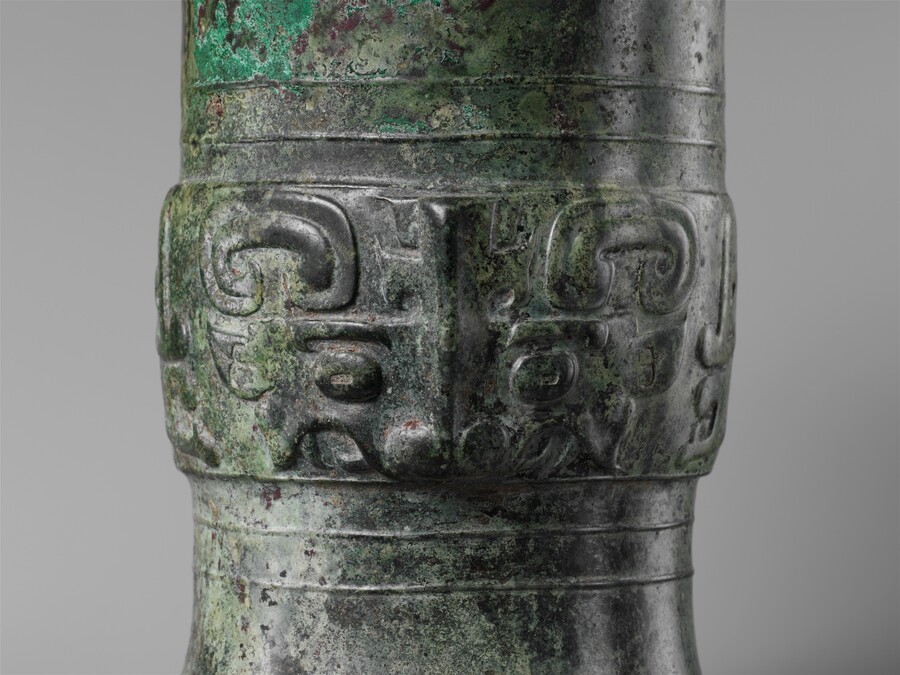
Fragment of a bronze wine vessel, zun, with a Taote relief mask. China, Shang–Western Zhou Dynasties, 13th–10th centuries BCE.
The research is based on bronze artifacts from the Shang and Western Zhou dynasties (approximately 16th–8th centuries BCE) sourced from museum collections. Most of the items are ritual vessels, but the selection also includes bells and weaponry. Comparing them is significant not only due to differences in function—the same theme of animal masks appears on square sides, rounded bodies, or small decorative fields. For selection, museum attribution, dating, and the ability to examine the ornamentation in sufficient detail were important factors. The work utilizes materials from The Metropolitan Museum of Art, the National Museum of Asian Art, the Cleveland Museum of Art, the Los Angeles County Museum of Art, and other collections.
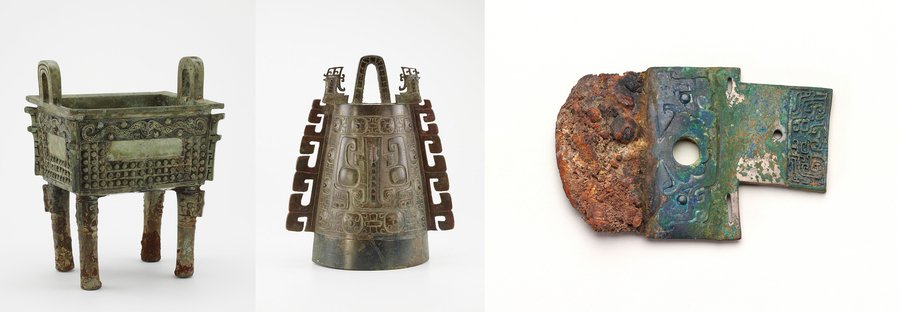
1. Rectangular ritual cauldron, Fandin. China, Shang Dynasty, 12th–11th centuries BCE. Bronze; 2. Hanging bronze bell with Taote masks and bird motifs. China, Late Shang, 11th century BCE; 3. Bronze axe with Taote masks. China, Shang Dynasty.
The research focuses on the artistic structure of the totem. Its potential ritualistic and mythological meanings are necessary for understanding the historical context but will not be the main subject of analysis; the meaning imbued by ancient masters in a single mask form cannot be reliably reconstructed. I am interested in what can be observed and compared: the spatial arrangement of eyes, horns, and other zoomorphic features, the function of the central axis, the character of curved and angular elements, the relief modeling, rhythm, and surface patterning.
The main research question is—how do geometricization, axial symmetry, relief, and the relationship between figure and ground influence the composition and visual recognizability of the totem? I hypothesize that the issue is not merely the presence of characteristic zoomorphic features. It is important how these features are connected, how they differ in scale and plasticity from the surrounding ornament, and whether the boundaries of a unified image are preserved. Moreover, recognizability in this context refers to the outcome of my formal visual analysis, not the universal reaction of viewers: the research does not claim to reconstruct the perception of people from the Shang Dynasty or conduct a psychological experiment.
1. Ritual grain vessel (Gui) with Taote masks and dragons. China, early Western Zhou, circa 1045 BCE; 2. Ritual water vessel (Yue) with Taote masks. China, Shang Dynasty, 13th–12th centuries BCE.
The main method is comparative visual analysis. I compare individual masks and decorative compositions, noting their symmetry, proportions, stylization techniques, and the relationship between large relief forms and fine background patterns. Overall views show how the motif occupies the object’s surface; magnified fragments allow for examination of its structure and details. The comparison is supplemented by museum descriptions, dating information, and art historical publications. I also examine the casting technology using composite molds: this helps explain how the relief and decorative ribs were formed. However, photographs cannot replace examining the originals; therefore, the depth of the relief, the technique of executing individual lines, and the initial appearance of the surface can only be assessed with reservations.
How the research is structured:
The material is divided into seven sequential parts. It begins with a brief historical context and an analysis of the mask’s structure. Following this, the study explores its geometrization and stylization, the interplay between the figure and the background, and the role of relief. Subsequent sections are dedicated to the rhythm of repeating motifs and the composition’s dependency on the object’s form. Finally, decorative solutions from different periods are compared, including the application of Max Lor’s five-style classification. I use this classification as a tool for comparison, not as a rigid schema for automatically assigning every vessel to a specific stage of development.
The same objects may appear in several parts of the study: on one vessel, it is useful to examine axial symmetry, while in another comparison, it helps reveal the characteristics of the ornamental frieze. Therefore, some images are examined in detail, while others serve as material for comparison. For me, the goal is not to present a collection of similar masks, but to illustrate the various ways in which the zoomorphic image transforms into a complex decorative structure.
Historical Context: Taote in Ancient Chinese Bronze Art
Bronze artifacts held a significant place in the ritual culture of ancient China. During the Shang dynasty (circa 1600–1046 BCE), master artisans created vessels for wine and food used in ceremonies honoring ancestors. Their forms were diverse, ranging from slender three-legged cups to massive rectangular cauldrons. The surface of many pieces was adorned with intricate decoration, featuring depictions of animals, mythical creatures, and geometric patterns. Furthermore, the bronze vessel was more than just an ornamented object—its form and ornament constituted a unified artistic whole.
1. Ritual wine vessel from Jia with Taote masks and dragons. China, Early Shang, c. 1600–1500 BCE. Bronze; 2. Ritual cauldron from the Fan ding. China, Shang Dynasty, 12th–11th centuries BCE. Bronze.
Among the decorative motifs, the taote—a frontal zoomorphic mask usually built around a pair of eyes and a central axis—stands out particularly. Its appearance may include horns, ears, a nose, and other animalistic features, but not all of them are necessarily present in every depiction. The term «taote» is conventional: it was applied to the ancient ornament significantly later than the creation of the bronze vessels. Therefore, the mask cannot be unequivocally identified with a specific creature from Chinese mythology. In our case, it is primarily the name of a recognizable type of decorative motif.
Ritual wine vessel of the Xiongnu featuring Taote masks, dragons, and animal motifs. China, Late Shang, c. 1100–1050 BCE. Bronze.
Taotie did not exist separately from other decorative motifs. On bronze artifacts, it was depicted alongside dragons, birds, cicadas, and other real or fantastic creatures. Sometimes these figures occupied independent ornamental registers, and other times they were so closely intertwined that the boundaries between individual shapes became difficult to discern. This is particularly evident on vessels, where the animal imagery covers not only the walls but also the lid, handles, and feet. In such instances, the ornament contributes to forming the entire aesthetic character of the object.
Ritual wine vessel, Hu culture. China, Western Zhou, late 9th—early 8th century BCE. Bronze.
After Shang’s decline in 1046 BCE, the tradition of bronze casting continued under the Zhou dynasty. During the Western Zhou period (1046–771 BCE), many types of ritual vessels persisted, although the forms of the vessels and their decorative treatments gradually changed. Alongside prominent zoomorphic masks, more abstract compositions emerged, constructed from curved bands, scrolls, and repeating motifs. On a hu vessel from the late 9th to early 8th century BCE, it is already difficult to distinguish the zoomorphic features from the overall design. Furthermore, the differences between early and late examples should not be interpreted as a mandatory progression from simple to complex representation—the artisans utilized diverse artistic solutions that could coexist.
Mask Anatomy: From Animalistic Traits to a Unified Form
At first glance, the totem is perceived as a symmetrical animal mask. However, upon closer examination, it becomes clear that this image is not always composed of conventional anatomical parts. On various bronze objects, you can discern eyes, horns, ears, nose, and other zoomorphic features, but their shape and placement vary noticeably. The most consistent element remains the pair of eyes, positioned on either side of the central axis. This is the easiest point from which to begin analyzing the mask: first, locate the eyes, then trace the lines surrounding them, and attempt to reconstruct the complete image.
Rectangular ritual cauldron, fan-ding, with Taote masks. China, Shang Dynasty, 12th–11th centuries BCE. Bronze.
In the fan-dining piece from the Metropolitan Museum of Art, the mask is quite legible. Two large eyes are positioned symmetrically, a vertical axis runs between them, and curved elements unfold on either side, resembling horns and parts of an animal’s snout. Interestingly, this image can be viewed in two ways: as a single frontal face or as two profile figures turned toward each other. This construction is found in Taoist ornamentation and allows two symmetrical halves to be unified into a single image. Furthermore, the boundary between them does not necessarily need to be perceived as a realistically rendered nose; it simultaneously organizes the entire composition.
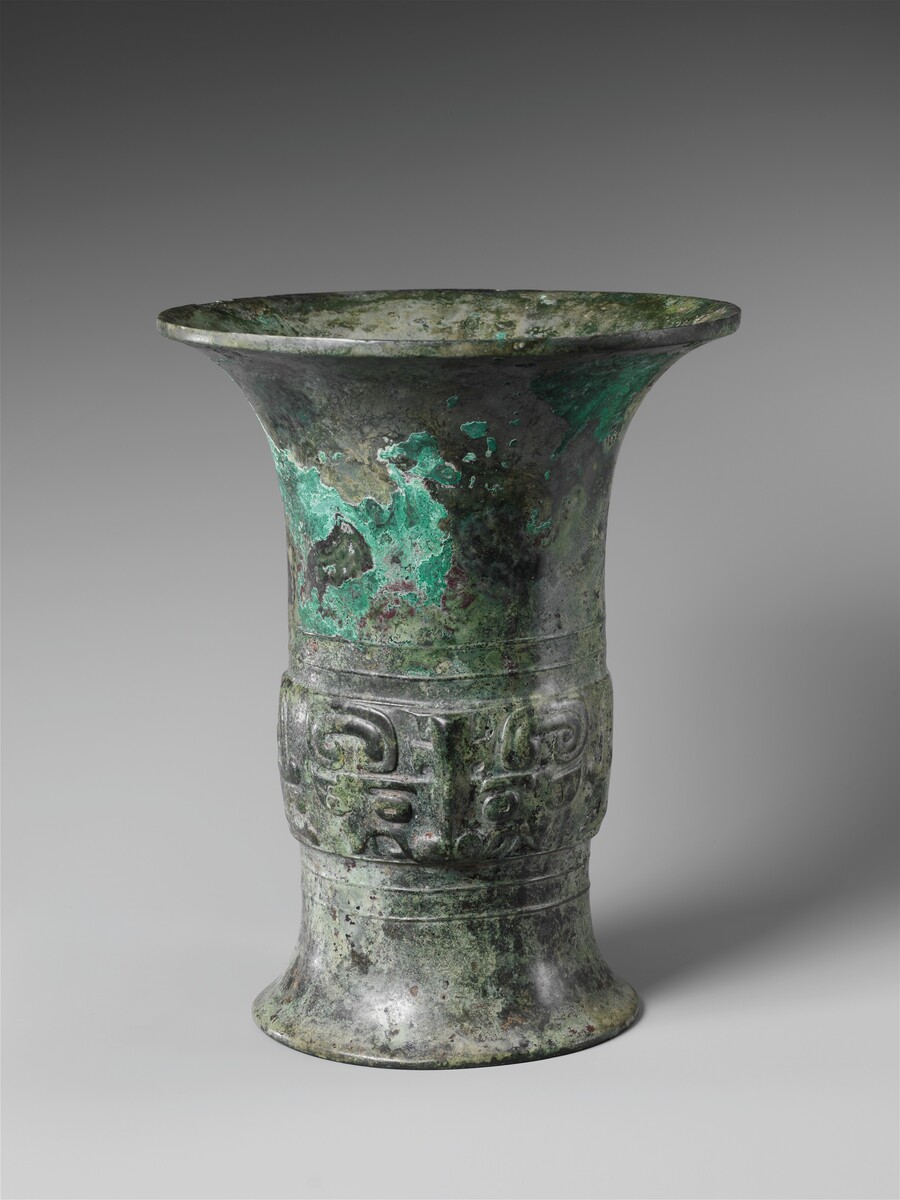
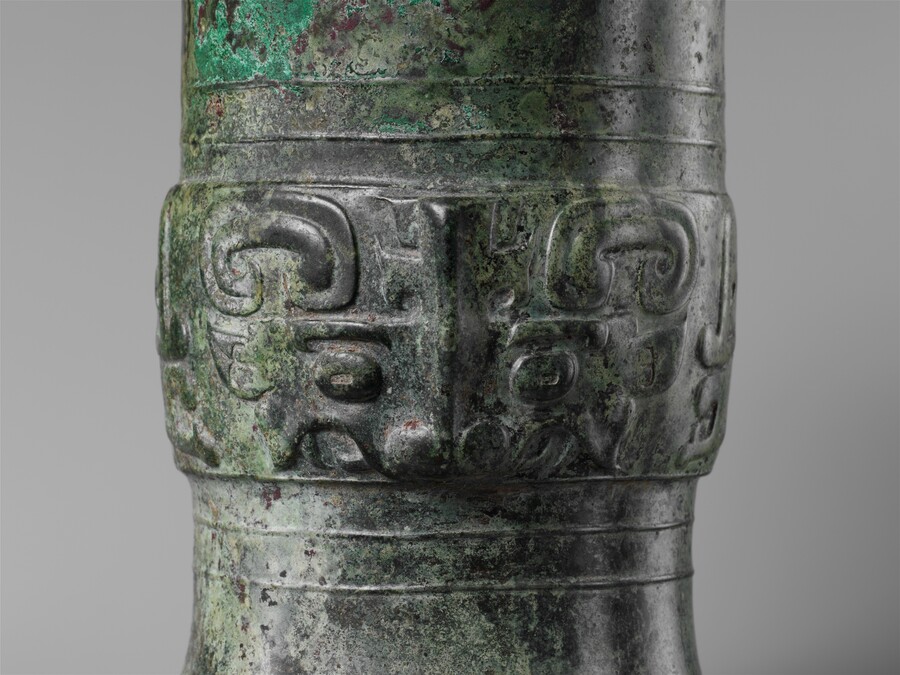
Ritual wine vessel zun with Taote mask. China, Shang–Western Zhou dynasties, 13th–10th centuries BCE. Bronze.
Bagley R. W. Ornament, Representation, and Imaginary Animals in Bronze Age China // Arts Asiatiques. — 2006. — Vol. 61. — P. 17–29. — DOI: 10.3406/arasi.2006.1636. — URL: https://www.persee.fr/doc/arasi_0004-3958_2006_num_61_1_1636 (Accessed: November 17, 2026).
Benskin E. The Art and Archaeology of Ancient China: A Teacher’s Guide / Freer Gallery of Art and Arthur M. Sackler Gallery, Smithsonian Institution. — Washington, 2003. — URL: https://asia-archive.si.edu/wp-content/uploads/2020/05/Art-and-Archaeology-of-Ancient-China.pdf (Accessed: November 17, 2026).
Ancient China: From the Neolithic Period to the Han Dynasty / Asian Art Museum, Education Department. — [n.d.]. — URL: https://education.asianart.org/wp-content/uploads/sites/6/2020/02/Ancient-China-Color-PDF-1.pdf (Accessed: November 17, 2026).
Department of Asian Art. Shang and Zhou Dynasties: The Bronze Age of China // Heilbrunn Timeline of Art History / The Metropolitan Museum of Art. — 2004. — URL: https://www.metmuseum.org/essays/shang-and-zhou-dynasties-the-bronze-age-of-china (Accessed: November 17, 2026).
Animals in Bronze // National Museum of Asian Art, Smithsonian Institution. — URL: https://asia-archive.si.edu/learn/ancient-chinese-bronzes/animals-in-bronze/ (Accessed: November 17, 2026).
Ancient Chinese Bronzes // National Museum of Asian Art, Smithsonian Institution. — URL: https://asia-archive.si.edu/learn/ancient-chinese-bronzes/ (Accessed: November 17, 2026).
Technology and Production — Ancient Chinese Bronzes // Teaching China with the Smithsonian / National Museum of Asian Art, Smithsonian Institution. — URL: https://asia-archive.si.edu/learn/for-educators/teaching-china-with-the-smithsonian/lesson-plans/technology-and-production-ancient-chinese-bronzes/ (Accessed: November 17, 2026).
Strahan D. Determining the Casting Process of a 3,000-Year-Old Bronze Elephant from China // Guidelines for the Technical Examination of Bronze Sculpture / J. Paul Getty Museum. — 2025. — Case Study 3. — URL: https://www.getty.edu/publications/bronze-guidelines/case-studies/3/ (Accessed: November 17, 2026).
Ritual Tripod Vessel (Ding) // Brooklyn Museum: Electronic Catalog. — URL: https://www.brooklynmuseum.org/ru-RU/objects/4304 (Accessed: November 17, 2026).
Ritual cauldron (li) with masks (taotie) and dragons // National Museum of Asian Art, Smithsonian Institution: Electronic Catalog. — Inv. No. S1987.64. — URL: https://www.si.edu/es/object/food-vessel-li:fsg_S1987.64 (Accessed: November 17, 2026).
Object from the British Museum collection, registration No. 1935,0115.21 // The British Museum: Electronic Catalog. — URL: https://www.britishmuseum.org/collection/object/A_1935-0115-21?selectedImageId=518392001 (Accessed: November 17, 2026).
Rectangular cauldron (fangding) // The Metropolitan Museum of Art: Electronic Catalog. — Inv. No. 49.135.2. — URL: https://www.metmuseum.org/art/collection/search/60594 (Accessed: November 17, 2026).
Ritual Water Container (Yu) // The Metropolitan Museum of Art: Electronic Catalog. — Inv. No. 23.17. — URL: https://www.metmuseum.org/art/collection/search/61117 (Accessed: November 17, 2026).
Ritual wine warmer (jue) with masks (taotie) // National Museum of Asian Art, Smithsonian Institution: Electronic Catalog. — Inv. No. S1987.53. — URL: https://asia.si.edu/explore-art-culture/collections/search/edanmdm:fsg_S1987.53/ (Accessed: November 17, 2026).
Wine beaker (gu) // The Metropolitan Museum of Art: Electronic Catalog. — Inv. No. 1985.214.4. — URL: https://www.metmuseum.org/art/collection/search/61322 (Accessed: November 17, 2026).
Ritual grain server (yu) with masks (taotie), dragons, and cicadas // National Museum of Asian Art, Smithsonian Institution: Electronic Catalog. — Inv. No. F1941.8. — URL: https://asia.si.edu/explore-art-culture/collections/search/edanmdm:fsg_F1941.8/ (Accessed: November 17, 2026).
Ritual tripod cauldron (Ding) // The Metropolitan Museum of Art: Electronic Catalog. — Inv. No. 49.135.10. — URL: https://www.metmuseum.org/art/collection/search/61239 (Accessed: November 17, 2026).
Ritual grain server (gui) with taotie and dragons // National Museum of Asian Art, Smithsonian Institution: Electronic Catalog. — Inv. No. F1968.29. — URL: https://asia.si.edu/explore-art-culture/collections/search/edanmdm:fsg_F1968.29/ (Accessed: November 17, 2026).
Square ritual food cauldron (fangding) with serpents and taotie // National Museum of Asian Art, Smithsonian Institution: Electronic Catalog. — Inv. No. F1950.7. — URL: https://asia.si.edu/explore-art-culture/collections/search/edanmdm:fsg_F1950.7/ (Accessed: November 17, 2026).
Ritual cauldron (ding) with masks (taotie) // National Museum of Asian Art, Smithsonian Institution: Electronic Catalog. — Inv. No. F1960.18. — URL: https://asia-archive.si.edu/object/F1960.18/ (Accessed: November 17, 2026).
Wine vessel (Zun) // The Metropolitan Museum of Art: Electronic Catalog. — Inv. No. 1985.214.6. — URL: https://www.metmuseum.org/art/collection/search/61323 (Accessed: November 17, 2026).
Tripod cauldron (Ding) // The Metropolitan Museum of Art: Electronic Catalog. — Inv. No. 43.27.2. — URL: https://www.metmuseum.org/art/collection/search/61224 (Accessed: November 17, 2026).
Tripod (Ding) // Cleveland Museum of Art: Electronic Catalog. — Inv. No. 2003.2. — URL: https://www.clevelandart.org/art/2003.2 (Accessed: November 17, 2026).
Wine Vessel (Fu Wu Zun) // Cleveland Museum of Art: Electronic Catalog. — Inv. No. 1938.13. — URL: https://www.clevelandart.org/art/1938.13 (Accessed: November 17, 2026).
Hollow-Legged Tripod (Li Ding) // Cleveland Museum of Art: Electronic Catalog. — Inv. No. 1961.203. — URL: https://www.clevelandart.org/art/1961.203 (Accessed: November 17, 2026).
Ritual wine container with handle (You) // The Metropolitan Museum of Art: Electronic Catalog. — URL: https://www.metmuseum.org/art/collection/search/44461 (Accessed: November 17, 2026).
Wine beaker (gu) // The Metropolitan Museum of Art: Electronic Catalog. — Inv. No. 1978.264.4. — URL: https://www.metmuseum.org/art/collection/search/53562 (Accessed: November 17, 2026).
Wine Vessel (Jia) // Cleveland Museum of Art: Electronic Catalog. — Inv. No. 2005.54. — URL: https://www.clevelandart.org/art/2005.54 (Accessed: November 17, 2026).
Ritual cauldron (ding) with masks (taotie) and cicadas // National Museum of Asian Art, Smithsonian Institution: Electronic Catalog. — Inv. No. F1946.31. — URL: https://asia.si.edu/explore-art-culture/collections/search/edanmdm:fsg_F1946.31/ (Accessed: November 17, 2026).
Wine Container (Pou) // The Metropolitan Museum of Art: Electronic Catalog. — Inv. No. 14.24.1. — URL: https://www.metmuseum.org/art/collection/search/61059 (Accessed: November 17, 2026).
Wine container (Pou) // The Metropolitan Museum of Art: Electronic Catalog. — URL: https://www.metmuseum.org/art/collection/search/52617 (Accessed: November 17, 2026).
Wine container (Hu) // The Metropolitan Museum of Art: Electronic Catalog. — Inv. No. 1988.20.4a, b. — URL: https://www.metmuseum.org/art/collection/search/44515 (Accessed: November 17, 2026).
Upright bell (nao) // The Metropolitan Museum of Art: Electronic Catalog. — Inv. No. 43.24.2a, b. — URL: https://www.metmuseum.org/art/collection/search/61220 (Accessed: November 17, 2026).
Ritual wine warmer (jia) with taotie and dragons // National Museum of Asian Art, Smithsonian Institution: Electronic Catalog. — Inv. No. S2012.9.571. — URL: https://www.si.edu/object/fsg_S2012.9.571 (Accessed: November 17, 2026).
Rectangular wine container (fangyi) // The Metropolitan Museum of Art: Electronic Catalog. — Inv. No. 1985.214.2. — URL: https://www.metmuseum.org/art/collection/search/61321 (Accessed: November 17, 2026).
Lidless Square Ritual Wine Container (Fangyi) with Masks and Dragons // Los Angeles County Museum of Art: Electronic Catalog. — Inv. No. AC1998.251.8. — URL: https://collections.lacma.org/object/85999 (Accessed: November 17, 2026).
Ritual Grain Server (Gui) with Masks, Dragons, Whorls, and Florets // Los Angeles County Museum of Art: Electronic Catalog. — Inv. No. M.75.111.2. — URL: https://collections.lacma.org/object/34872 (Accessed: November 17, 2026).
Ritual Wine Storage Jar (Zun) with Masks and Birds // Los Angeles County Museum of Art: Electronic Catalog. — Inv. No. 55.39. — URL: https://collections.lacma.org/object/18456 (Accessed: November 17, 2026).
Fragment of a Ritual Grain Steamer (Yan) with Masks // Los Angeles County Museum of Art: Electronic Catalog. — Inv. No. AC1998.251.40. — URL: https://collections.lacma.org/object/86075 (Accessed: November 17, 2026).
Wine warmer (Jue) // The Metropolitan Museum of Art: Electronic Catalog. — Inv. No. 49.135.15. — URL: https://www.metmuseum.org/art/collection/search/44775 (Accessed: November 17, 2026).
Rectangular wine container (fangyi) // The Metropolitan Museum of Art: Electronic Catalog. — Inv. No. 43.24.5a, b. — URL: https://www.metmuseum.org/art/collection/search/49398 (Accessed: November 17, 2026).
Ritual Wine Storage Jar (Zun) with Masks and Dragons // Los Angeles County Museum of Art: Electronic Catalog. — Inv. No. AC1998.251.16. — URL: https://collections.lacma.org/object/86076 (Accessed: November 17, 2026).
Lidded Square Ritual Wine Container (Fangyi) with Masks and Dragons // Los Angeles County Museum of Art: Electronic Catalog. — Inv. No. AC1998.251.36a–b. — URL: https://collections.lacma.org/object/86081 (Accessed: November 17, 2026).
Ritual Grain Steamer (Yan) with Masks // Los Angeles County Museum of Art: Electronic Catalog. — Inv. No. M.78.123.2. — URL: https://collections.lacma.org/object/31840 (Accessed: November 17, 2026).
Small Ritual Wine Warmer (Jue) with Masks // Los Angeles County Museum of Art: Electronic Catalog. — Inv. No. M.68.60.7. — URL: https://collections.lacma.org/object/26420 (Accessed: November 17, 2026).
Spouted vessel (he) in the form of an elephant with masks (taotie), dragons, and snakes // National Museum of Asian Art, Smithsonian Institution: Electronic Catalog. — Inv. No. F1936.6a–b. — URL: https://asia-archive.si.edu/object/F1936.6a-b/ (Accessed: November 17, 2026).
Ritual wine warmer (fangjia) with masks (taotie), dragons, birds, and cicadas // National Museum of Asian Art, Smithsonian Institution: Electronic Catalog. — Inv. No. F1935.12a–b. — URL: https://asia-archive.si.edu/object/F1935.12a-b/ (Accessed: November 17, 2026).
Ritual wine ewer (gong) with masks (taotie), dragons, and real animals // National Museum of Asian Art, Smithsonian Institution: Electronic Catalog. — Inv. No. F1939.53a–b. — URL: https://asia-archive.si.edu/object/F1939.53a-b/ (Accessed: November 17, 2026).
Ritual wine container (you) in the form of two owls with masks (taotie), dragons, and birds // National Museum of Asian Art, Smithsonian Institution: Electronic Catalog. — Inv. No. F1942.14a–b. — URL: https://asia-archive.si.edu/object/F1942.14a-b/ (Accessed: November 17, 2026).
Ritual wine container (hu) with masks (taotie) and dragons // National Museum of Asian Art, Smithsonian Institution: Electronic Catalog. — Inv. No. F1948.1. — URL: https://asia-archive.si.edu/object/F1948.1/ (Accessed: November 17, 2026).
Square lidded wine ewer (fangguang) with taotie, dragons, and birds // National Museum of Asian Art, Smithsonian Institution: Electronic Catalog. — Inv. No. F1949.10a–b. — URL: https://asia-archive.si.edu/object/F1949.10a-b/ (Accessed: November 17, 2026).
Ritual wine container (fangyi) with masks (taotie) and dragons // National Museum of Asian Art, Smithsonian Institution: Electronic Catalog. — Inv. No. F1954.13. — URL: https://asia-archive.si.edu/object/F1954.13/ (Accessed: November 17, 2026).
Rectangular wine container (fangyi) // The Metropolitan Museum of Art: Electronic Catalog. — Inv. No. 1974.268.2a, b. — URL: https://www.metmuseum.org/art/collection/search/44776 (Accessed: November 17, 2026).
Axe with masks (taotie) // National Museum of Asian Art, Smithsonian Institution: Electronic Catalog. — Inv. No. F1934.10. — URL: https://asia-archive.si.edu/object/F1934.10/ (Accessed: November 17, 2026).
Dagger-axe (ge 戈) with masks (taotie) and dragons // National Museum of Asian Art, Smithsonian Institution: Electronic Catalog. — Inv. No. F1940.10a–e. — URL: https://asia-archive.si.edu/object/F1940.10a-e/ (Accessed: November 17, 2026).
Suspension bell with masks (taotie) and birds // National Museum of Asian Art, Smithsonian Institution: Electronic Catalog. — Inv. No. S1987.10. — URL: https://www.si.edu/object/suspension-bell-masks-taotie-and-birds:fsg_S1987.10 (Accessed: November 17, 2026).
Ritual water basin // National Museum of Asian Art, Smithsonian Institution: Electronic Catalog. — Inv. No. S1987.316. — URL: https://asia-archive.si.edu/object/S1987.316/ (Accessed: November 17, 2026).
Ritual grain server (gui) with square base and masks, dragons, and birds // National Museum of Asian Art, Smithsonian Institution: Electronic Catalog. — Inv. No. F1938.20. — URL: https://asia-archive.si.edu/object/F1938.20/ (Accessed: November 17, 2026).
Container (bu) with masks (taotie), dragons, and waterfowl // National Museum of Asian Art, Smithsonian Institution: Electronic Catalog. — Inv. No. F1913.30a–b. — URL: https://asia-archive.si.edu/object/F1913.30a-b/ (Accessed: November 17, 2026).
Ritual wine