Navigator
- Concept
- The Face as a Fixed Form in the Early 20th Century
- The Fragmentation of a Unified View of Reality
- Cubism and the Deconstruction of the Human Face
- Expressionism: The Face as a State of Being
- The Post-War Shift in the Image of Humanity
- The Face as an Unstable Image
- Portraiture as Assembly
- Image as Interpretation
- Conclusion
- Bibliography
- Image Sources
Concept
The visual study examines how the depiction of the human face evolves in 20th and 21st-century art. Interest in this topic stems from the fact that the portrait, as one of the most enduring genres, is gradually ceasing to be a means of precisely describing physical appearance. In contemporary art, the face is increasingly perceived not as a fixed form, but as a dynamic image capable of manifesting emotional states, perceptions, and various levels of identity.
The research material is organized around the principle of the face image’s gradual transformation—moving from the more composed and recognizable portraits of the early 20th century to works where form becomes less stable—dissolving, distorting, or losing sharp boundaries. The goal here is not merely to illustrate stylistic shifts, but to trace how the very function of the portrait changes over time.
The structure of this work follows a progression: the face is first understood as a form, then as a state, and finally as a means of organizing meaning. Each stage is connected to the previous not by a change in direction, but by the necessity of a new approach as the old method of depiction gradually ceases to function. Therefore, changes in the portrait can be viewed as a continuous process rather than a collection of discrete artistic movements.
Sources include the visual and artistic practices of the 20th and 21st centuries, as well as the artists' own statements, which reveal shifts in their attitude toward representing the human figure. Theoretical texts are used only as a backdrop to help better interpret what is occurring in the visual material, not as the primary foundation.
The central question of this research is how the function of the face image in 20th and 21st-century art changes, and why the portrait is progressively moving away from the task of accurately reproducing appearance.
The hypothesis is that the depiction of the face is gradually shifting away from describing physical appearance and beginning to function as a mechanism for assembling meaning. In this process, the face ceases to be a fixed object and becomes a dynamic structure through which human perception, state, and ways of seeing are revealed.
The Face as a Fixed Form in the Early 20th Century
In the early 20th century, portraiture still relied on the notion that the face could be fixed as a stable form. Even in cases of stylization or simplification, the basic logic remained: the image must allow the viewer to recognize the person. This means that portraiture at that time was still tied to the idea of stable identity—appearance and personality were perceived as mutually corresponding elements.
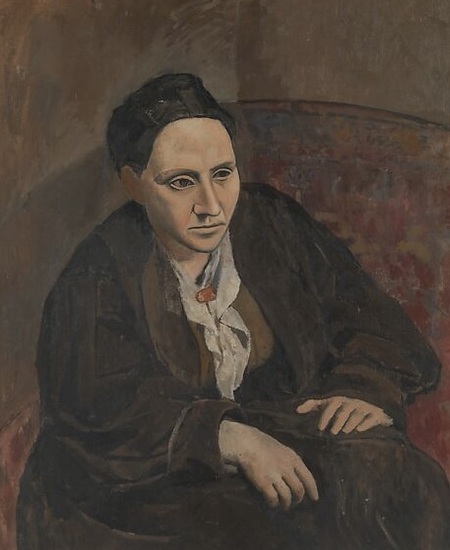
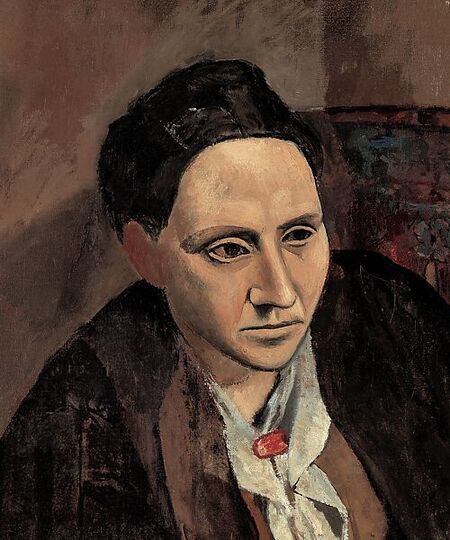
Pablo Picasso, «Gertrude Stein, ” 1905–1906
Henri Matisse, «Woman in Green,» 1909
Valentin Serov, «Portrait of Ida Rubinstein,» 1910
Gustav Klimt, «Medusa of Primavera, ” 1912.
It is important to note that here the image serves not only an artistic but also an almost «verifying» function: it documents the existence of a specific person through their outward appearance. Therefore, even when the artistic language changes, the fundamental task of the portrait remains the same—to preserve recognizability.
The dissolution of a single view of reality
What changes next is not so much painting as the very way reality is perceived. It stops being a single, stable object of observation. The same object can be perceived from different viewpoints, and none of them is the «main» one.
Pablo Picasso, «Portrait of Daniel-Henri Canville, ” 1910.
Gino Severini, «Self-Portrait, ” 1912
Pablo Picasso, «Bullfighter, ” 1912
This is precisely what causes the portrait to lose its cohesion. If there is no singular way to perceive an object, the image no longer needs to fix one stable form. The face begins to fragment not as an artistic technique, but as a consequence of a shift in visual thought itself.
Cubism and the Deconstruction of the Human Face
In Cubism, this process becomes visually evident.
Albert Gleizes, «Portrait of Igor Stravinsky,» 1914.
The face ceases to exist as a unified surface and begins to assemble from multiple viewpoints simultaneously. This is not an attempt to «distort» the form, but rather an effort to show that an object cannot be perceived entirely from a single perspective.
Albert Glezes, «Portrait of Igor Stravinsky, ” 1914
Juan Gris, «Harlequin with Guitar, ” 1919.
Thus, the image ceases to be a copy of reality. It becomes a construction that assembles different fragments of perception into a single form. The reason for this shift is a change in the logic of vision itself: the world stops being static and becomes manifold.
Expressionism: The Face as a State of Being
The next stage involves a shift in focus from external appearance to the inner state of a person. However, this state is not a fixed structure—it is constantly changing and cannot be held in a stable form.
Max Beckmann, «Self-Portrait with Cigarette,» 1923.
Max Beckmann, «Self-Portrait Before a Red Curtain, ” 1923.
Because of this, the image begins to lose its neutrality. It becomes more tense, sometimes distorted. What is important is that this deformation is not an end in itself—it arises as the only way to convey what cannot be expressed through a calm and stable form.
The Post-War Shift in the Human Image