Rationale for the Topic:
When discussing the funerary reliefs of Palmyra, the focus is typically on the portrait: the face, hairstyle, clothing, gestures, and inscription. The fabric behind the figure remains secondary, even though on many reliefs it is stretched and secured to supports. This study examines how this fabric backdrop, the dorsarium, constructs the image and highlights the figure. It is not assigned any pre-existing symbolic meaning.
Rationale for material selection:
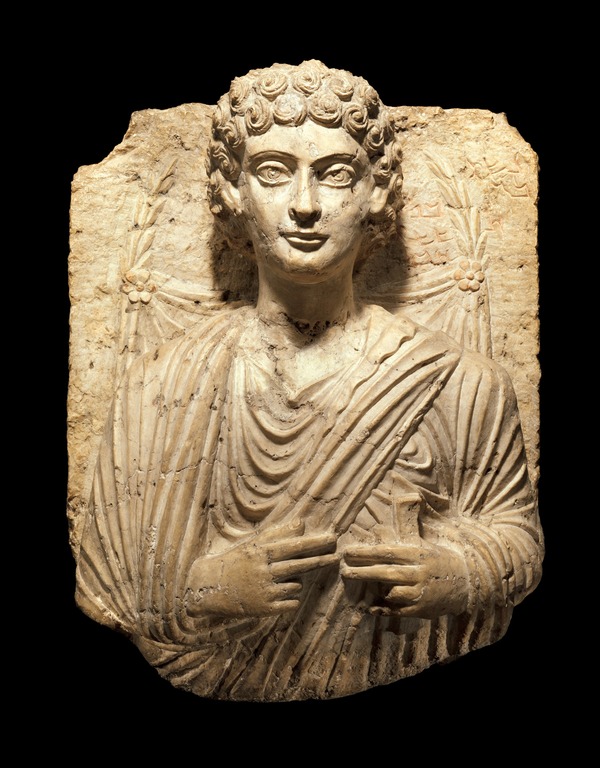
All the selected reliefs are made of limestone; these are tombstones from Palmyra, and almost all of them feature drapery behind the figure. The drapery is rendered differently in each case: in some, it is stretched taut between circular fasteners; in others, it is connected to curved branches; and in some, it is only partially preserved. This allows for easy comparison between the reliefs. Here, the drapery is considered an element of the relief itself, without a predetermined symbolic meaning. This enables one to observe how it is depicted on different monuments and to verify what conclusions can be drawn when comparing the image with museum data. The comparison shows not only whether the motif is present, but also how it is constructed.
Material Categorization Principle:
The material is analyzed based on individual monuments, and then these monuments are compared according to several criteria: 1) the shape and positioning of the fabric; 2) attachment methods; 3) the direction and rhythm of the folds; 4) the relationship of the fabric to the contour of the head and shoulders; 5) the role of branches and fasteners; and 6) the preservation of the surface and possible pigment traces. In every instance, the description of what is visible is separated from interpretation.
Principles for Selecting Textual Sources:
Primary sources include museum collection catalogs, which detail the date, material, provenance, and description of the composition. These sources allow for verification of what is visible on the relief, preventing reliance on symbolic interpretations without confirmation. For broader context, I consulted Nicola Barham’s research on the form of burial reliefs and the catalog of Palmyrene burial portraits from the Vatican Museums.
Key Question:
How does the drapery following the figure, the dorsalium, construct the composition of Palmyrene funerary reliefs from the 1st–3rd centuries CE, and what visual elements connect it to the portrait of the deceased?
Hypothesis:
Presumably, in busts, the fabric forms a frame around the head, while in full-figure reliefs, it runs along the entire figure, emphasizing that the person is standing. In both cases, it directs the viewer’s gaze and connects the portrait with the other details of the relief. Moreover, how the fabric is depicted may simply depend on the monument’s size or its state of preservation. Therefore, the mere presence of a dorsalium is insufficient to assert a particular symbolic meaning.
Area of Study:
Visual Culture and Burial Sculpture of Palmyra. The subject of study is the formal role of the fabric backing, its attachments, and its folds within the composition of the funerary portrait.
Time and geographical scope of the research:
Palmyra, Syria, 1st–3rd centuries CE. The bulk of the comparison consists of monuments from the 1st–2nd centuries CE. One of the Metropolitan Museum of Art’s objects dates to approximately 172 CE, and the relief from the Kunsthistorisches Museum is attributed to the first half of the 1st century CE.
Research Question:
What dorsalium imagery techniques are repeated, and how do these design choices alter the impression of the figure across different gravestones?
Goal:
To identify and compare the ways the textile background is depicted on specific funerary reliefs from Palmyra, to determine its compositional functions, and to ascertain what conclusions about its significance are supported by visual and museum data.
Objectives:
1. Determine the dating, material, function, and museum history of each artifact.
2. Describe the fabric’s form, folds, edges, and attachment points.
3. Examine how the dorsalium relates to the figure’s head, shoulders, clothing, and gestures.
4. Compare the fabric on disc fasteners with the fabric associated with plant branches.
5. Note how damage and loss constrain visual analysis.
6. Compare the objects and test the hypothesis, separating observation from assumptions about symbolic meaning.
Introduction
Palmyra was a major city in Syria, situated along the trade routes connecting the Middle East and the Mediterranean. During the first three centuries CE, large stone funerary reliefs were widely created to cover niches in private and communal tombs. These reliefs depicted the deceased as busts or full-figure statues, often accompanied by an inscription detailing the person’s name, origins, and familial connections. Such a relief served as a memorial to the deceased while simultaneously presenting their likeness to visitors entering the tomb. Usually, viewers focus on the figure itself—the frontal pose, large eyes, hairstyle, clothing, and items held in the hands. However, behind the portrait, there is often a dorsarium—a depicted fabric stretched between fixtures or hung from vegetative supports. Museum descriptions refer to this as draped cloth. This raises the question of how this fabric is integrated into the composition and why its edges and fastenings are depicted with such precision.
Here, the dorsalium is considered the visible part of the relief. One should examine not only the folds but also the geometry of the entire composition: the fabric forms a surface behind the figure, its edges define the space around the head and shoulders, the fastenings connect it to the side elements, and the branches may extend the frame beyond the fabric. This allows one to describe the external characteristics of the drapery without predetermining what it symbolizes.
Four main monuments were selected from museum collections for the work, along with two additional examples for comparison. It is convenient that major museums have catalogs where one can verify dating and descriptions. Since the reliefs are not completely preserved and are eroded in places, when discussing the original appearance of the fabric, the condition of the stone must be taken into account.
Analysis Method
Objects are analyzed in a consistent order: first the catalog data, followed by a description of what is visible on the relief, and only then the interpretation. The description includes the fabric’s position relative to the figure, the shape of its edges, the direction of the folds, the method of attachment, and surrounding elements. The interpretation is verified by comparing it with other artifacts. If the museum itself provides information on the fabric’s attachment, pigment, or damage, it is indicated with a source citation. If an element’s significance is inferred from its placement on the relief, it is marked as an analytical hypothesis.
Object 1. Burial Relief of Zabda’ate. Circa 150–200 CE.
Metropolitan Museum. Sepulchral relief from Zabda’ate. Circa 150–200 CE. Limestone. Inv. No. 98.19.2.
According to the Metropolitan Museum of Art’s description, the relief depicts the upper body of a bearded man. The figure projects strongly from the stone and gazes directly at the viewer. The face dominates the center, but there is another noticeable detail behind him: fabric fastened to leafy branches. An inscription in Palmyrene Aramaic names the deceased, his father, and the brother who commissioned the monument. The relief is dated to approximately 150–200 CE.