Categories
(1) Concept (2) Proximity Without Words (3) Pause and Awkwardness (4) Space and Distance (5) Bodily Intimacy Without Harmony (6) Conclusion (7) Bibliography (8) Image Sources
(1) Concept
What if we hypothesize that in European cinema of the latter half of the 20th century and the beginning of the 21st century, intimacy is most often born not in the moment of confession or dialogue—as is typically the case—but in those seconds when speech is interrupted, delayed, loses its conviction, or proves simply superfluous?
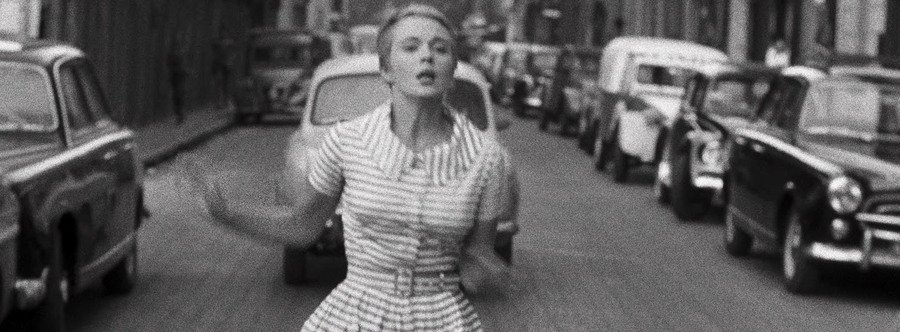
«In the Last Gasp.» Jean-Luc Godard. 1960
In this paradigm, closeness is shaped through pauses, gazes, the arrangement of bodies in the frame, the distance between them, and the ways the film organizes space and time. This logic can be appropriately examined through several complementary approaches. For instance, silence—which is almost never absolute in cinema—sharply stimulates the perception of sound. A close-up shot, emphasizing moments of affect, conveys more information through facial expression than through words. At the same time, distance itself functions as a form containing important information.
The films chosen for analysis vividly confirm this, as they bring together diverse national traditions and historical modes of representation: Fellini’s Italian post-war humanism, Godard’s French New Wave, Hitelová's Czech New Wave, Kęsylewski’s late-socialist Polish cinema, Mike Leigh’s British social realism, and Corneliu Porumboiu’s Romanian New Wave.
The key research question can be formulated as follows: what visual means does European cinema use to make proximity palpable where words fail?
In this study, the hypothesis is formulated as follows: the less a film relies on explanatory dialogue, the more its organizational structure carries emotional weight. In other words, intimacy in such films does not precede form; it is created by it. This hypothesis is particularly relevant to European cinema, where speech often functions as a social mask, an ideological ritual, or empty automatism.
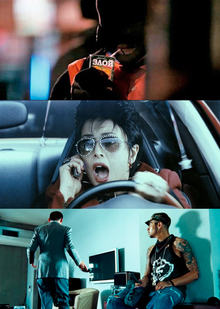
The principle behind material selection in this context is extremely deliberate. I decided to move away from well-known films about feelings and instead focus on projects where cinematic language conflicts with traditional drama of revelation. The films «Nights of Cabiria» and «Breathless» illustrate how the modernist camera transforms emotion into facial expression and pause. The film «Marguerite» shows how togetherness can be edited as both a physical game and a disintegration. The film «The Incident» is interesting because it pauses the structure of fate. «Naked» portrays intimacy as a painful remnant following speech and violence. «12:08 East of Bucharest» pushes to the limit the situation where people talk extensively but become extremely vulnerable in moments of silence. The film «The Incident» is crucial for analysis because it shifts the question of closeness from a moment of romance to the characters' indecision, the collision of life choices, and the body’s uncertainty in the face of choice.
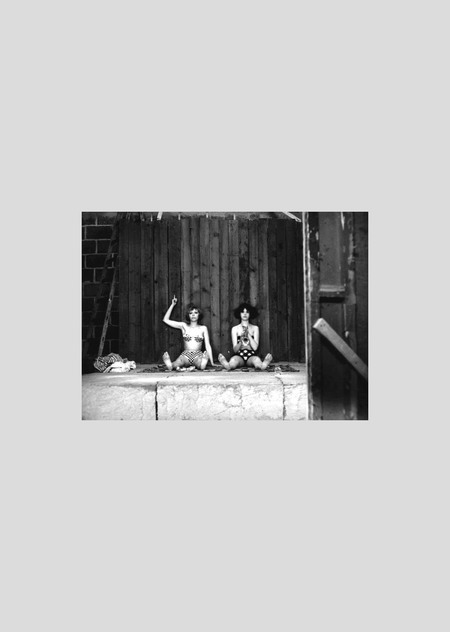
«Margarets.» Vera Khitilova. 1966
The principle of rubrication is defined by the diversity of intimacy in cinema, including aspects such as silence, pause, distance, and physical closeness. Each chapter presents a brief comparative analysis, which is significant because the study is not a substitute for a monograph on each film, but rather focuses on moments where form reveals the overarching issue. This structure helps to avoid mere recitation and maintains the author’s perspective, as I am interested in how the film allows the viewer to experience uncertain, fragile, and sometimes painful intimacy.
When working with textual materials, the primary guide is the critical and analytical writings of leading film institutions and academic publications. The main body of sources consists of reviews and analytical articles published in specialized cinema journals and on film industry platforms.
(2) Intimacy Without Words
Cinematic silence is not emptiness; it is a focus on perception. Silence in European cinema should be viewed as a moment when attention shifts from dialogue to gestures, facial expressions, and space. Intimacy arises in such scenes because the film encourages the viewer to linger in their shared time.
«12:08 AM Eastern Bucharest Time»
«12:08 East of Bucharest.» Corneliu Porumboiu. 2006
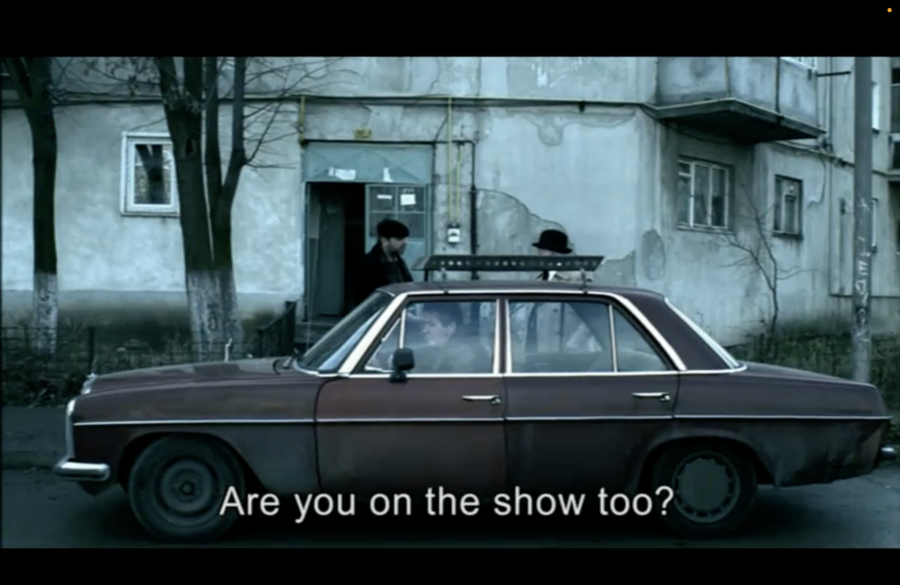
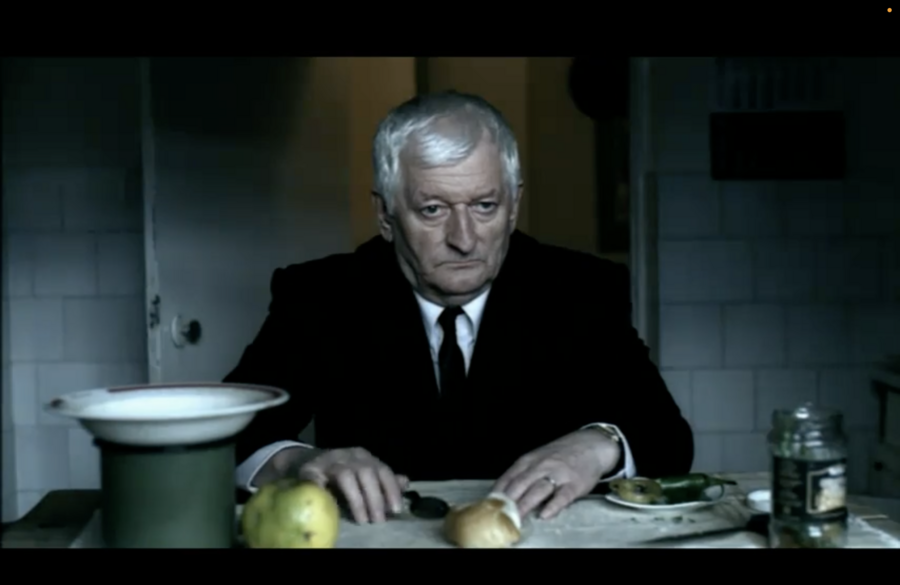
«12:08 East of Bucharest.» Corneliu Porumboiu. 2006
At first glance, the film Porumbo may seem like a poor example for this chapter because it is saturated with diverse everyday communications. However, it is precisely this that makes it so valuable. Porumbo illustrates a world where speech is reduced to artificially scripted lines. For instance, the host of a local channel attempts to turn the anniversary of the revolution into a clear public ritual of memory, but every new voice only deepens the ambiguity of the events. The film was inspired by a real television program that Porumbo watched—one that initially struck him as funny but later became irritating—and the director himself stated that he wanted to recreate this shift from the comedic to the aggressive.
«12:08 East of Bucharest.» Corneliu Porumboiu. 2006
Visually, the film is constructed so that the lapses in speech become the central focus of attention. The second part of the film unfolds almost entirely in a cheap, dilapidated local television studio. Porumbao establishes strict formal boundaries and maintains a static camera, occasionally yielding only to the movement of the television camera itself, which trembles. The viewer observes not only the characters’ words but also how poorly they handle the situation—how their thoughts become disjointed, how they lose the thread of conversation, how they wait for calls, how they sit together under light that does not protect them but only emphasizes their vulnerability. Intimacy takes on a civic quality, as the three men are bound by a shared public defenselessness rather than by a shared worldview.
«12:08 East of Bucharest.» Corneliu Porumboiu. 2006
«12:08 East of Bucharest.» Corneliu Porumboiu. 2006
«12:08 East of Bucharest.» Corneliu Porumboiu. 2006
It is important that the first half of the film shows these individuals alone, performing mundane and slightly humiliating rituals of the pre-New Year’s Eve, and only then do they gather in the studio. Therefore, the tele-discussion functions as a peculiar form of intimacy, where the forced shared presence in front of the camera—where every silence proves more honest than any word—becomes apparent. When viewer calls transform the conversation into an exposé, words disintegrate, and in that awkwardness, the human fragility of each participant is revealed. The film is funny precisely because underlying the laughter is a shared helplessness.
«On the Last Breath»
«Breathless.» Jean-Luc Godard. 1960
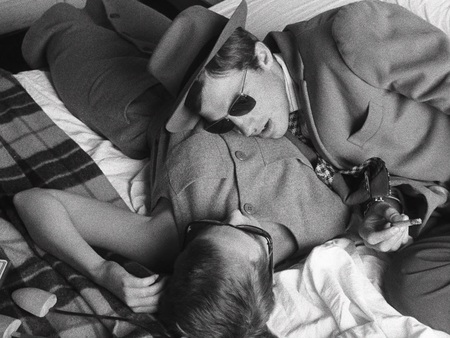
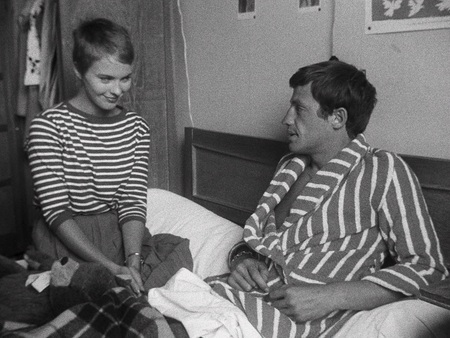
«Last Breath.» Jean-Luc Godard. 1960
For Porumboy, speech fades into awkward emptiness, while for Godard, it settles into rhythm. In the film Breathless, one must observe how words cease to be the central event of the frame. One of the film’s key scenes is the long episode in the cramped room of the Hôtel de Suède, which, instead of featuring a chase or accelerating the plot, traps Michel and Patricia in a small space and dedicates itself to the time passing between two people. In other words, intimacy arises here from the very fact of shared time.
«Last Breath.» Jean-Luc Godard. 1960
This is a scene of nonverbal intimacy. Patricia lights a cigarette; Michelle moves endlessly, sprawls on the bed, looks, approaches, and retreats. Speech becomes as much background noise as it is content, but the emotional meaning is conveyed through tempo, micro-gestures, the pauses between lines, and how the bodies do not align yet remain within the same confined space. This holds true even when they discuss love, death, journalism, or the future. Here, the film insists not on the meaning of the statements, but rather on the fact of the characters' shared existence within the frame. In this sense, the scene is highly cinematic because it renders the experience of closeness into an act of continuous observation.
«Breathless.» Jean-Luc Godard. 1960
Another important point is the cinema scene of the kiss, where Michelle and Patricia tenderly kiss against the backdrop of another film’s sound, but instead of a natural auditory coincidence, an external poetic voice emerges. This directorial choice makes the intimacy quite autonomous in relation to public space. Closeness happens within the noise, yet it does not dissolve into it. This is one of the key gestures of European modernism, where feeling is carved out of social and acoustic chaos as something fragile and ephemeral.