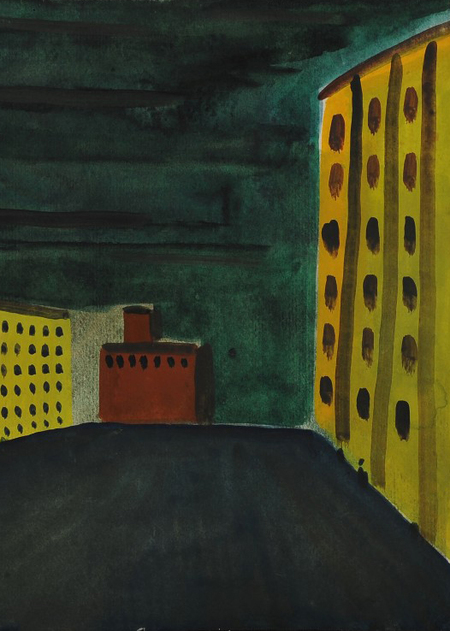
Concept
Comparing Giorgio de Chirico and the artists of the «Arefyev circle» is not straightforward: half a century, a thousand kilometers, and fundamentally different historical and artistic contexts separate them. My choice of this topic stems from a personal interest in the work of the Arefyev circle. During a course on irrational modernism, I was inevitably drawn to a parallel between these artists and Giorgio de Chirico—a precursor to Surrealism and a leading figure in early twentieth-century metaphysical painting. I was captivated by a similar sense of tension in the artists' works and the resemblance of their representational techniques, which prompted this study. The goal of this visual investigation is to identify the characteristics of Giorgio de Chirico’s poetics within the works of the Arefyev circle and to attempt to explain them.
Are there elements of Giorgio de Chirico’s poetics in the work of the Arefyev circle? How might these be substantiated?
During the research, I uncovered several contextual parallels that help explain the similarity in the artists' visual languages. Furthermore, I discovered certain imagery and motifs that appear in both De Chirico’s and the Arefyev artists' work. Some of these themes—the depiction of the city and the human figure—allowed me to logically divide the study into two parts.
Let’s delve into the context.
Giorgio de Chirico—a leading proponent and ideologue of metaphysical painting—worked in Italy, France, and Germany, with his artistic zenith occurring in the early twentieth century. His works are charged with internal tension and anxiety; they are mysterious and virtually indecipherable. The artistic space the artist creates is absolutely unique, and his poetics are characterized by the following features. In de Chirico’s world, humanity is either entirely absent or present in a completely non-human form, generating a sense of solitude and isolation. The world in his works seems desolate and evokes a feeling of alienation. Time appears nonexistent; everything seems motionless, frozen, yet imbued with energy—it seems nothing is happening, but every object, every shadow conceals an unsolved mystery. Beneath the visible stillness lies an intense inner life of things—their «metaphysical essence"—which the artist strives to expose by stripping reality of its conventional temporal connections.
Giorgio de Chirico witnessed several major wars throughout his life. In his memoirs, he writes: «I became a witness to a vast number of terrible, sorrowful, burdensome, sometimes repulsive events, similar to those I observed, only magnified tenfold, several years later, during the First, and later the Second, World War.» Undoubtedly, these events profoundly traumatized the artist, allowing the sense of tension, emptiness, and alienation in his work to be interpreted as a consequence of the war he experienced.
The Arefyev Circle—also known as the «Order of Unsold Painters”—was a group of unofficial Leningrad artists who organized themselves in the late 1940s when its members—Alexander Arefyev, Richard Vasmi, Sholom Schwartz, Vladimir Shagin, and Valentin Gromov—were between 14 and 16 years old. Born in the 1930s, the Arefyev artists survived the Great Patriotic War and witnessed its horror firsthand. This undoubtedly traumatic experience, and the postwar world in which they were forced to live, arguably became the primary factor in shaping their artistic approach. The artists saw and felt the devastation, poverty, and cruelty of their surrounding reality, and they wanted to speak honestly about it; this is why their work is imbued with such vital energy and truth. While these artists possessed a keen sensitivity to beauty and recognized the inherent beauty of their city, they were also able to perceive and wished to capture the hidden, non-parade beauty of Petersburg-Leningrad, all while adhering to the core principle—artistic truth.
«We always tried to choose an object of observation that, in itself, would induce a certain tension through the unusual perception of an elusive subject» (Alexander Arefyev)
In the lives of Giorgio de Chirico and the artists of the «Arefyev Circle, ” certain similarities can be observed that help explain the resemblance in their visual languages. First, the military and post-war context is crucial: for de Chirico, the World Wars—the First and Second—were turning points in his life; for the Arefyev circle, the Great Patriotic War was that pivotal event. From this military trauma emerges a desire to speak the truth—to portray the tension and pain the artists felt. Second, the theme of isolation seems significant: Giorgio de Chirico felt loneliness within his ideas, considering himself a „fighter“ against Modernism. He did not share the prevailing contemporary ideas, which set him apart from his contemporaries. Similarly, the Arefyev artists perceived their mission as opposing official art, which they believed failed to depict reality.
«In truth, I had to fight alone. And still today, I fight alone in the wilderness of art. This arena is not as dangerous as a battlefield, but winning on it is significantly harder, because it is much easier to win a dozen battles using stones, cannons, and atomic bombs than it is to paint a good picture» (Giorgio de Chirico)
The material consists of works by De Chirico, primarily from his «metaphysical period”—especially the series „Italian Squares, ” „Towers, ” and „Mannequins”—as well as the painting and graphics of the „Arefyev Circle“ from the 1950s–1990s, which most vividly reflect the artists' style. The main selection criterion is the presence of common visual themes, subject matter, and artistic techniques across the authors’ works.
The textual sources were chosen based on the reliability and authority of the authors; therefore, George de Chirico’s autobiography was used to analyze his creative work, and my study of the „Arefyev Circle“ art was based on an article by the renowned historian of unsanctioned art from St. Petersburg, Ekaterina Andreevskaya.
Categories
- City
- Human
City
The sense of the city in the artists' works is largely similar—it is portrayed as a space that, while resembling the familiar world, possesses entirely different properties that are simultaneously captivating and repellent. In both De Chirico’s work and that of the Arefyev artists, the city is mystical and enigmatic; people or any transportation (other than the stationary train in De Chirico’s pieces, which only raises more questions) are almost always absent, creating a feeling of deafening silence and anxiety. For these artists, the city is a space that exists independently of humanity, and the presence of a person there seems unnatural and anomalous.
Giorgio de Chirico, «Montparnasse Station (Melancholy of Departure),» 1914
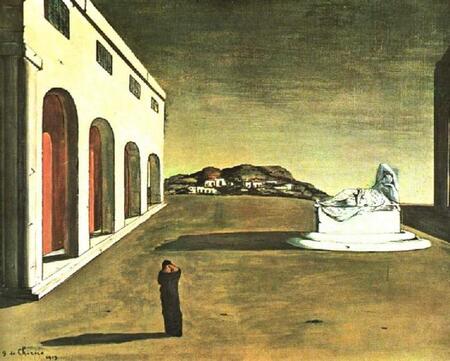
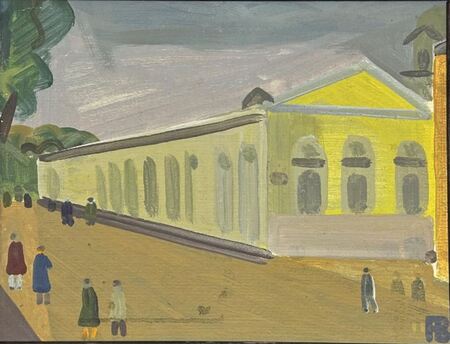
Giorgio de Chirico, «Melancholy of a Beautiful Day,» 1913 / Richard Vasmy, «Manege,» 1994
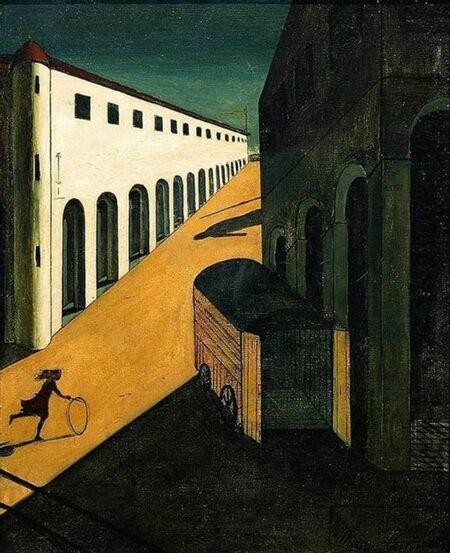
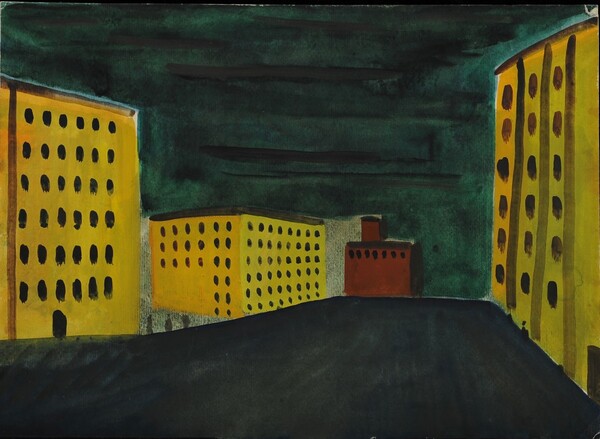
Giorgio de Chirico, «Mystery and Melancholy of the Street,» 1914 / Richard Baumeister, «Yellow Houses,» early 1960s
The frequent repetition of identical objects in artists' work is fascinating: for Giorgio de Chirico, it is arches, columns, and sculptures that repeat from one painting to the next; for the Arefyev group, it is identical «box houses,» rivers, and canals, and solitary trees. This rhythm evokes a feeling of tension and cyclical entrapment, creating the impression that escape from these worlds is utterly impossible.
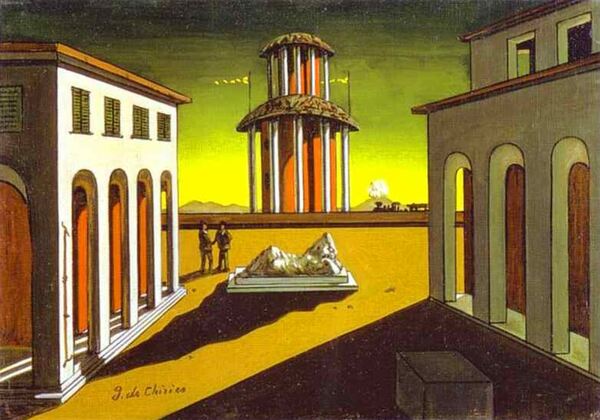
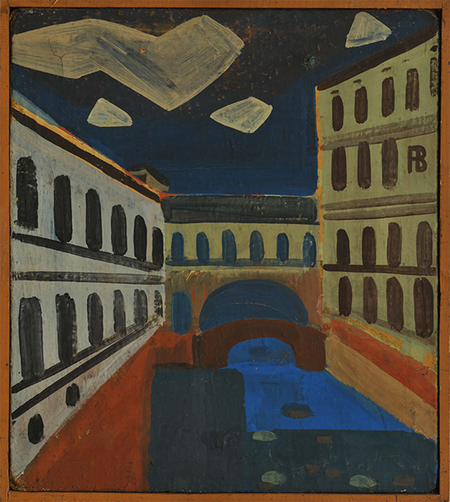
Giorgio de Chirico, «Piazza d’Italia,» 1913 / Richard Diebenkorn, «Winter Green,» 1964
«The embankments, tram tracks, houses, barges, and steamships painted by Vasmy in multitude often look as if they are situated above or floating not on the Neva, but on the Leto. Beyond the firewall, beyond the coastal strip bordered by granite or asphalt, Vasmy’s paintings evoke a metaphysical transcendence» (Ekaterina Andreeva, 2011)
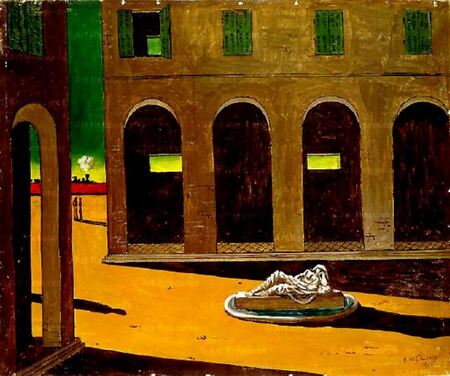
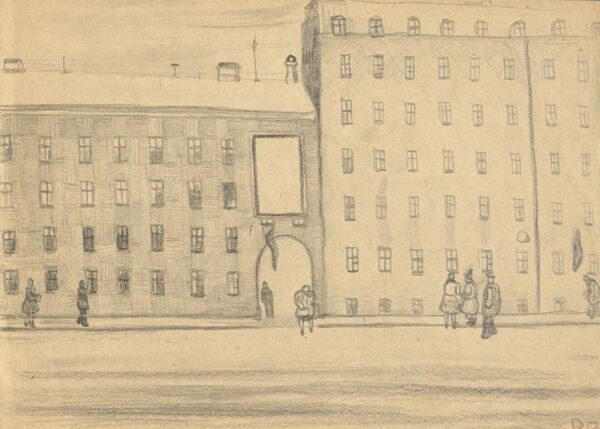
Giorgio de Chirico, «Piazza d’Italia,» 1912 / Richard Baume, «Two Multi-story Houses Adorned with Flags,» 1953
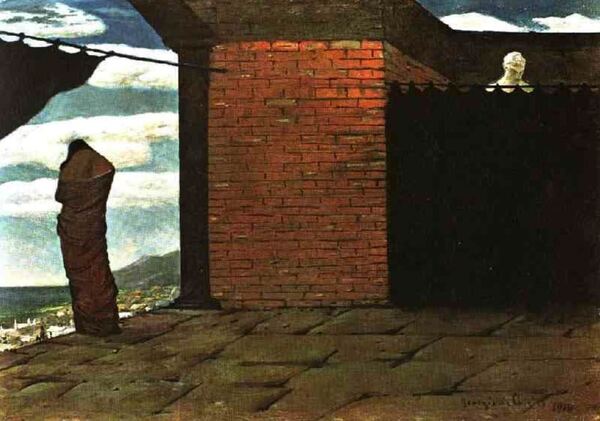
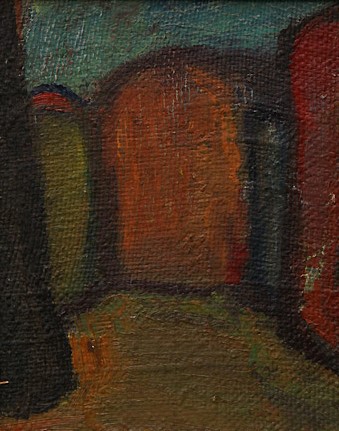
Giorgio de Chirico, «The Oracle’s Enigma, ” 1910 / Shlomo Schwartz, Untitled, 1950s
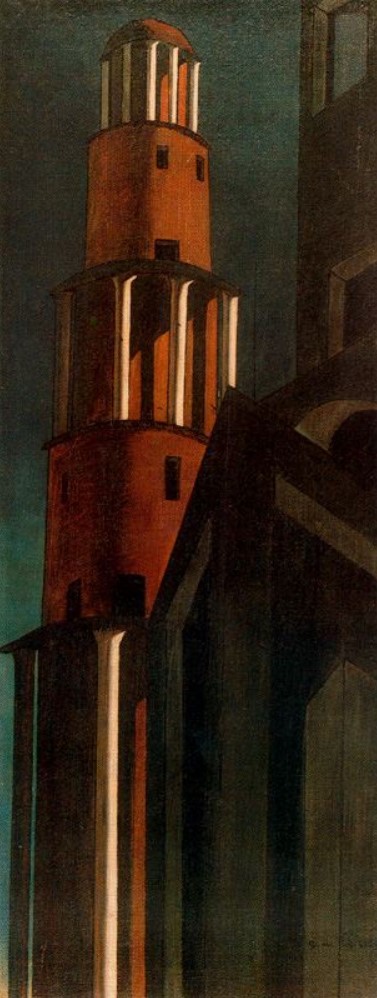
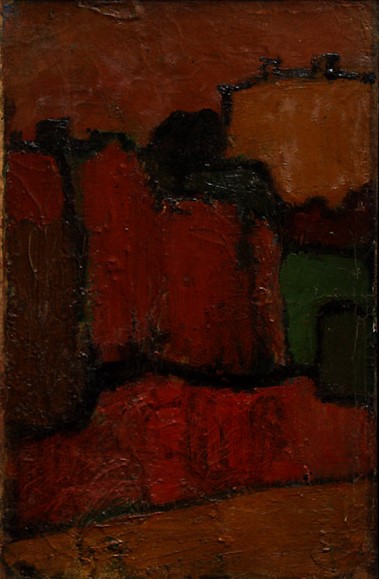
Giorgio de Chirico, «The Tower, ” 1913 / Shlomo Schwartz, Untitled, 1950s
A notable technique involves a strong distortion of perspective: whether in the work of Giorgio de Chirico or the Areffyev group, it creates a sense of tension and deforms the space, rendering it uninhabitable for the average person.
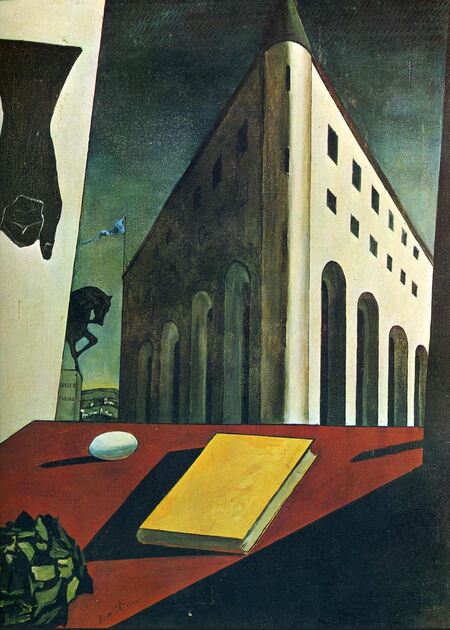
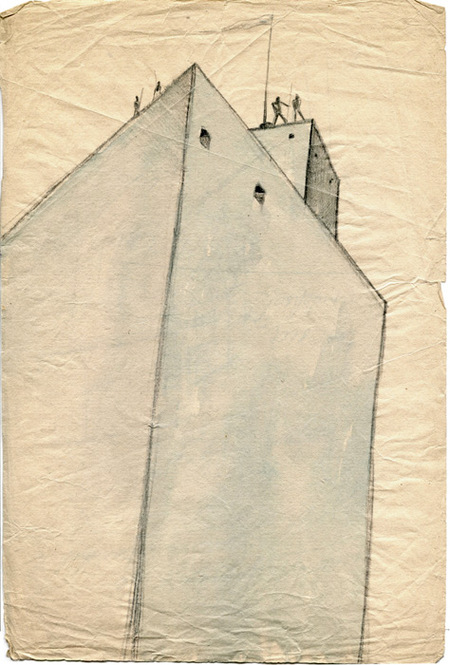
Giorgio de Chirico, «The Turin Spring,» 1914 / Shlomo Schwartz, «House,» early 1950s
«If you hear the cosmic echo reflected in the facets of city squares, factory buildings, and train stations, in the mirror of canals, and the slopes of hills, Schwarz represents the very force of life pressing upon the individual—the struggle between earthly gravity and the light wave dissolving heavy matter» (Ekaterina Andreeva, 2011)
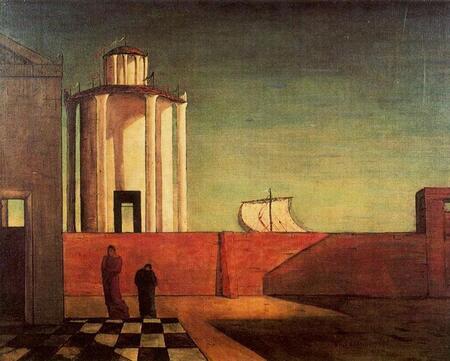
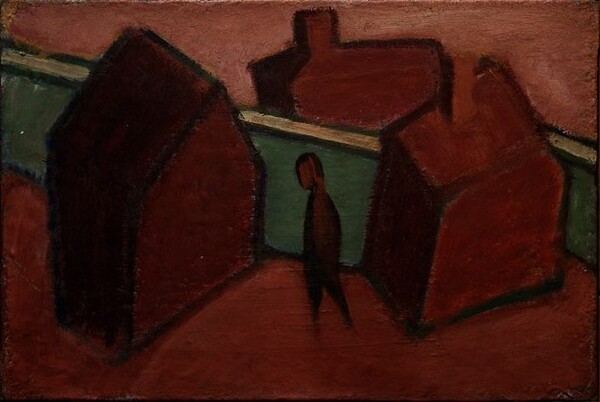
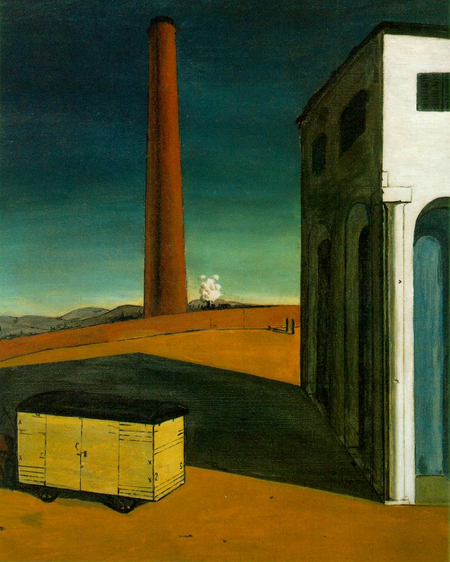
Giorgio de Chirico, «The Mystery of Arrival and Day, ” 1912 / Shlomo Schwartz, „Homes, ” early 1950s.
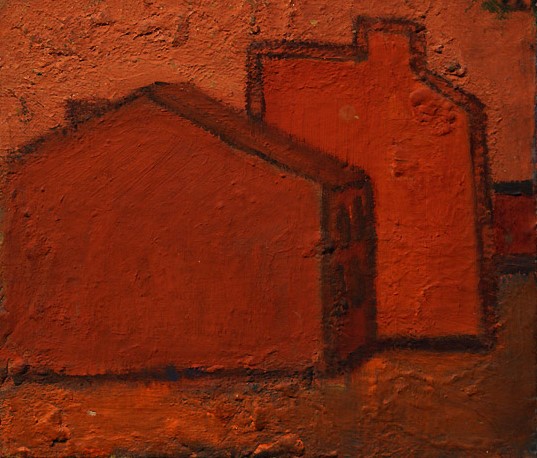
Giorgio de Chirico, «Melancholy, ” 1914 / Sholom Schwartz, Untitled, 1950s
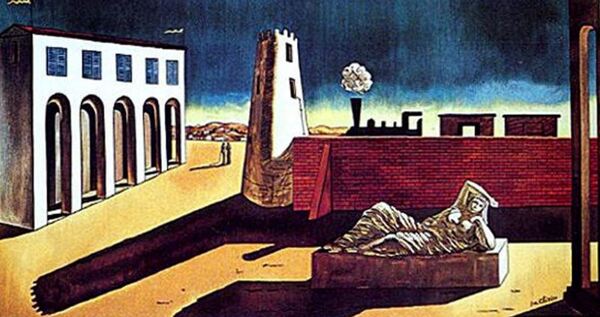
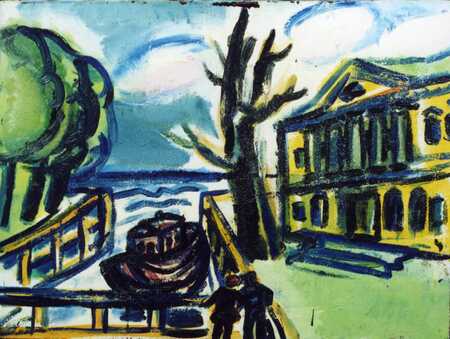
Giorgio de Chirico, «Piazza d’Italia,» 1913 / Vladimir Shagin, «Skipper’s Strait,» 1996
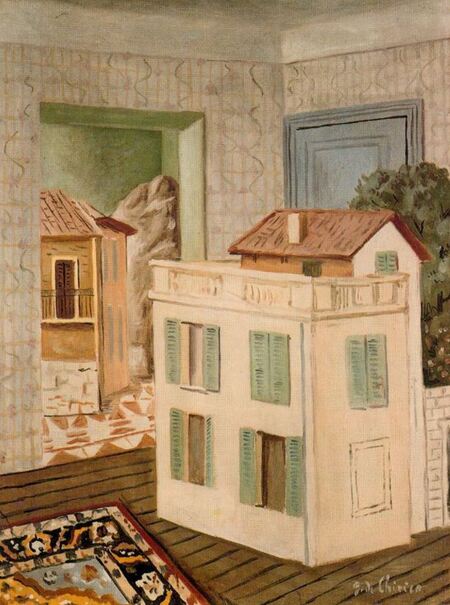
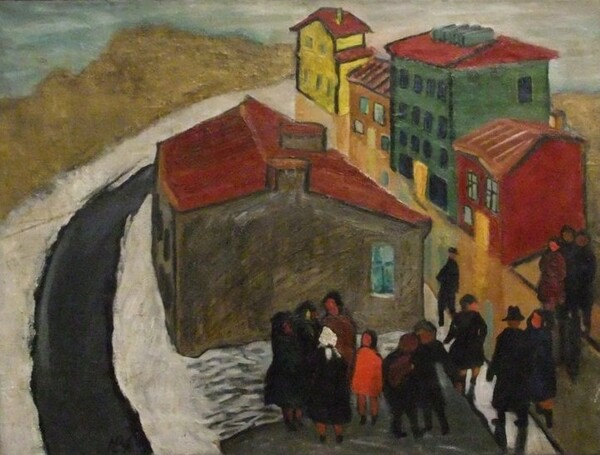
Giorgio de Chirico, «House in a House,» 1924 / Alexander Arefyev, «Street,» 1960s
Human