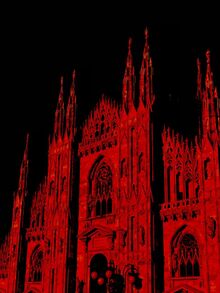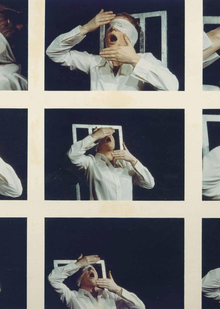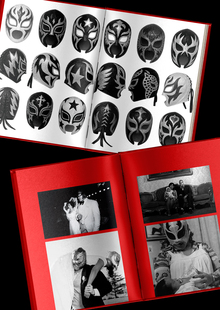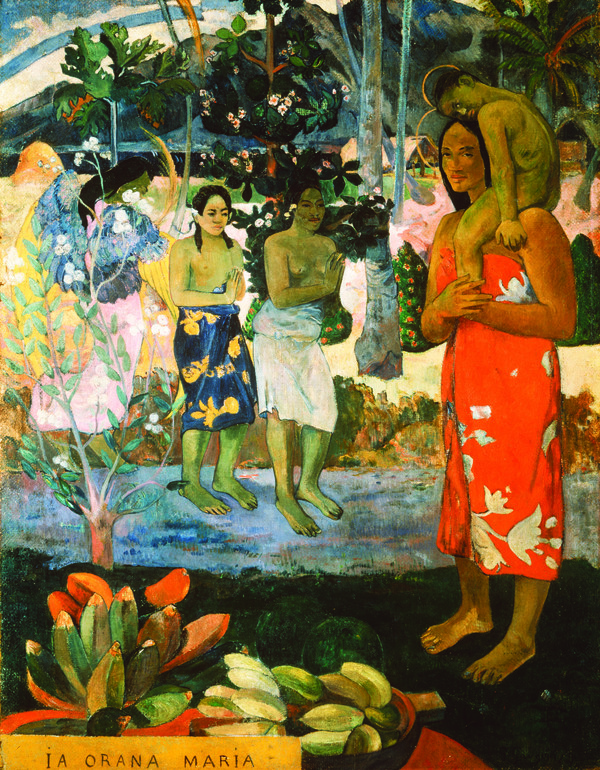
Concept
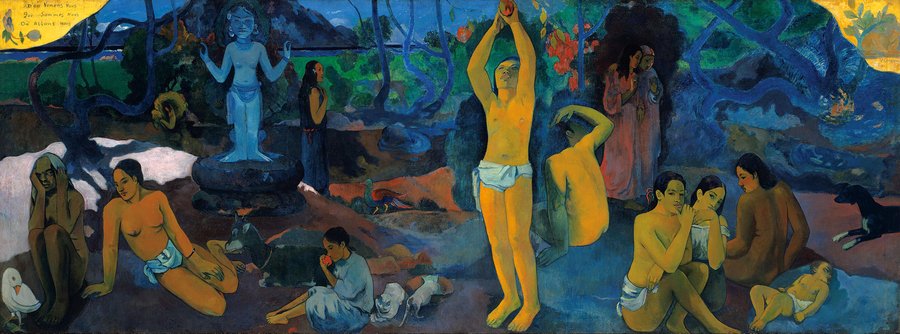
Where did we come from? Who are we? Where are we going? / Paul Klee / 1897
Primitivism in Post-Impressionism was not simply a «search for exoticism.» This phenomenon was rather a strategy to overcome the crisis of European representation. Artists began to consciously turn to visual techniques that went beyond academic traditions—for example, the absence of linear perspective, the deformation of body anatomy, and the conventionality of color. One could say that the artists were striving to create a new visual language.
However, this strategy was built upon a colonial worldview because the «primitive» was perceived as something wild, childlike, and authentic—a resource for consumption. This theme creates an ethical paradox that remains relevant today.
The goal of my research is to explore how and why European artists of the late 19th century referenced «primitive» cultures as a strategy for revitalizing artistic language, and what significance this held for 20th-century art and contemporary perspectives on cultural appropriation.
The choice of topic is supported by several factors.
First, most studies on Post-Impressionism are based on the biography of artists or the analysis of artistic techniques, such as color, brushwork, and composition. Primitivism, in contrast, is often treated as a secondary factor influencing artistic language. My research proposes examining primitivism not as a subordinate subject, but as a central one.
Second, there is a timely relevance to this topic. Understanding how late 19th-century European artists utilized the «primitive» image helps in comprehending contemporary ethical and aesthetic conflicts.
Principle of Selection and Material Analysis for Visual Research:
I selected works where the influence of «primitive» sources is most evident and amenable to analysis. Each piece by a European artist is accompanied by a visual source—that is, the inspiration from which the author drew. This helps illustrate the relationships clearly.
Textual sources utilized included the statements of the artists themselves: Vincent van Gogh’s letters, Gauguin’s notes, and Cézanne’s interviews and memos. These texts help reveal how the artists themselves contemplated the theme of primitivism.
Research Outline:
1. Introduction; 2. Japanese Primitivism: Van Gogh and Lorrain; 3. Medieval Primitivism: Gauguin in Brittany; 4. Oceanic Primitivism: Gauguin in Tahiti; 5. African Primitivism; 6. Conclusion.
In Earlier Times / Paul Klee / 1892 / Fragment
Introduction
«Primitivism is an artistic movement that emerged in the late 19th and early 20th centuries. Its followers drew inspiration from archaic, medieval, and folk art, as well as children’s drawings. In their works, artists consciously employed simplified forms, imagery, and painting techniques.»
Maruru / Paul Gauguin / 1894 // Sacred Island / Paul Gauguin / 1892 / Fragment
By the late 19th century, the academic tradition of Realism had reached the peak of its development. Artists faced a fundamental question: what should they do next? Consequently, the Post-Impressionists found a radical solution and began to dismantle the canon of European vision and academicism.
Various Post-Impressionists—such as Paul Gauguin, Vincent van Gogh, Paul Cézanne, and Henri de Toulouse-Lautrec—were not a unified group. Each artist followed their own path, pursuing a unique style. However, they were united by one common goal: a desire to move away from the academic tradition built upon linear perspective, precision, and idealization. To achieve this, they began to search for an alternative vision of the world outside the framework of European academicism.
The interest in the «primitive» was less about a genuine interest in other cultures and more a projection of personal and European ambitions and anxieties. Through the «primitive, ” they sought what they felt was missing in the European world: authenticity, spirituality, freedom from social conventions, and immediate perception.
The Great Wave off Kanagawa / Katsushika Hokusai / 1831 / Fragment
Japanese Primitives: Van Gogh and Lorrain
In 1854, Japan opened its borders to international trade. This event led to the dissemination of Japanese art—specifically, Japanese woodblock prints, or «ukiyo-e"—beyond the country. For Post-Impressionist artists, this was a breath of fresh air, as Japanese prints presented an alternative system of seeing and depicting the world.
What made Japanese prints unique?
- Flatness — the absence of aerial perspective; all elements reside on a single surface.
- Asymmetry — the composition is offset from the center, creating dynamism.
- Cropped composition — figures and objects are cut off by the frame’s edge.
- Pure color — colors are not mixed or used to create shading.
- Strong outline — a black line that separates color zones.
Woodblock print from the «Fifty-three Stations of the Tōkaidō» series / Katsushika Hokusai / c. 1805 // Ono Beauty / Katsushika Hokusai / date unknown
Van Gogh and Japan
Vincent van Gogh never visited Japan. However, this country became for him a kind of imaginary, utopian world where art was inseparable from everyday life, and the artist was free from convention. Van Gogh collected Japanese prints, repainted them, drew inspiration from them, and borrowed their techniques.
Below, on a self-portrait by Van Gogh, a Japanese print is depicted in the background.
If I could go to Paris even for one more day, I would undoubtedly stop by Bing’s to see the drawings of Hokusai and other great masters of that era… Japanese art is like a primitive—it will last forever.
Self-Portrait with Bandaged Ear / Vincent van Gogh / 1889
Although Van Gogh deliberately copied Japanese prints, he did not aim for a literal reproduction. He copied them in his own style—intensifying the contrast, thickening the lines, and making the colors more saturated.
Below are two works. On the left is the Japanese print, and on the right is Van Gogh’s work, a copy of the print. In Van Gogh’s piece, you can notice the thicker brushstrokes and intense colors, the more impasto surface, and the greater painterly quality.
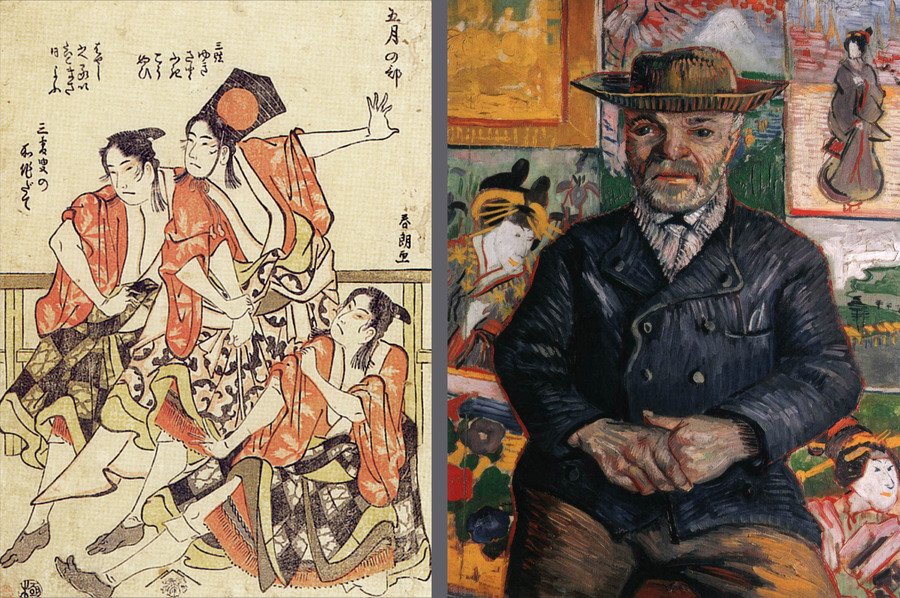
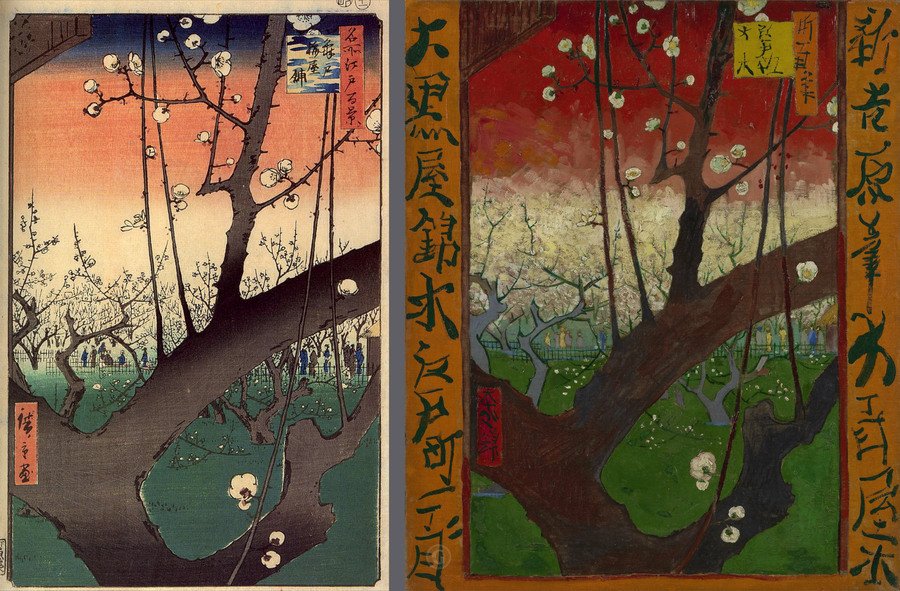
Plum Orchard in Kameido / Utagawa Hiroshige / 1857 Flowering Plum Garden / Vincent van Gogh / 1887 Energetic Dance / Katsushika Hokusai / 1793 Portrait of Papashi Tangi / Vincent van Gogh / 1887
Van Gogh adopts the principles of asymmetrical composition from Japanese prints: a low horizon line, shifted center, and diagonal lines that create dynamism. Figures and objects often appear «cropped» by the edge of the canvas—a technique uncommon in academic painting.
In Japanese prints, the contour is a vital element. Van Gogh also begins using it, outlining forms and rendering them graphically. Line becomes an independent expressive medium.
Instead of blending colors for chiaroscuro, as in academic painting, Van Gogh employs pure colors, often in contrasting pairs: yellow and blue, red and green. This is a direct borrowing from Japanese prints, where color does not create volume but exists as an independent field of color.
The works shown below exemplify all these techniques at once: cropped objects, a certain flatness in perspective, a plane of color, black outlines around objects, and horizontal compositional elements.
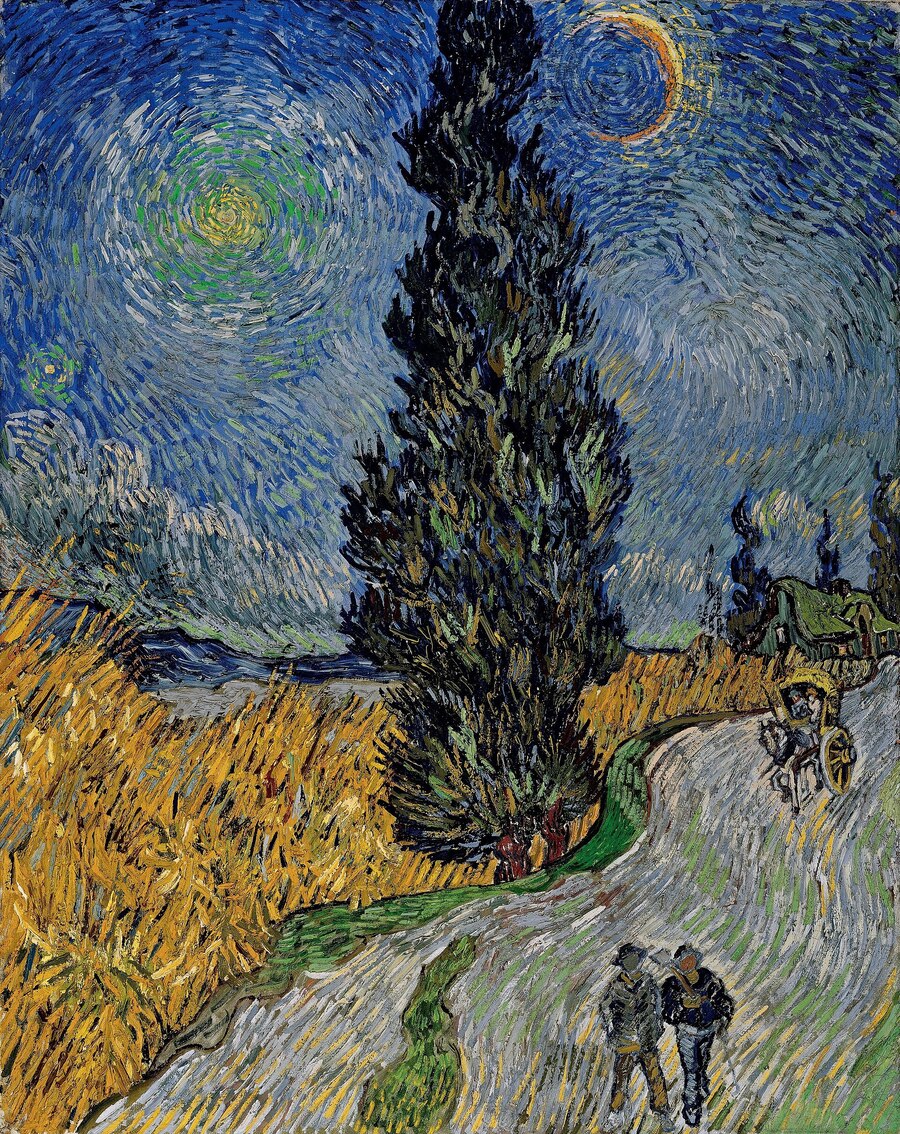
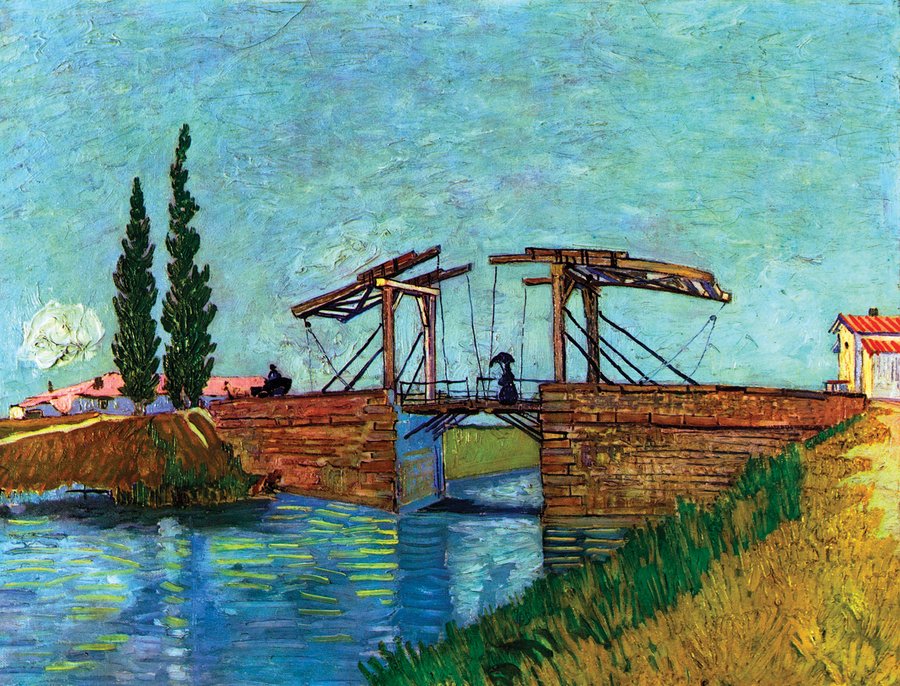
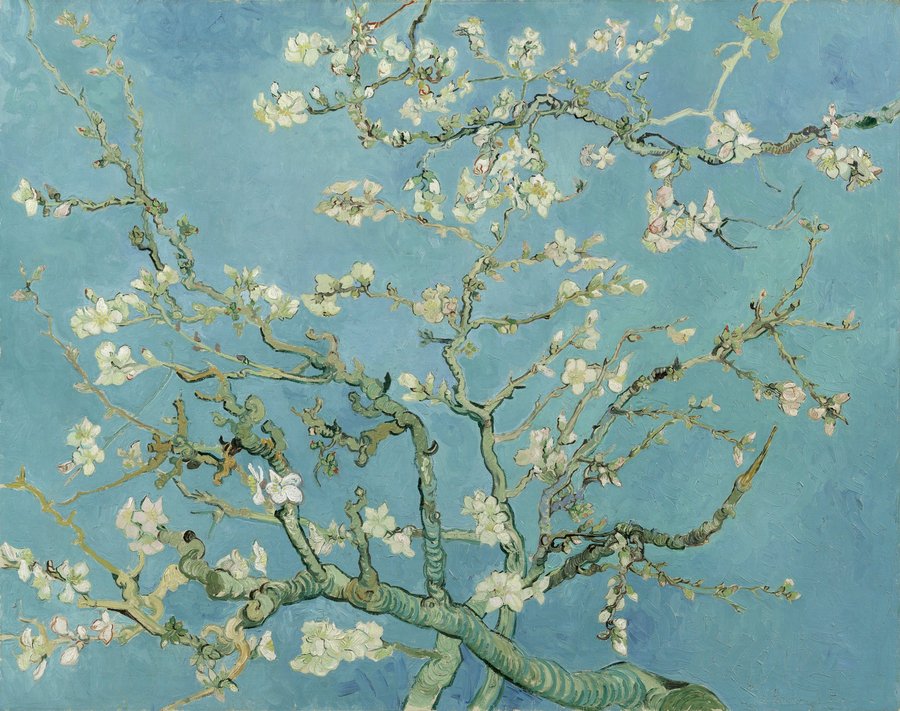
Langlois Bridge in Arles / Vincent van Gogh / 1888 // Flowering Almond Branches / Vincent van Gogh / 1890 // Road with Cypress and Star / Vincent van Gogh / 1890
Beyond technical aspects and techniques, etchings inspired Van Gogh through their subject matter—or more accurately, perhaps through their simplicity or even their lack thereof. The Japanese tradition celebrated beauty in simple things, in the ordinary, which is why Van Gogh frequently depicted straightforward subjects: nature, insects, and flowers. A prime example of this work is «Flowering Almond Branches, ” one of Van Gogh’s later paintings.
In Vincent van Gogh’s work, «Bedroom in Arles, ” he consciously disrupts linear perspective—the distorted angles of the room, the absence of a single vanishing point. The floor seems to „slope“ upward, and the walls converge at unnatural angles. Following a similar logic, Japanese woodblock prints were created where space didn’t recede into depth but rather „unfolded“ across the entire surface.
Bedroom in Arles / Vincent van Gogh / 1888
Lotrec and Japanese Engravings
Henri de Toulouse-Lautrec began applying Japanese principles not only in easel painting but also in commercial graphic arts—posters for cabarets. Lautrec blurred the line between «high» art and «low» design, making the poster a self-sufficient artistic statement.