Concept
Perestroika in the USSR became a pivotal period not only in the country’s political life but also in its cultural sphere. The weakening of ideological control and censorship allowed for greater thematic diversity in official art, and partially de-marginalized underground art. The opening of specialized exhibitions dedicated to clandestine Soviet art, along with the expansion of thematic and artistic diversity in the works, forged a new generation of artists who, even after the dissolution of the Soviet Union, adopted the imagery and practices of artists who worked during Perestroika, thereby creating a new art form in terms of thematic and visual diversity.
How did Perestroika change the boundaries between official and unofficial art, and how did this impact the thematic diversity, artistic language, and public presence of artworks?
While official and unofficial art undoubtedly tended toward thematic and pictorial convergence, it maintained distinct differences. Even with newly acquired possibilities, artists working in the official sphere did not fundamentally alter the themes or semantics of their work, and exhibition venues reluctantly featured once-marginalized underground and avant-garde artists. The Perestroika period ultimately served as the starting point for the development of post-Soviet Russian art, which partially merged both approaches to imagery.
This visual study is dedicated to analyzing the influence of the Perestroika period on official and underground art. The visual material for this study was selected based on its accurate depiction of the changes inherent in the art of that era, as well as for the purpose of directly comparing the official and unofficial art of that time. Using the selected material, one can trace how Soviet art—which was sharply divided into underground and accepted—transformed into the art of 1990s Russia.
The analysis of the paintings will cover not only thematic content but also composition, color, tone, and form creation. This approach to analysis will allow us to trace how the thematic diversity of official and unofficial art changed during the Perestroika period, while also comprehensively examining the influence of various aspects on the artistic language of these groups.
The research is structured chronologically. This helps clearly illustrate the changes that occurred in Soviet art during the Perestroika era. First, the status of the two groups of artists before the Perestroika period will be examined, followed by changes in the visual language of artists during Perestroika in the USSR, and finally, the impact of this period on subsequent Russian art of the 1990s will be analyzed.
The source texts were selected based on their connection to the Perestroika period. The majority of the sources are historical and art-historical texts that explore the main theme of the visual research from different perspectives.
Official and unofficial art prior to the Perestroika period
Following Joseph Stalin’s death, during the Thaw period, the increased liberalization of the state in the USSR began to create an environment for the formation and development of new experimental artistic practices. Despite this, official artistic unions and exhibition spaces remained largely closed off to art that diverged from Socialist Realism. The 1962 exhibition held at the Manege in Moscow, coupled with Nikita Khrushchev’s criticism of the nonconformist works—a small contingent of which was displayed—solidified a sharp divide between official, accepted art and underground, unofficial art. As Yuri Gerchuk wrote: «The exhibition immediately became a cultural event, even before it attracted scandalous attention. Television showed interest in it, which at the time was still a rarity.» Due to this intense focus on nonconformist artistic practices, the exhibition was followed by an increase in control over experimental art, which in turn led to the isolation of unofficial creative groups and a significant limitation on their access to official exhibition venues.
Thus, by the mid-1960s to the early 1970s, two separate creative spheres emerged in the USSR: an official sphere linked to state institutions and party ideology, and an unofficial sphere that developed and formed in opposition to established creative and exhibition spaces.
Official art of that era developed within the framework of Socialist Realism—an artistic method that required a realistic depiction of reality while affirming socialist ideals of labor, industrialization, collectivism, and heroism. Victoria Voskresenskaya writes that by the 1930s, «instead of artistic experimentation or the search for new solutions, traditionalist forms and idealized resemblance were asserted.» Although the paintings were rendered predominantly in a realistic style, artists used expressive elements such as composition, tone, and color to emphasize the significance of the events and figures depicted.
On Peaceful Fields, A. A. Milynikov, 1960
A prime example of this artistic method is Andrey Mylnikov’s painting, «In the Peaceful Fields.» It depicts peasant women walking through a field as monumental, steadfast figures. Through a warm color palette, the artist portrays the prosperity of their lives and heroizes their figures. This painting demonstrates the core principles of Socialist Realism: the heroization of peasants and simple workers, the idealization of reality, and the glorification of collective labor.
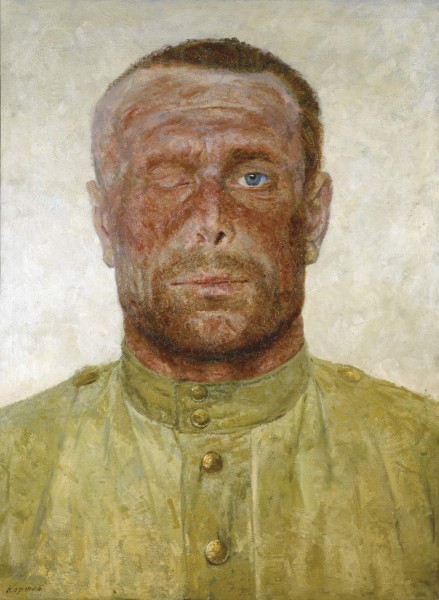
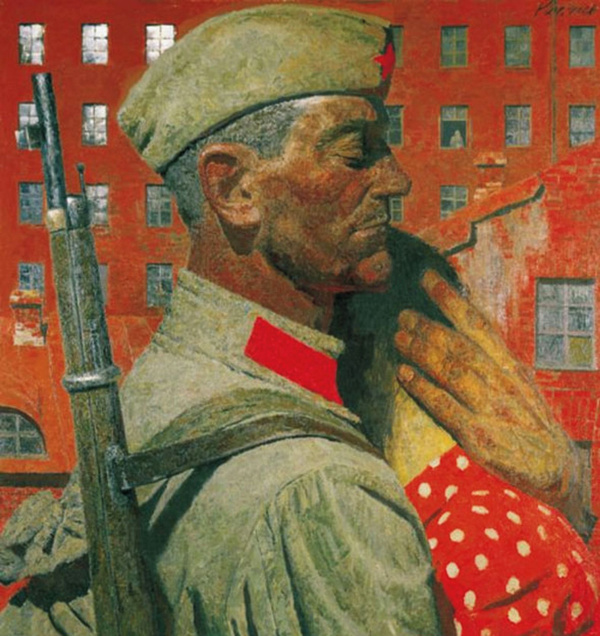
Traces of War, Korzhev G. M., 1965 / Farewells, Korzhev G. M., 1967
However, over time, Socialist Realism evolved and gave rise to new movements. The «Severe Style,» for instance, was one such development, characterized by psychologically intense imagery, heightened contrasts, and a focus on depicting the resilience and strength of Soviet people. According to Maria Kolesnik, the heroes in the works of artists from the «Severe Style» were «geologists, polar explorers, participants in major Soviet construction projects, collective farm workers—everyone who faced the difficult realities of a Soviet citizen’s life and explored new spaces for living while interacting with natural elements.» The artists assigned «them the status of symbols of the era.» Examples include Geley Korzhev’s paintings «Traces of War» and «Farewells» from the polyptych «Burned by the Fire of War.» In these paintings, the artist explores the theme of war through personal tragedies and emotional experiences. In both works, Geley Korzhev deliberately avoids idealizing war while retaining the monumental quality of the figures and the exaltation of the Soviet people inherent to Socialist Realism.
In contrast to official Soviet art, a unique environment emerged among nonconformist artists, developing through small creative communities and personal connections. Anna Pismanik wrote that in the late 1950s and early 1960s, «for the first time in a long time, artists and writers whose aesthetic programs diverged from the principles of Socialist Realism could attempt to fulfill their desire to build their own audience—to make their own aesthetic statement a subject of discussion.» Unofficial, «underground» art was not a single direction; it contained individuals with diverse aesthetic principles, creative explorations, and approaches. One of the earliest creative associations of unofficial artists was the «Lianozovo Group,» which united numerous artists and poets who opposed Socialist Realism with their work and exhibited alternative art to an interested circle of people. Thus, unofficial art formed its own sphere, rooted in personal initiative, creative independence, and opposition to official culture.
Still Life with Fish and the «Pravda» Newspaper, Rabin O. Ya., 1968
An example of unofficial art is Oscar Rabin’s painting, «Still Life with Fish and the Pravda Newspaper, ” one of the artists of the „Lianozovo School.“ In this painting, the newspaper Pravda—an important symbol of Soviet ideology—is juxtaposed with simple everyday objects, which desacralizes its image and makes it a simple part of human life. The overall richness of texture and abstraction in Oscar Rabin’s paintings sharply differentiates his art from the official sphere, and the painting’s context creates a subtle critique of Soviet reality while illustrating the simplicity of Soviet citizens' lives.
Horizon, Bulatov E. V., 1971–1972
Another example of unofficial art in the USSR is Erik Bulatov’s painting «Horizon.» It features bright, light painting that shares an atmosphere with Socialist Realism, yet it sharply contrasts with a red ribbon reminiscent of the Order of Lenin, one of the highest state honors. In «Horizon, ” Erik Bulatov reinterprets official art through this composition, revealing the influence of official state ideology on the lives of Soviet people.
Thus, by the early 1980s, two artistic environments had emerged in the USSR: the official and the unofficial. These differed not only in their level of interaction with established institutions but also in their approaches to depicting Soviet reality and their artistic language. Official art, despite the diversity of approaches to figuration in paintings, thematically leaned toward representing specific ideals of Soviet society: the glorification of labor, the moral purity of Soviet citizens, and a positive, idealized portrayal of life in the Soviet Union. The unofficial, or «underground,» environment, conversely, offered artists greater opportunities for experimentation and innovation in painting, as well as in nonconformist and critical subjects and visual language.
Official and Unofficial Art During the Perestroika Period
By the mid-1980s, the Soviet Union was grappling with significant political and economic problems, which necessitated Perestroika—a package of reforms aimed at transforming the state apparatus. One of the most crucial instruments of political reform was the policy of glasnost, designed to gradually weaken ideological control and censorship. This allowed many official artists to address previously forbidden or controversial themes, and to experiment significantly with visual language and artistic forms. Simultaneously, nonconformist artists and cultural figures, who had previously been excluded from the mainstream cultural landscape, began to integrate into the official, mass culture sphere.
These transformations within the cultural environment allowed various creative groups to gradually begin interacting and evolving, enabling a reconsideration of the mass audience’s perception of Soviet art and expanding its thematic and stylistic diversity.
One of the major changes of that era was the gradual expansion of exhibition opportunities for artists who were working outside the official creative environment. Key events that demonstrated a slow shift in the public paradigm and the official establishment’s acceptance of past underground art were the exhibitions «Retrospective of Moscow Artists' Work. 1957–1987,» held in the «Belyayevo» exhibition hall in the fall of 1987, and «From Unofficial Art to Perestroika: A History of Leningrad’s Art Life. 1949–1989,» which opened on January 8, 1989. These exhibitions did not merely display previously prohibited works; they comprehensively illustrated the history of the creative environment in Moscow and Leningrad that existed outside of official art. According to Anastasia Kotyleva, the exhibition «From Unofficial Art to Perestroika» «became one of the events marking changes in the local art scene, which were rapidly unfolding due to reforms in the ideological and economic policies of the USSR.» Thus, the exhibition landscape during the Perestroika period not only provided a platform for underground art to be shown but also created the conditions for re-examining the boundaries between the official and unofficial spheres, allowing them to interact and exchange visual experiences.
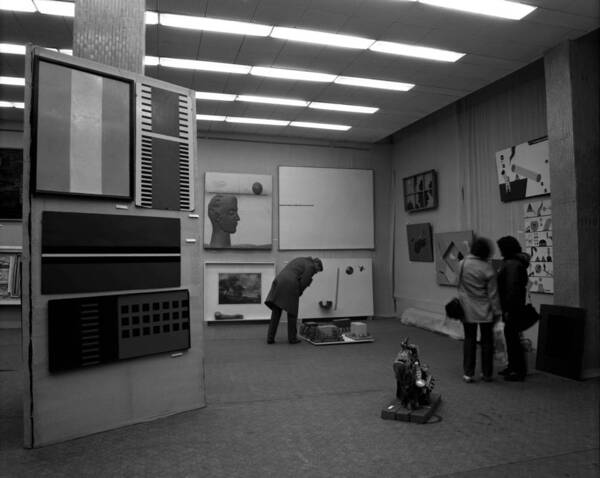
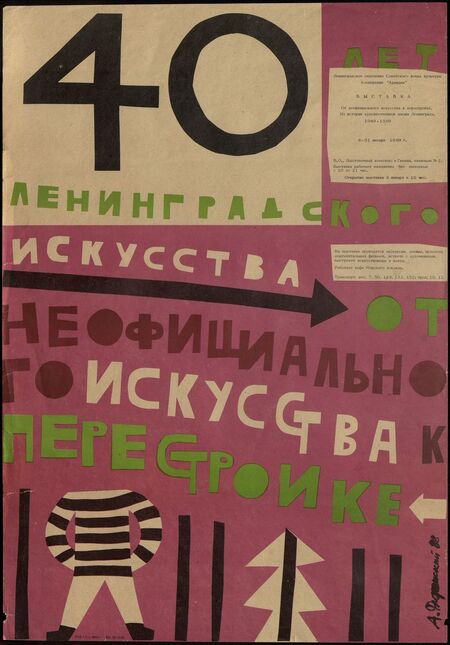
Exhibition «Retrospective of Moscow Artists' Work. 1957–1987, ” photograph by Kizevalter G. D. / Poster for the exhibition „From Unofficial Art to Perestroika. From the History of Artistic Life in Leningrad. 1949–1989, ” design by Florensky A. O.
A significant development in Soviet art during the Perestroika period was its entry onto the global market. The Sotheby’s auction in Moscow, held on July 7, 1988, which introduced Soviet art to collectors from around the world, featured both officially recognized artists and underground, nonconformist painters. This helped dismantle the hierarchy and boundaries separating official and unofficial Soviet art. As Anna Savitskaya writes, the auction «signaled the Russian art scene’s entry into the international market and drew the attention of Western collectors, gallerists, and art critics to Soviet unofficial art.»
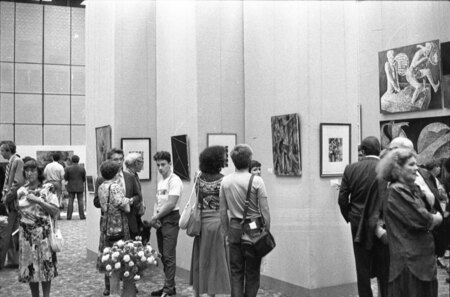
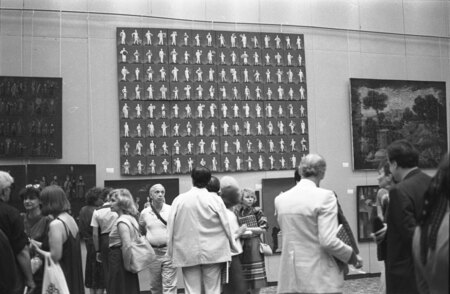
Sotheby’s Pre-auction Exhibition: «Russian Avant-garde and Soviet Contemporary Art, ” photographs by A. N. Lavrentiev.
Despite the official art scene retaining its foundation in Socialist Realism, the 1980s saw gradual shifts in the subject matter and visual language of some Soviet painters. By this time, artists increasingly turned to personal, emotional, and philosophical imagery, moving away from the themes of heroism, patriotism, and industrialization that were customary for official art.
Large Window, Nazarenko T. G., 1895
Tatyana Nazarenko’s painting, «Large Window,» through its interior and multilayered narrative, reflects the relationship between the artist’s inner world and surrounding reality. Through the city landscape, the details of her studio, and her portrait reflected in the mirror, the artist analyzes her view of everyday life and her own place in the world. This distinguishes her painting from the works of Soviet artists operating within the official artistic sphere of the past: unlike the glorification of collectivism and labor life, she addresses scenes of everyday life that reveal her inner world and emotional state.