Topics
- Relevance of the Topic
- Physicality: The Body as the Primary Tool of Comedy
- Facial Expression: The Face That Says Everything Without Words
- Posture and Gait: Self-Assurance as a Comedic Gesture
- Dance and Musicality: A Protagonist Who Cannot Remain Still
- Costume and Appearance: Clothing as an Extension of Character
- Character Interaction with Surroundings: Distance and Social Behavior
- Conclusion
- Bibliography
- Image Sources
Relevance of the Topic
The relevance of this visual study stems from the significance of the actor in shaping the recognizable archetype of the European comedic hero. His on-screen image represents a unique blend of appeal, self-assurance, roughness, spontaneity, and expressive physicality. Chelintano utilizes not only dialogue but also facial expressions, gestures, gait, poses, and interaction with his surroundings, transforming his own body into an independent tool of comedy.
Examining the visual persona of Adriano Celentano allows us to trace how the character’s appearance, costume, physical presence, and behavior construct the comedic effect and influence the audience’s perception of him. Analyzing films featuring this actor helps identify the enduring visual characteristics of his on-screen persona, as well as the specific ways these traits evolve across different comedic situations.
Thus, this research is relevant to understanding the expressive potential of acting physicality and the specific visual language of Italian comedy.
Physical Plasticity: The Body as the Primary Tool of Comedy
One of the defining characteristics of Celentano’s acting style is his unusual bodily plasticity. His characters rarely move in the way a typical movie hero would be expected to. They might suddenly shift their posture, dramatically slouch in a chair, cross their legs, lean, wave off conversational partners, or make clumsy movements. Celentano does not strive to make his movements beautiful or harmonious. Instead, the actor often emphasizes their angularity and awkwardness. Because of this, the character’s body becomes a source of comedic effect.
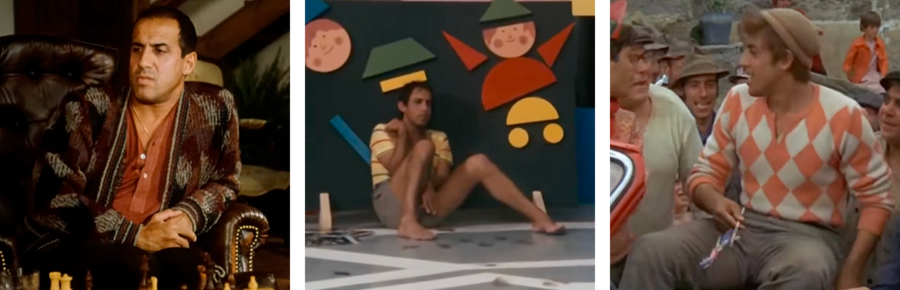
Stills from the films «Taming of the Shrew,» «Bingo-Bongo,» and «Seraphina»
An actor can transform an ordinary action into a comedic episode through physical expressiveness. This principle is particularly vivid in «Taming the Wild One, ” where Elia Codogno constantly resists his surroundings and demonstrates independence through his own body. He is unwilling to change his habits, does not strive to appear well-behaved, and does not take social norms seriously. His poses often appear defiant, and his movements underscore the hero’s unwillingness to adapt to his environment.
Stills from the film «The Taming of the Shrew»
This feature is most strongly evident in the scene of grape crushing. Elia steps on the grapes, transforming agricultural labor into a dance. His movements take on a rhythmic quality, and the physical activity becomes a standalone comedic performance.
Stills from the film «Taming of the Shrew»
In «Seraphina,» Chelentano uses bodily expressiveness to create the image of a person who lives outside conventional social rules. The protagonist maintains immediacy, interacts freely with nature, and does not strive to control their own movements. They do not perceive social conventions as obligatory at all. Their body conveys naturalness and spontaneity.
Stills from the film «Seraphina»
In «Bingo-Bongo,» physical comedy takes on an even more unusual form. The protagonist grew up among monkeys and does not know conventional human rules. He uses his hands, feet, facial expressions, and gait in a completely different way than those around him. Chelentano creates a comedic image through physical incongruity. Bingo-Bongo might suddenly lean over, move on all fours, or react to objects or people in an unfamiliar manner. The audience laughs not only at the hero’s actions but also at the collision of two different behavioral systems.
Still from the movie «Bingo-Bongo»
Stills from the movie «Bingo-Bongo»
Thus, the physical performance of Celentano becomes a universal tool of comedy. It allows for the creation of vastly different characters while retaining a recognizable individual acting persona.
Facial Expression: The face that says everything without words
Another characteristic of Chelintone is his expressive facial expression. The actor frequently uses squinting, raised eyebrows, a frown of dissatisfaction, or an exaggeratedly serious look. He can react to events almost motionless, but even a slight change in his expression transforms into a comedic effect.
Stills from the films «Taming of the Shrew» and «Bluff»
In «Taming the Wild, ” Elia consistently displays dissatisfaction with those around him. His face becomes a peculiar barrier—as if the character is preemptively signaling to the other person that he does not wish to engage in conversation. In „The Bluff, ” Chelentano uses facial expressions differently. Here, his expression helps the character sustain the deception, project confidence, or conceal his true intentions. In „The Ace, ” the actor again relies on expressive reactions that underscore the character’s self-assurance and comical invincibility.
Stills from the films «The Proud One,» «Bluff,» and «Ace»
In «The Bluff, ” Chelentano’s facial expressions appear dynamic. The character frequently uses his face to conceal his true intentions. His smile can look friendly, cunning, or suspicious. The viewer is not always certain whether the character is sincere or plotting another scheme. Thus, Chelentano’s face becomes a kind of mask—it simultaneously conveys and hides emotion. The actor constantly plays with the audience’s expectations, creating a comedy situated on the border between sincerity and pretense.
Stills from the film «Bluff»
In «The Ace» in Cheltenham, there is a gambling card player who is confident in his own talent. His character often displays self-assurance through his gaze, smile, and exaggerated reactions. He seems to be already certain of his victory.
A still from the film «Ace»
From the above, it can be concluded that the facial expressions in Chelentano function as an independent component of the visual narrative. The audience perceives the character’s relationship to the situation before the character speaks a word.
Posture and Gait: Self-Assurance as a Comedic Gesture
Chelentano often portrays a self-assured man. The hero stands with his feet spread wide, slightly leans his torso, moves unhurriedly, and does not seem willing to yield the right-of-way to others. This manner of behavior creates the impression that the character has complete control over the situation. However, this confidence often turns out to be comical. The hero may appear invincible, but those around him easily derail his plans. In «Taming of the Shrew, ” Elia demonstrates independence through his gait and posture. In „Bluff, ” this manner helps the characters create an impression of confidence and superiority. In „The Ace, ” Chelentano also uses physical self-assurance as part of the hero’s persona.
Stills from the films «Taming of the Shrew,» «Bluff,» and «Ace»