Topics
1| Concept 2| The Donkey-Humped Boy 3| The Firebird 4| Ivan Tsarevich and the Grey Wolf 5| Conclusion
Concept
After the Great Patriotic War, animation underwent a noticeable transformation. Before the war, animators created non-narrative works set to rhythmic music, which dictated the characters' movements, but the pictures changed drastically after the war. Animation became smoother, full plots and dialogues appeared, and music served only to complement and set the mood. Works based on fairy tales, featuring clear morals and rooted in folklore, began to take center stage. Fairy tales featuring the Firebird are among these. The Firebird is one of the most famous and enduring images in Russian folklore, and it is referenced repeatedly. In the fairy tales and Soviet animation, she is not merely a decoration; she plays a crucial role in the plot. She acts as the engine of the story, compelling the hero to act and setting them on a quest toward their goal. Her image is very complex and always stands out against the backdrop of the landscape and other characters. In every cartoon, she is depicted as a bright flame; her movements are fluid and varied, with each element of her image moving to its own rhythm. Furthermore, in different works, she initiates the plot in various ways, but she never remains in the background. Artists pay meticulous attention to her, recognizing her as a key character.
The selection of the theme is based on the fact that the Firebird itself is one of the central figures in Russian folklore. The aim is to investigate the role it plays in various animated fairy tales and how its image is interpreted. Specifically, what artistic techniques do animators use to convey the fairy-tale quality and vibrant nature of this character—namely: palette, light, movement, and stylization. Materials were chosen from animated films featuring the Firebird. Three sources were selected, in which the character is rendered not only in different techniques and varying styles but also plays different roles in different narratives. This selection allows for a comparison of works by different creators—revealing what distinguishes them beyond technique and plot, and what role the bird plays in each.
The research structure is organized not chronologically or by director, but by the function the Firebird performs in the narrative: — First: Ivan Ivanov-Vano’s animated films «The Cobbler» (1947) and (1975); the Firebird feather as the trigger for a chain of quests.
— Second: Cezar Orshansky’s animated film «The Firebird» (1983); the main motif and the resolution of the problem.
— Third: Galina Barinova’s «Ivan Tsarevich and the Grey Wolf» (1991); also a launch of trials for the hero, but it represents the primary assignment.
Key Question: What techniques do the creators use each time to highlight the Firebird as a central element in the plot and frames of Soviet animation?
The Firebird drives the plot; the hero encounters her, and his destiny changes after this meeting. She is a dual character—she both guides the path and «burns» the characters, yet she ultimately directs and assists them. Her brilliant image utterly overshadows everything else. This is precisely why she cannot be a «secondary element»; her role and persona are unique.
Konyok-Gorbunok
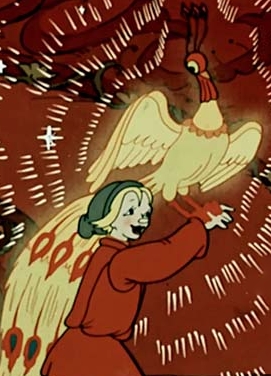
In the animated film «The Little Horse and the Humpback» by Ivan Ivanov-Vano (1947), the Firebird appears not as a character, but as a feather. The feather, found by Ivan, becomes the central plot element and launches our hero’s journey through the Tsar’s assignments. The visual decision was made to portray the feather not as an object, but as a source of light. This is actually a very important key element—the encounter with the Firebird is not direct, but indirect, thereby intriguing the audience toward a meeting with the mysterious creature.
The capture of the Firebird is depicted very beautifully and unusually. To lure the bird, the hero first creates bait. After an unsuccessful catch, he performs a dance and mimics the birds' movements, thereby attracting one of the individuals. This is a very interesting and significant moment because Ivan does not oppose the fairy-tale world; instead, he tries to adapt to it.
The key point is that we are not seeing a single bird, but an entire flock. While other animated interpretations of fairy tales often show only one individual in the frame, here the creators chose a different approach. They created an entire «species» with its own hierarchy and natural laws. This approach resolves many questions: «Why is there only one bird?», «How did it appear?», «Does it live forever?». Thanks to this decision, we can observe the mating dance between two Firebirds.
The magic of the Firebird is built upon light and color combinations that contrast with the painting’s main palette. In the catching scene, color is resolved through contrast. The night, shifting from deep blue to russet, changes after the Firebirds arrive. This technique is also noticeable in the scene where Ivan finds a feather in the forest and when he combs the horses at night in the stalls. The birds themselves adhere to the logic of luminescence. They are not merely colored in bright shades; they emit a light that alters the surrounding illumination. Furthermore, they give off a soft glow, which also lends them a radiant effect. Director Ivan Ivanov-Vano recalled that the principle of color contrast was intentionally repeated in the «Catching the Firebird» episode, following the scene with the feather in the palace, where the flashes of light were also based on a sharp shift in the color scheme.
It is important to note that «Konyok-Gorbunok» from 1947 is one of the first full-length animated films in color. To convey its entire vibrancy, it was shot on multi-layered Agfacolor film. The artists originally planned to use color to express the artistic decisions laid out in the script.
Firebird
Vladimir Samsonov’s animation, «The Firebird» (1984), was created using glass painting techniques. Every frame was painted individually with oil paints directly onto the glass surface. The resulting image has a shimmering quality; it lacks distinct outlines but possesses a rich texture from the brushstrokes and a deep saturation in the dark tones. This creates an atmosphere where light seems absent, which the Firebird compensates for.
The painting has no lines—only patches of color—and it is thanks to these patches that the Firebird is brought into the foreground. The Firebird is depicted using vibrant shades of yellow that transition into red (thanks to the oil paints). The technique is the same as used in Konьka-Gorbunka: contrast. By using deep tones of color, the luminescence was conveyed solely through the paint itself, without adding an external glow around the bird.
The plotline of the Firebird in the animated film differs from the Frog Boy. While the bird’s feather initiates a chain of events in the former, in the 1984 «Firebird, ” the bird itself is the primary means of combating evil. Ivan Tsarevich obtains its feather, which becomes the central narrative and visual element of the entire second half of the film. The feather transforms into a shining sword with which the hero defeats the black dragons into which the dark force has transformed. Thus, the Firebird serves as a source of light and power that acts through the feather.
Ivan Tsarevich and the Gray Wolf
The tale of Ivan Tsarevich and the Gray Wolf exists in several forms within Soviet culture. Regarding the theme of the Firebird, it is important to note that the bird almost always remains off-screen or at the edge of the frame. In the 1975 animated film, the plot centers on «three princes setting out to find the Firebird for the Tsar, ” but only Ivan Tsarevich is fortunate enough to have the Gray Wolf as his servant. The Firebird itself is merely the goal of the journey here, not a constant character: she steals golden apples from the Tsar’s garden, prompting the heroes to pursue her.
The Firebird functions here as an object of desire around which the hero’s journey is built, yet its screen time in the cartoon is minimal. This raises the question: what happens to the plot when the Firebird is «set aside»? How does the cartoon, and the fairy tale, sustain its presence through anticipation? However, the visual construction of this film is more complex. It is a 49-frame, color-illustrated diaphilm by artist Pyotr Bagin. It is Bagin’s technique that defines how the Firebird exists within it and why it is perceived not as «an illustration of the text, ” but as an independent visual entity.
Conclusion