
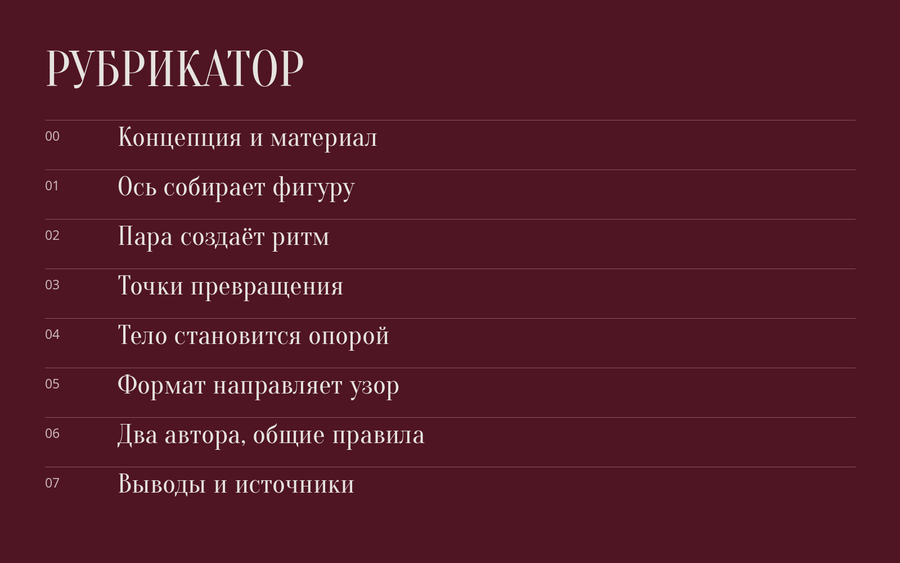

The grotesque ornament is initially perceived as a dense mixture of incompatible elements. A single small sheet combines human torsos, bird heads, wings, leaves, vessels, and delicate scrolls. What interested me was how such a combination appears cohesive. If viewed individually, the figures’ anatomy seems impossible. Yet, within the composition, they occupy definite spaces and support the overall pattern. I want to understand what rules allow the human body to become part of a design.
The object of study is the ornamental engravings of 16th-century French masters, Étienne Delon and Jacques Andre Ducerso. The subject is the methods by which the human figure connects with vegetal, animal, and geometric forms. The key question is: by what compositional rules are human figures joined with plants, animals, and scrolls? By a hybrid body, I mean a figure whose human part shares a common contour with a part of another origin. Next to this, I examine figures associated with the ornament only through gesture or placement. This comparison helps reveal the moment of transformation more precisely.
For the visual reference, I selected plates from Dürer’s «Small Grotesques» and «Book of Grotesques, ” as well as compositions by Delon featuring herms, deities, and allegories. The primary source material comes from the collections of the Metropolitan Museum of Art, Rijksmuseum, the Louvre, and the Wellcome Collection. The selected plates include examples where the central axis, flanking pairs, or the point of form connection can be discerned. I exclude narrative scenes lacking this structural rigor. The study pertains to the French artistic tradition, not solely the place of print; some of Delon’s works are connected to Strasbourg. I maintain the broad museum dating ranges and do not substitute them with presumed precise years.
My hypothesis is that the hybrid body becomes part of the ornamentation through a stable compositional system. Its main techniques include a central axis, correspondence among side elements, repetition of curves, and continuity of the contour. The transitions between different sections are usually placed at a node easily understood by the viewer—at the shoulders, waist, or the lower termination of the torso. Furthermore, the figure is constructed using gesture, conventional support, and the outer format of the sheet. Therefore, unusual anatomy can coexist with a fairly clear order.The structure of the study is typological. First, I examine the axis and symmetry, then the points of transformation, the work of gesture, and the influence of the framing. In the final section, I compare two authors based on the same characteristics. Each technique is shown through an entire sheet and a significant fragment. In separate images, I add axis and level lines. These are my analytical schematics and do not appear in the originals. They are necessary so that the suggested reading can be verified against the engraving itself.
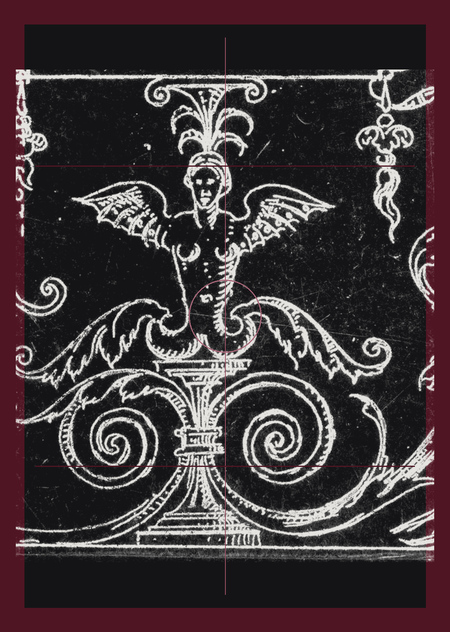
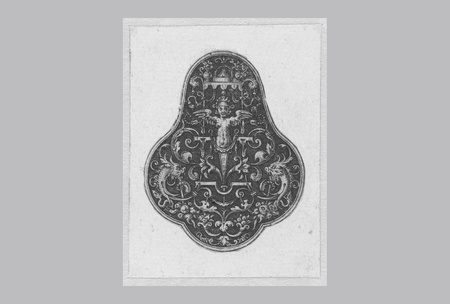
E. Delon. Winged female heraldry, 16th century. Rijksmuseum
First, I look at the overall silhouette. The figure is centered, and the expansion of the side swirls mirrors the expansion of the field itself. Here, the axis, symmetry, and the dependence of the details on the format are already visible.
What compositional rules dictate how human figures interact with plants, animals, and scrolls?
J. Andrew Dürer. «Small Grotesques, ” 1550 (left). E. Delon. „Mercury, ” pre-1573 (right)
The light, open panel and the dense composition on a black background are arranged differently. To compare them, I will look for the same features within them: axis, lateral correspondences, line directions, and figure relationships.
What do I mean by a hybrid?
Grotesque is an ornament that combines plant, animal, human, and architectural motifs. In this study, Germa is a human half-figure with a narrowing lower termination. A register is a separate horizontal tier. I view the physical merging, contact, and connection through gesture as different ways to incorporate the human into the pattern.
E. Delon. «Winged Female Herm, ” 16th century; J. André Ducerso. „Small Grotesques, ” 1550. Fragments
In both cases, the torso is recognizable, but the lower part of the figure has already been incorporated into another structure. This is a convenient entry point for investigation—the human body is still legible, even though its contour begins to function as ornamentation.
The vertical axis dictates the reading order. The head, torso, vessel, or mask are positioned one above the other. Fantastic details spread out to the sides, but the center remains clear. Furthermore, this axis does not imply exact bilateral symmetry.
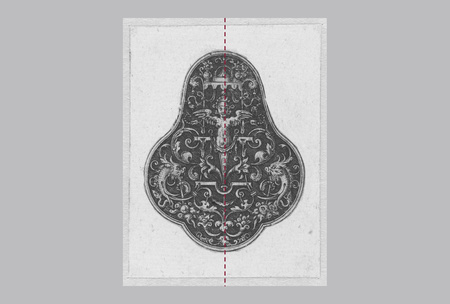
E. Delon. Winged female herm. 16th century. Rijksmuseum
The slider shows how Germana connects the upper and lower parts of the composition. The same vertical movement continues from her body. The side scrolls can be read as branches extending from a stable center.
E. Delon. Mercury from the series «Six Pagan Gods.» before 1573. Metropolitan Museum of Art, 47.139.121. Artist’s sketch
In «Mercury,» the center is occupied by the independent figure of the god. The axis runs through the architectural framing and the lower decorative group. The example demonstrates that the central positioning itself does not turn the person into a hybrid.
J. André Desours. Panel from «Petites Grottesques.» 1550. Metropolitan Museum of Art, 21.10.1(30). Artist’s sketch
In Dueserso, the central vertical is noticeable through several half-figures and supports. The elements on either side of it vary. The composition is held together by an overall framework, rather than the complete uniformity of the details.
E. Delon. «Winged Female Herm, ” 16th century; J. André Dusorse. „Small Grotesques, ” 1550. Axial Fragments
The cut-out central strips allow for a comparison of the element sequence. The torso is one of the nodes in the vertical chain, on par with the mask, vase, and architectural detail.
J. Andrew Duquesne. Panel from «Petites Grotesques.» 1550. Metropolitan, 21.10.1(11). Artist’s study
On this panel, the axis is complemented by horizontal tiers. Pairs of figures are situated on different levels, repeating the general principle. This allows the long panel to be viewed in segments while maintaining connection to the whole.
Conclusion to Section (1)
The first rule is a stable hierarchy. The axis gathers various motifs into one composition, and the tiers divide it into readable groups. For this, only positional correspondence is needed; exact mirror repetition is not always required.