Visual Research Concept
Games have existed throughout human history. For ancient civilizations, they were not merely entertainment but a method of interaction among people. They reflect religious beliefs, social relationships, and cultural values. Unfortunately, however, not all gaming traditions and games have survived to our day. This topic remains relevant because ancient games are currently being reconstructed. Their rules are newly devised based on archaeological findings, and the games are released as modern board games. But it is very difficult to say how accurately these versions correspond to the originals. Therefore, I believe it is very important to examine what exactly we are preserving: the authentic ancient game or merely our modern conception of it.
To this day, archaeologists are discovering various game boards, tokens, player depictions, and other artifacts that attest to the existence of games. Yet, the rules for many of them remain a mystery, or they are only partially reconstructed. This creates an interesting situation: the game physically survives, but people no longer know how it was played or what meaning it held.
This contradiction is what formed the basis of my research. I am interested in understanding what happens to a game after the society in which it existed disappears, and whether a game can be considered preserved if only its material objects remain.
Research Objectives:
- To examine the role of games in the lives of ancient civilizations.
- To study the surviving material evidence of ancient play practices.
- To compare games whose rules have been lost.
- To analyze the influence of religious, social, and historical changes on the existence of games.
- To determine whether modern reconstructions can be considered a complete continuation of ancient games.
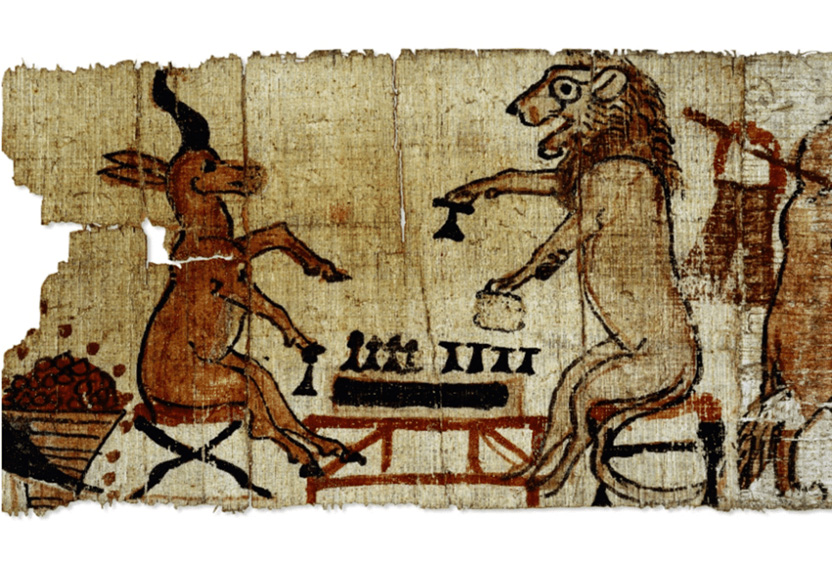
Fragment of an ancient Egyptian papyrus depicting the game of Senet between a deceased person and a lion-headed creature. Ancient Egypt.
Research Subject: Play practices of ancient civilizations that have lost their original form of existence or cultural significance.
Research Topic: The relationship between the disappearance of play traditions, the loss of rules, and the transformation of the cultural context of ancient games.
Research Perspective: A historical and cultural analysis of ancient games using archaeological findings, imagery, and modern reconstructions. I plan to pay particular attention to the distinction between the preservation of material objects and the preservation of the gameplay practice itself.
Research Methods: In this work, I will examine archaeological finds, historical depictions, and contemporary reconstructions of ancient games. I will also compare surviving play items and information regarding their rules to understand which elements of the games have been recovered and which have been lost.
Research Plan: First, I will examine the royal game «Ura,» which existed in Ancient Mesopotamia, and then transition to Senet—one of the most renowned games of Ancient Egypt. Using these two games as case studies, I aim to demonstrate how their meaning has changed, what information about them has survived, and why we cannot reconstruct their original rules with complete certainty today. Finally, I will attempt to answer the main research question: can a game be considered preserved if only material evidence remains?
Key research object
Why do some ancient games survive with boards, pieces, and images, yet lose the rules and cultural meanings that once made them a part of people’s lives?
Hypothesis
The disappearance of a civilization does not necessarily mean the annihilation of the games it created. However, the loss of cultural memory, traditions, and methods of transmitting the rules can transform a game into a historical artifact. Therefore, preserving a game requires more than just safeguarding its material elements—it also demands the transmission of knowledge about how it was played and why.
Ancient Egyptian mural from the tomb of Queen Nefertari, depicting her playing the game Senet. Ancient Egypt, 13th century BCE.
Goal of the visual study
To investigate how the disappearance or transformation of ancient cultures has impacted the preservation of game traditions, and to understand which elements of play can survive a civilization while others are lost.I am also interested in comparing ancient game pieces with their modern reconstructions to see how much their appearance, design, and function have changed.I specifically want to focus on what can be learned about a game from its appearance. For instance, how the shape of the board, the arrangement of the cells, the materials, and decorative elements help us understand the role the game played in people’s lives.Ultimately, I want to determine whether an ancient game can be considered fully preserved if we can reconstruct its appearance today, but no longer know exactly how it was played or what meaning the people of that time ascribed to it.
My Research Methods and Materials
The research employs methods of visual, comparative-historical, and cultural analysis.The visual material is primarily composed of photographs of archaeological finds, images of game boards and figures, ancient paintings, historical illustrations, and modern reconstruction schematics.The anticipated result is that the study should demonstrate that the disappearance of a game is a more complex process than the mere loss of game pieces. A game may survive in the form of an archaeological find, an image, or a modern reconstruction, yet simultaneously lose its original rules and meaning.When archaeologists discover an ancient object, its intended use is not always clear. This is especially true for game boards, as they can externally resemble ordinary decorative items, religious artifacts, or even furniture.To determine the purpose of a find, researchers examine several details—for instance, recurring cells, specialized indentations, tokens, and other adjacent objects. If similar sets are discovered in different locations, this allows the suggestion that they were used for a specific game practice.However, even if scholars are certain that they have found a game, it does not mean they understand its rules. The same board could theoretically have been used in various ways. Therefore, archaeologists must cross-reference the finds with ancient images, written sources, and other evidence.It turns out that the study of ancient games begins not with reconstructing the rules, but with an attempt to understand the objects' very function.
Archaeological excavations
Visual Study
Tsar’s Game Ura
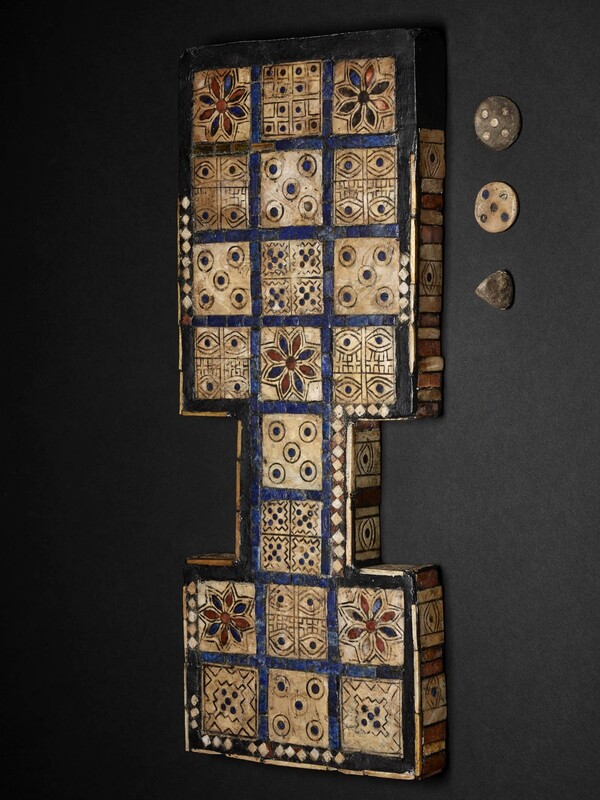
Ancient Ur Royal Game board with 20 decorated squares, two sets of pieces, and gaming dice. Mesopotamia, circa 2600 BCE.
Mesopotamia, around 2600 BCEThis game possesses an incredibly fascinating history. The Royal Game of Ur is one of the oldest known board games currently in existence. Copies of it were discovered by archaeologist Leonard Woolley during excavations of the royal cemetery of the city of Ur in modern-day Iraq. The finds date back to approximately 2600 BCE.The game board itself consists of twenty squares decorated with geometric patterns and rosette motifs. Along with it, gaming pieces and items used to determine moves were discovered. The rich ornamentation suggests that the game might have been not only entertainment but also a valuable artifact of material culture.It is particularly interesting that the board has survived for over four thousand years, while the original rules have not reached us in their complete form. Modern understandings of its mechanics are based on archaeological discoveries and later written sources.Thus, we arrive at an important question: if the playing field and pieces survived, but the original rules were forgotten, can we say that the game itself has survived?If one looks closely at the photograph, they can notice that the playing field has a rather unusual shape. It is composed of two broad sections connected by a narrow area. This distinguishes the Game of Ur from typical modern board games with square or rectangular fields.It is also interesting that not all squares look the same. Some feature eight-petaled flowers, while others display circles and geometric patterns. The squares with «rosettes» are particularly prominent, appearing in different areas of the board. Perhaps they held a special significance during the game.
Modern reconstruction of the Tsar’s game Ura. The game board consists of 20 cells adorned with floral and geometric ornaments, complete with black and white pieces and dice to determine moves.
What remains of the game?
Comparing the original board with the modern reconstruction reveals which elements of the game have survived millennia.
All three images show the characteristic twenty-cell pattern of the game board. The recurring ornaments suggest that the board design possessed a specific structure. However, the images themselves do not allow us to determine the exact sequence of moves, the winning conditions, or the meaning of individual symbols.
The modern reconstruction visually restores the ancient game’s original function: pieces are placed on the field, and the board becomes an interactive object. Nevertheless, this reconstruction is not an exact copy of the original game.
The researcher Irving Finkel studied a later cuneiform tablet containing information about the rules of a similar game. This allowed for the proposal of a reconstruction of the mechanics of the Ur Royal Game, but it did not prove that the inhabitants of Ur in the third millennium BCE played by exactly the same rules.
We can draw a rather interesting conclusion here: the material form of the game may have endured, but its original content was lost.
This game beautifully demonstrates to us that an archaeological artifact can survive an entire civilization, but its return to contemporary play culture requires answers.
Ancient board game, the Ur Game, featuring geometric and floral ornaments. Round game pieces of two colors are situated nearby. Mesopotamia, circa 2600 BCE.
What do game elements tell us?
This photograph clearly shows that the pieces are divided into two groups. Some are light, and others are dark, but both groups have matching markings in the form of dots. This division suggests that two opponents participated in the game, each with their own set of pieces.Another interesting detail is the small, pyramid-shaped objects placed next to the board. These were used to determine the moves, indicating that the game included an element of chance.Based on these photos, we can immediately learn several things: the approximate number of participants, the appearance of the elements, and the fact that the game’s progression was partially dependent on chance. However, taken together, the images do not explain exactly how the players moved the pieces or under what conditions they won.
Why were the rules lost?
In ancient times, the rules of various games were passed down orally from one person to another. For participants, these rules were a familiar part of daily life, so the need to record them in detail did not always arise.This game existed in Mesopotamia for a long period, but its original rules have not been preserved. Shifts in society, tradition, and leisure activities led to the loss of this play practice.However, the disappearance of the rules did not mean the destruction of the game pieces themselves. The boards and tokens continued to exist as material objects, even when people stopped understanding how they were used.This demonstrates how much a game ultimately depends on human interaction. Without players who know and pass on the rules, even a well-preserved game board loses its original purpose.
A modern reconstruction of the Tsar’s Game of Ura with game pieces and instructions.
Why were ancient game boards so heavily decorated?
If you look closely at the Tsar’s game, Ura, you can see that its design is far from simple. Its surface is adorned with floral ornaments, geometric patterns, and repeating symbols. Furthermore, not every square looks identical.
Why was so much attention dedicated to the aesthetics of a common board game?
Perhaps these objects served purposes beyond mere entertainment. Such decorated game sets might have signaled the owner’s status, showcased the skill of the artisans, or been used in specific social settings.
It is also interesting that today we primarily perceive these boards as works of ancient art rather than as games. We examine their materials, colors, and decorative elements, even though for people of the past, the playing experience itself might have been the most important element.
What was once used for human interaction has now become a museum artifact and a historical source.
Review of this board game