Иллюзии в картинах: Сравнение тромплея XVII века и гиперреализма XX–XXI веков
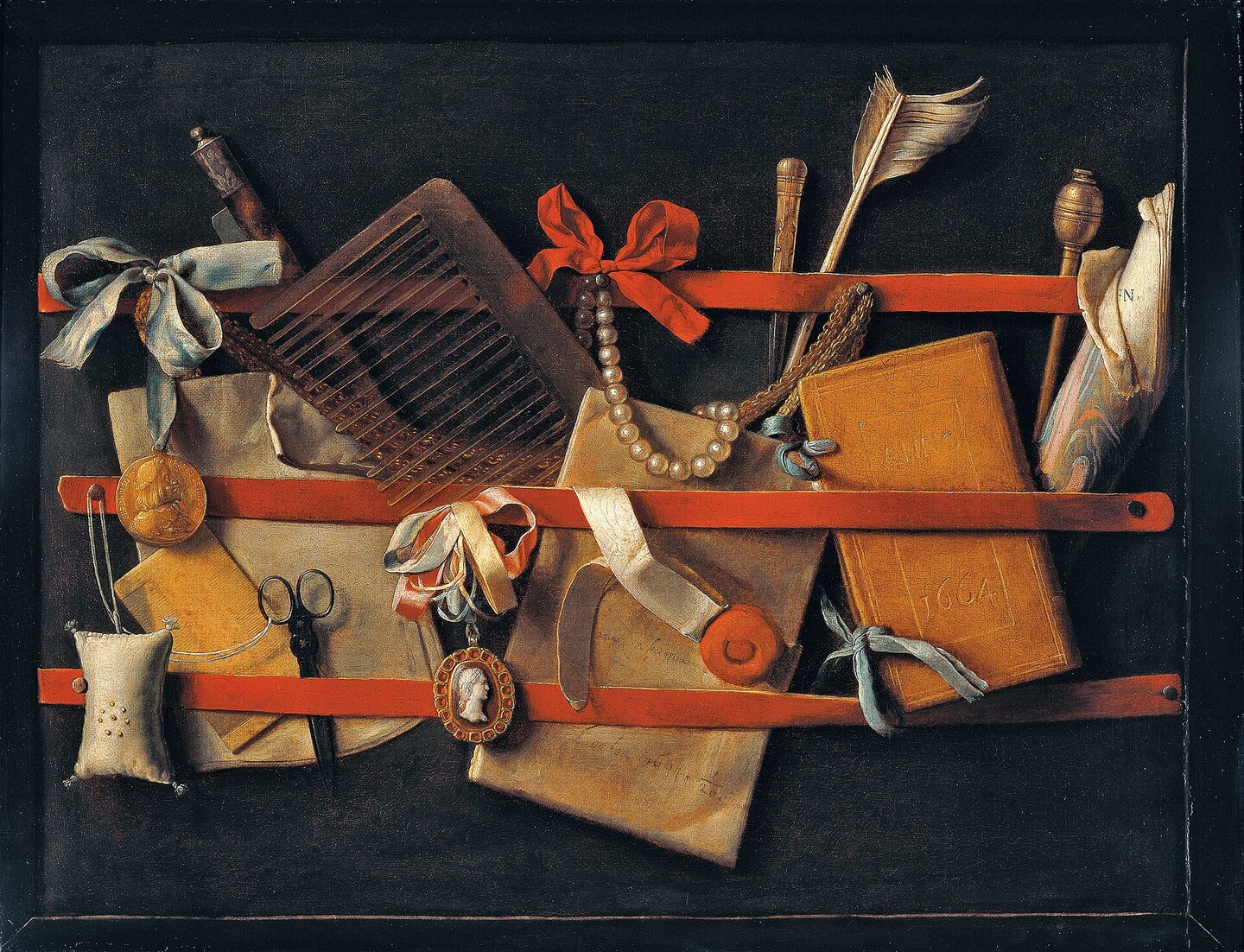
Самюэл ван Хогстратен. «Натюрморт Trompe-l’oeil» (1664). Холст, масло.
Navigation
- Concept | Introduction
- Trompe-l'œil Still Life as an Interior Element
- The Human as a «Participant» in the Trompe-l'œil
- Utilizing Photography in Creating Hyperrealistic Paintings
- Hyperrealism and Social Media
- Overly Realistic Still Life Arrangements
- Conclusions
- Bibliography
- Image Sources
1. Concept | Introduction
Humans were creating illusions as early as the Paleolithic era: for instance, an animal drawing with an extra pair of legs or hooves implied that the animal was in motion. However, images deliberately designed to appear as part of reality first emerged in Ancient Greece and Rome, where artists painted walls to create the illusion of rooms, a view from a window, or expensive materials [1].
Trompe-l'œil (French for «deceive the eye, ” „deceptive appearance, ” or „optical illusion“ [2]), as an artistic technique, was especially popular in the seventeenth century—both in architecture and painting.
Trompe-l’oeil paintings have become interesting interior decor. They often confused guests and became conversation pieces. Notably, trompe-l’oeil existed not only in paintings and frescoes but also in life-sized figures; the «people» and «animals, ” painted on thin wooden panels and then cut out and placed in an interior, initially perplexed the viewer. Some of these „people“ could even „hold a candlestick in their hand.“
Trompe-l'œil is not a relic of the past; it is still used today to design interiors through this technique.
«Trompe-l’oeil» techniques are used both to expand visual space and to create hidden rooms. (For instance, creating the illusion of a bookcase when in reality it is just a panel concealing premium beverages [3].)At the end of the 20th and beginning of the 21st century, the genre of hyperrealism gained popularity in its modern interpretation: still lifes and portraits are so realistic that viewers initially mistake them for photographs. The artists who create these works use photographs as a source of inspiration [4]. Unlike traditional trompe-l’oeil, contemporary hyperrealistic paintings are less often integrated into interior designs, as they are mostly created for publication on social media, where the size of the artwork is irrelevant. Furthermore, such images can be more easily produced on large or even massive canvases, which are less likely to deceive a person viewing the work in reality.In addition to paintings, hyperrealistic sculptures are created, which also amaze the imagination with their detail. However, some sculptors' pieces are also too large, meaning not all hyperrealistic sculptures initially appear to be real people or objects.
So, artists and sculptors have been creating paintings and sculptures for centuries that deliberately deceive viewers. But why? And most importantly, how?
In this study, we compare illusions in 17th-century painting with hyperrealistic paintings of the 21st century, using several artworks as case studies: the materials employed by the artists; the audiences intended to perceive the illusions; and the settings where the paintings were displayed.
2. Trompe-l’oeil Still Life as an Interior Element
Even some of the earliest pictorial illusions were part of the interiors of homes and palaces, so it is quite logical that trompe-l'œil also once adorned someone’s home.
Trompe-l'œil effects might not have been mere decoration, but rather an indication of the owner’s specific interests.
Such a function might have existed in paintings like Samuel van Hoogstraeten’s «Trompe-l’oeil Still Life» (1664) and Antoni Leman’s «Still Life with Hunting Gear» (1661).
Самюэл ван Хогстратен. «Натюрморт Trompe-l’oeil» (1664)
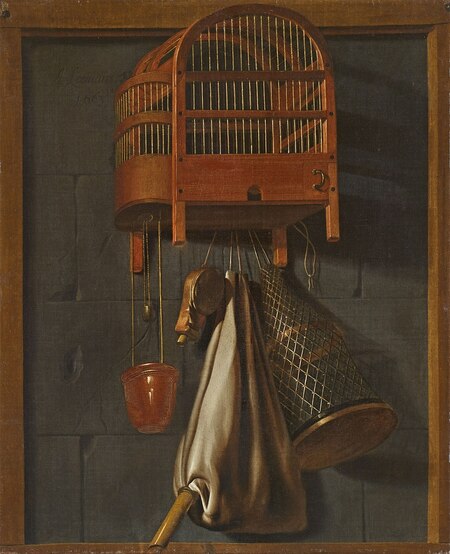
Антони Леманс. «Охотничий натюрморт с птичьей клеткой» (1663)
Samuel van Hoogstraaten. «Trompe-l’oeil Still Life» (1664). Canvas, oil.
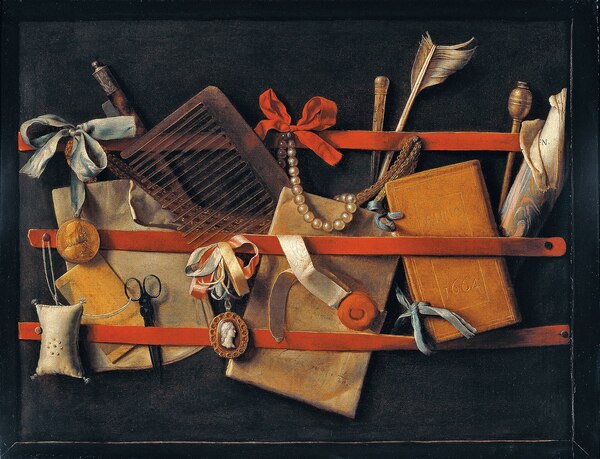
In the still life by Van Huysteren, the objects appear, at first glance, to have no discernible connection. However, upon closer inspection, one might surmise that these items belonged to a man: the painting displays two medals—awards for distinguished achievement, either in culture or in military service. Central to the still life is a comb; perhaps this man paid attention to his appearance. Next to the comb are pearl necklaces, one of which is adorned with a red ribbon. To the right is either a feather or an arrow. In any case, it can be inferred that the gentleman who owned these objects in the still life was a lover who enjoyed writing correspondence (the arrow is one of the symbols of love, as the ancient Greek god of love, Eros—also Amor in Roman mythology—carries a quiver of arrows and a bow).
There is a hypothesis that this trompe-l'œil is composed of objects belonging to Van Houten, and one of the depicted medals is an award given to the artist by the Emperor of the Holy Roman Empire, Ferdinand III, for painting the trompe-l'œil that managed to deceive the Emperor [5].
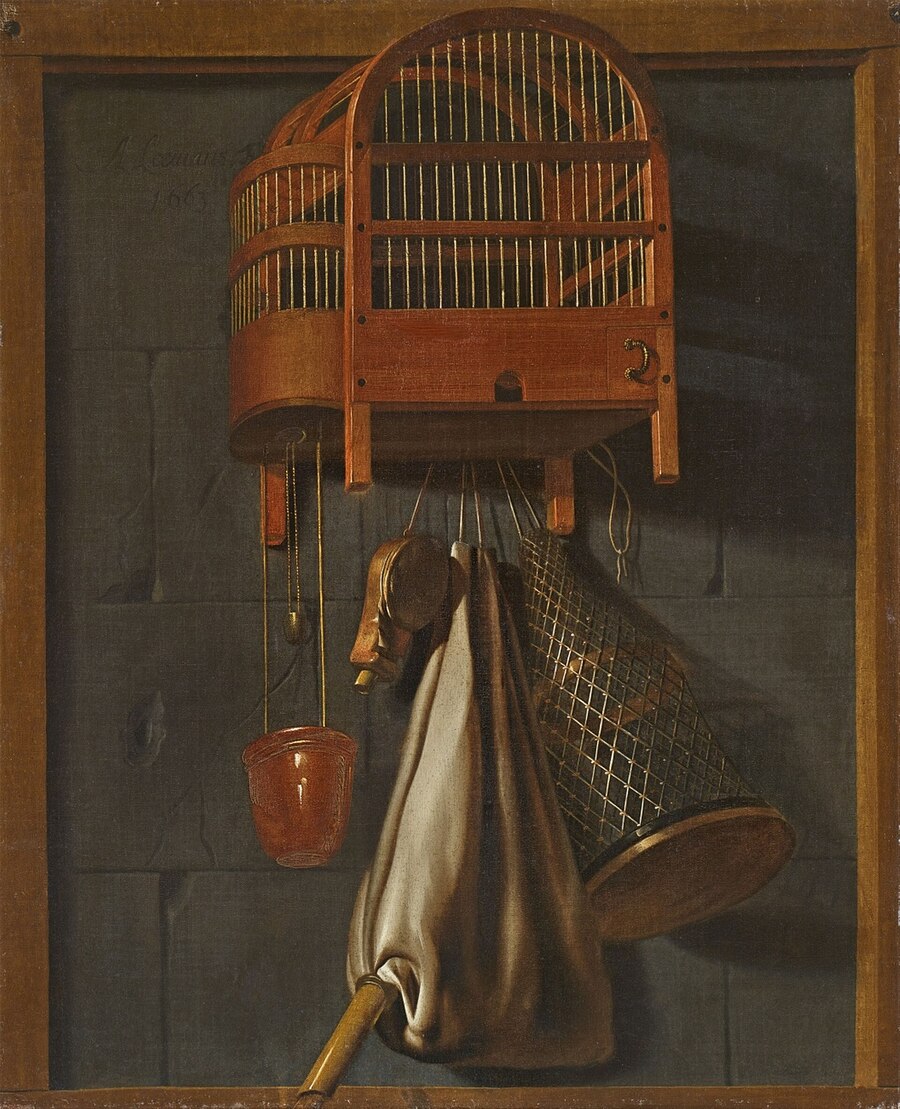
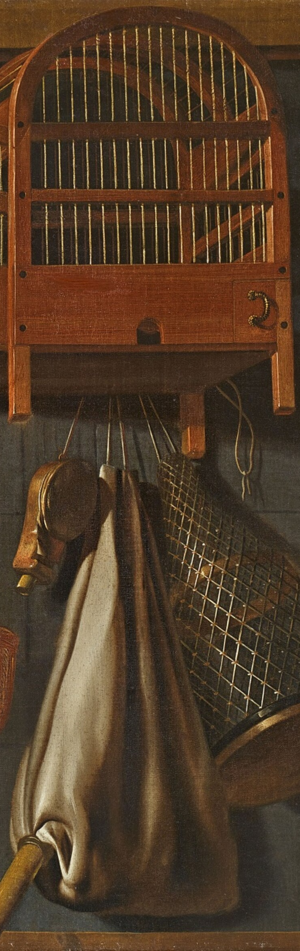
Antonio Llamas. «Still Life with Hunting Equipment» (1661). Canvas, oil.
Turning to the painting «Still Life of Hunting Gear» by Lemans, one cannot help but notice its economy of detail: only a few neatly hung items, which a hunter might use, are depicted. In the upper portion, there is a cage, likely intended for captured birds. Below, a lure pot, a whistle, a sack, and another cage or net are visible. From this collection of objects, it is clear that the owner of these items is a hunter or a hunting enthusiast.
Unlike Van Huysum’s trompe-l'œil, Lemans' painting is less spiritually elevated; it portrays attributes of either a person forced to hunt for a living or an avid hunter. And hunting is a more physically exhausting and messy pursuit than writing letters or reading books. Consequently, Van Huysum’s trompe-l'œil might have been commissioned by a wealthier patron than Lemans' still life.
It can therefore be hypothesized that the audiences for these works of art—people who viewed the paintings by visiting the owners of these canvases—were diverse. Much like the homes that might have featured trompe-l’oeil works by Samuel van Hoogstraeten and Anton Lemans.
Consulting the materials cited in sources (1) and (2), one can observe that both artists used oil paints on canvas for their paintings. «From the 16th century through the end of the 20th century, oil painting on canvas remained the most popular technique, utilized by artists across the globe.» [6] Consequently, it is quite clear why these still lifes were executed specifically with oil paints on canvas.
3. The Spectator—a «participant» in the trompe-l'œil
The viewers of trompe-l’oeil play a significant role, because it is only when the illusion succeeds that the canvas can be considered the work of a true master.
«…to revive trompe-l'œil, the humanism of the Renaissance was needed—not yet a love for humankind, but an interest in it.» [1]
When people visit someone’s home and notice a birdcage hanging on the wall, they will undoubtedly want to know if there is a live animal inside. If it turns out to be a trompe-l’oeil rather than an actual cage, the untrained viewer will be astonished by the painter’s skill in rendering a portion of the real world in intricate detail on canvas.
Thus, trompe-l’oeil pieces are designed for viewer engagement. These paintings should surprise the person and captivate the imagination with how perfectly they integrate into a room’s interior.
4. Using Photography to Create Hyperrealistic Paintings