«Images glowing with the colors of yesterday and inscriptions still retaining the crispness and angularity of the original chisel.»
The concept of early Christian catacombs currently encompasses a massive complex of underground cult structures, numbering over a hundred sites located throughout modern Italy. However, the etymology of the word «catacombs» traces back to a single specific monument—the burial galleries beneath the Church of San Sebastiano on the Appian Way, which was named catacumbas by the first discoverers from Greek-Latin cata tumbas («in the tombs, ” „among the tombs“)[1]. It was in the Catacombs of San Sebastiano that some of the oldest symbols of Christ were found, and from that moment, the great history of the transformation of His image begins.
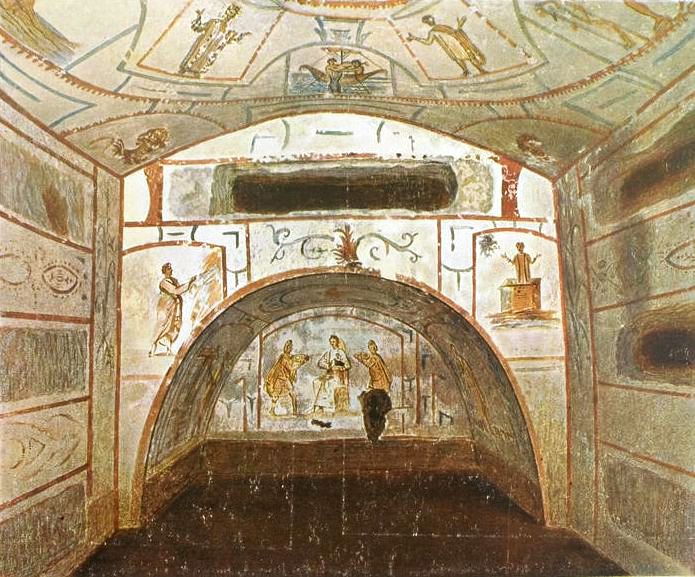
0. Catacombs of Saints Marcellinus and Peter, rich with early Christian frescoes
Navigator
I. Concept
II. Symbols and Monograms
III. Heroes of Ancient Myths
IV. Shepherd and Flock
V. Anthropomorphism
VI. Conclusions
VII. Bibliography
VIII. Image Sources List
I. Concept
During the 2nd–4th centuries CE, catacomb art flourished, revolutionizing the understanding of painting’s core functions. The primary goal shifted from aesthetic quality to the informativeness and sacredness of the imagery. Unlike pagan traditions, which emphasized decorative appeal and expressiveness, early Christian frescoes shifted the focus from the high quality of the depiction to the narrative and its interpretation. Their rich symbolism allowed them to preserve «mystery,» enabling the art to continue surviving and developing within the underground labyrinths despite persecution against Christianity. Frescoes from the catacomb period addressed a wide variety of themes: Roman myths and biblical stories, images of Medusa, Orants, the Virgin Mary, and many others.
Undoubtedly, the image of the Divine—or Jesus Christ—holds a special place in early Christian painting.
Over two centuries, its visual representation has transformed from the most basic symbols to anthropomorphic figures. To convey the image of the Divine, Christians turned to familiar and understandable representations of the 2nd–4th centuries. Mythological characters, in which Christians sought parallels with Christ, or secret symbols concealing the sacred image of God from the outside world, could have served as prototypes. By the 4th century, early Christian symbolism encompassed dozens of signs that formed a new visual language. After Christianity was legalized in the Roman Empire, the need to hide the faith gradually disappeared, and art began to approach a modern depiction of the divine, shaping the image of Christ that is still used to this day.
Key Question and Material Working Methods
The key question of this research is which prototypes and images Christians referenced while conceptualizing the visual representation of the Divine. The main objective was to identify the core categories of imagery that served as inspiration and to understand how the historical and cultural context influenced these choices. The visual study is based on the catacomb paintings from the 2nd–4th centuries—the time of early Christianity’s genesis—and also involved the comparative analysis and exploration of the theme using several early reliefs and ancient Greek sculpture. During the process, the primary guiding sources in the scientific literature were the archaeological works of W. H. Withrow [2], articles by Tatiana Zuykova [3] and Irina Yazykova [4]. Additionally, lecture notes from Natalia Nikolaevna Sorvina, a lecturer at the HSE Lyceum, were used from her personal library. The main stages of source work involved their study, analysis, and verification of their relevance.
Principles of Subject Categorization and Research Structuring
The methodology of typological structuring was used as the framework for the research. It was decided to adhere to the typology identified during the material analysis to visually illustrate the transformation. Four main groups of prototypes and Divine imagery were isolated: symbols, mythological characters, the image of the Good Shepherd, and anthropomorphic depictions of Christ. According to this typology, the illustration series shows the evolution of form across four principal semantic stages.
II. Symbols and Monograms
1. Excerpt from a tombstone featuring images of anchors, fish, and chrism from the San Sebastiano Catacombs, 3rd–4th centuries; 2. Chrism, San Sebastiano Catacombs, 3rd–4th centuries.
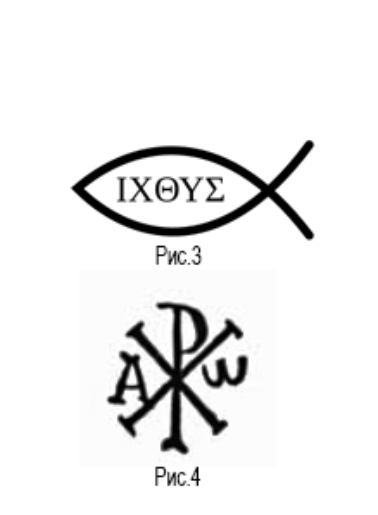
The very first divine image in early Christian art is the fish symbol (Fig. 3). This image did not arise by chance because Ichthys (from Greek «Ίχθύς”—“fish») is a monogram for «Ἰησοῦς Χριστός, Θεοῦ Υἱός, Σωτήρ» (Jesus Christ, Son of God, Savior) [5]. Thus, the ordinary person only recognizes a primitive image of a fish, whereas a Christian imbues this image with the highest significance.Chi-Rho is another monogram of the name of Christ, which, after the Edict of Milan in 313, became the official symbol of God. In its simplified form, it consists of intersecting letters—Chi and Rho—and later the Greek letters alpha and omega were written on either side, which derive from the text of the Apocalypse and signify beginning and end [5], as can be seen in Fig. 4.
Eucharistic bread and fish, Catacombs of San Callisto, 2nd–3rd centuries.
The fresco depicts a well-known biblical scene, the Eucharist (a sacrament of the Christian Church involving the transformation of prepared gifts—bread and diluted wine—into the Body and Blood of Christ [1]). However, as one can observe, Christ is portrayed in the fresco using a familiar symbol—the fish. Through this monument, one can understand that individual symbols can be integrated into narratives, each hiding a mystery that only the faithful can grasp by interpreting the symbols, regardless of the artistic quality of the execution.
III. Heroes of Ancient Myths
The next milestone in the visual representation of Christ is the adoption of motifs from ancient Greek mythology. At this stage, the first human-like image of the Divine emerges in Christianity, with mythological heroes serving as prototypes.
This phase is a transitional stage, positioned between the familiar image of Christ and symbolism. Christians still reference highly recognizable characters, as paganism was the official religion in the 2nd–3rd centuries; however, the frescoes begin to accumulate new meanings, and artists gain the opportunity to engage with the mythological narrative, rendering it symbolic.
6. Hercules bringing Alcestis out of the underworld, Cubiculum N of the Via Latina catacombs, 4th century AD.
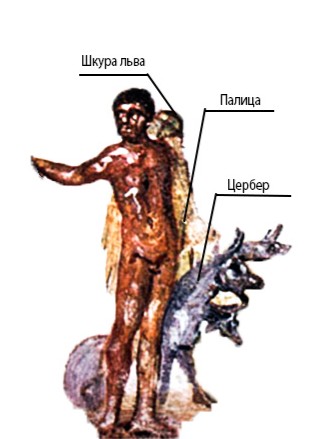
Let’s examine the fresco, «Heracles Leading Alcestis from the Underworld.» The image of Heracles is immediately recognizable through his canonical attributes—the pelt of the Nemean Lion draped over his shoulder, and the heavy club the hero holds in his left hand. Cerberus is a direct reference to the myth wherein the king commanded Heracles to descend into Hades' realm to subdue the three-headed guardian. It is noteworthy that he fulfills this task without resorting to violence.
This plot was not chosen by the master by accident; it is difficult to ignore the significant parallels between the hero and Christ. First, just as Heracles managed to return from the underworld, this resonated with the human conception of the Resurrection. Second, the hero’s refusal to use violence and his kindness in rescuing Alcestis from the netherworld are associated with divine benevolence.
Thus, we see how the image of Christ metaphorically intersects with the ancient Greek myth in the consciousness of a Christian. The attributes assume the function of symbols, and Heracles becomes a complete prototype through which humanity represents Christ.
7. Orpheus, the catacombs of Peter and Marcellus, 4th century.
Orpheus captivated with his lyre playing for animals and birds; Christ—the souls of people.
The fresco from the catacombs of Peter and Marcellinus presents the viewer with an image of Orpheus holding his constant attribute—the lyre. Like Hermes, he is also a figure in ancient Greek mythology. Along with the similarities previously noted with the image of Christ, Orpheus was also able to return from the afterlife and sincerely try to help Eurydice escape the realm of Hades.
However, Orpheus possesses other characteristics similar to the Divine image. The main difference is Orpheus’s ability, through his beautiful playing on the lyre, to gather beasts and birds around him. Here, for the first time, a symbol arises not only of Christ as a preacher but also of humanity as a believer. The images of colorful birds sitting in trees depict Christians as faithful disciples.
In this fresco, just as in the image with Hermes, the prototype of Christ is positioned at the center of the composition, conveying his significance and his hierarchically superior position compared to the other characters. This technique was also employed in other scenes, emphasizing the revered nature of the image of Christ.
IV. Shepherd and Flock
Parallel to the emerging images of Christ-Orpheus and Christ-Hercules, another way to represent the Divine began to appear—in the guise of the «Good Shepherd.» The depiction of the shepherd and his flock became one of the most widespread visual representations of Christ, found in nearly every individual catacomb complex. However, this powerful visual and spiritual image did not appear immediately; rather, it evolved into a generalized embodiment of one of the forms of Hermes—the Cryophoros.
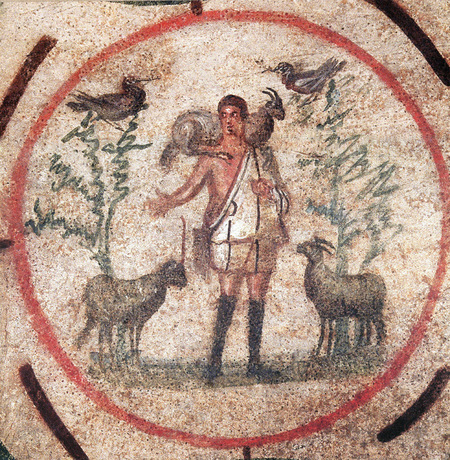
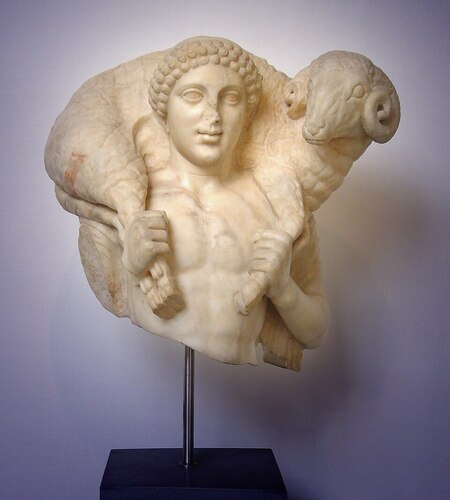
9. Good Shepherd, Catacombs of Priscilla, 3rd–4th centuries. 10. Hermes Crioform, Baroque Museum, Rome, 5th century BCE.
s
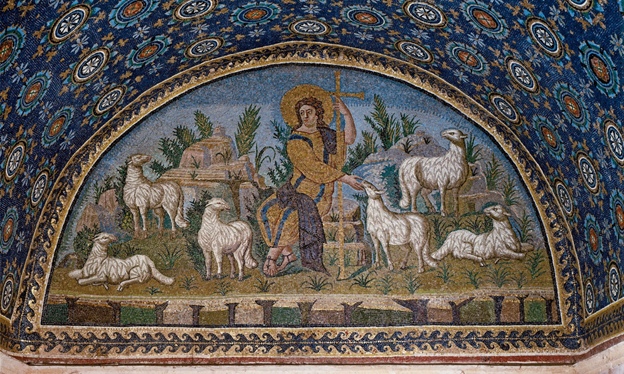
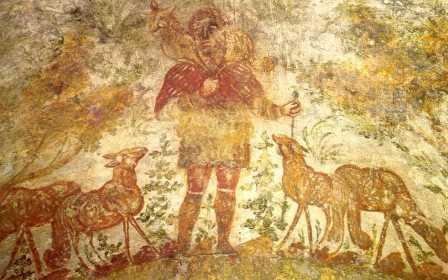
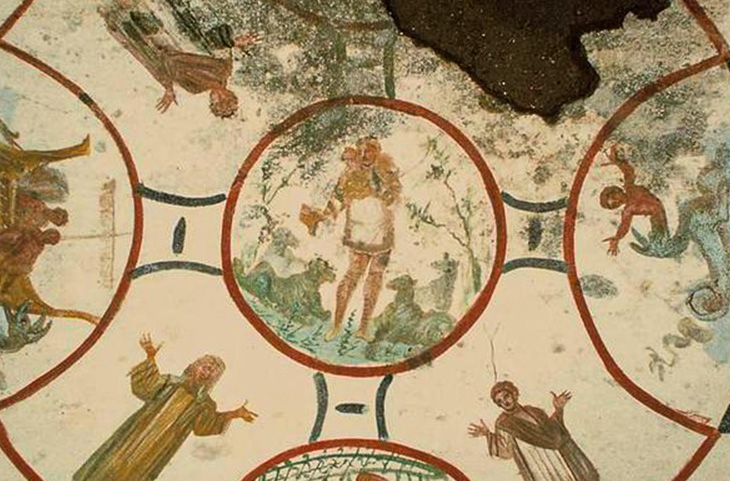
10. Good Shepherd, Domitilla Catacombs, 3rd century. 11. Good Shepherd, San Callisto Catacombs, 3rd–4th centuries. 12. Mausoleum of Galla Placidia, Rome, 4th quarter of the 5th century.