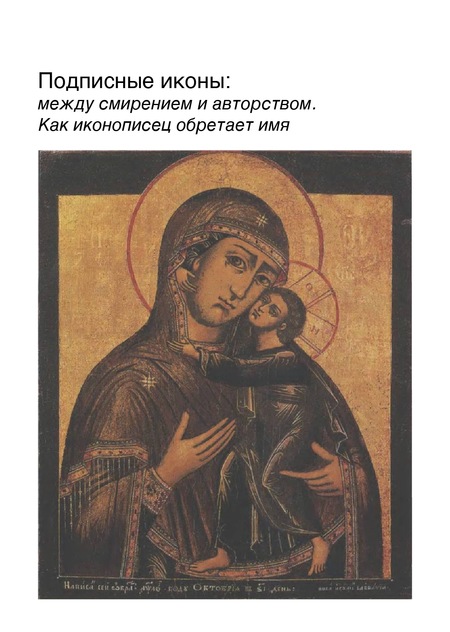
Concept
The icon is traditionally perceived as a work where the artist’s personality takes a secondary role to the sacred image being depicted. The iconographer acts not as an author, but as a conduit who «transmits» the divine image through themselves. In contrast to secular painting, where the author’s individuality, the artist’s signature style, and their recognizability are almost the most important elements of the work, the iconographer cannot invent their own interpretation of a sacred subject: their task is to reproduce the image in accordance with established iconographic canons and maintain fidelity to the Church’s Tradition.
In this case, the absence of a signature is not perceived as a lack of information. It is viewed as a natural consequence of understanding the icon. A signature can be seen as pride, while its absence is considered complete devotion to God. Traditionally, the icon is understood as a work in which the artist’s personality takes a secondary role to the sacred image depicted. The iconographer acts not as an author, but as a conduit, one who «channels» the divine image through themself.
Unlike secular painting, where the author’s individuality—the artist’s unique signature and recognizability—is perhaps the most crucial element of the work, the iconographer cannot invent a personal interpretation of the sacred subject matter. Their task is to reproduce the image in accordance with established iconographic canons, maintaining fidelity to the Church Tradition. In this context, the absence of a signature is not perceived as a lack of information; rather, it is seen as a logical consequence of understanding the icon. A signature might be viewed as pride, while its omission signifies complete devotion to God.
However, in the history of Russian icon painting, there are works where masters left their names. Such icons are known as signed icons. These works evoke a particular cultural interest because behind the divine image, one can see a specific person with their own biography and name. The signed icon becomes not only a divine image and an object of religious veneration but also a unique historical document, preserving information about the era, the people, the environment, and the culture of its time.
I chose this topic precisely because of the inherent tension between tradition and the individual identity of the icon painter. I am interested in exploring not so much the mere fact of the signature’s appearance, but the causes and conditions under which it becomes possible and gains significance. Why does one artist maintain the role of a «guide,» while another leaves his name, surname, and date of birth on the icon, proclaiming not only God but also himself? Is such a signature a display of the artist’s pride, or does it serve an entirely different function? Can it be considered evidence of the gradual transformation from craftsman to artist?
As a key research question, I pose the following: how does the presence of an artist’s signature alter the perception of an icon, and what does this reveal about the changing social and artistic status of the icon painter?
My hypothesis is that the proliferation of signature icons is not simply related to the masters' desire to assert their individual identity. The gradual complication of icon production played a significant role. The development of large workshops, the emergence of professional centers, increased state oversight of icon painting quality, changes in the relationship between the commissioner and the artisan, and various administrative details all contributed to the master’s name becoming an integral part of the object itself. Furthermore, the signature did not necessarily contrast the artist against religious tradition; it could serve as a testament to execution accountability, confirmation of the work’s provenance, a form of professional self-identification, or part of a commissioned inscription.
The principle for selecting visual materials is based on the presence of documented authorial signatures or inscriptions that reliably establish a specific master’s involvement in creating the icon. The research is grounded in works from museum collections, primarily the catalog of signed icons from the 17th to early 20th centuries from the Vladimir-Suzdal Museum-Reserve, as well as materials from the State Russian Museum and scholarly publications on the history of Russian icon painting.
Ultimately, the research should lead to the conclusion that the icon not only preserves the image of the saint but also the memory of the person who created that image. This is precisely where its unique historical and artistic value lies.
I. The Icon Without an Author: A Tradition of Anonymity
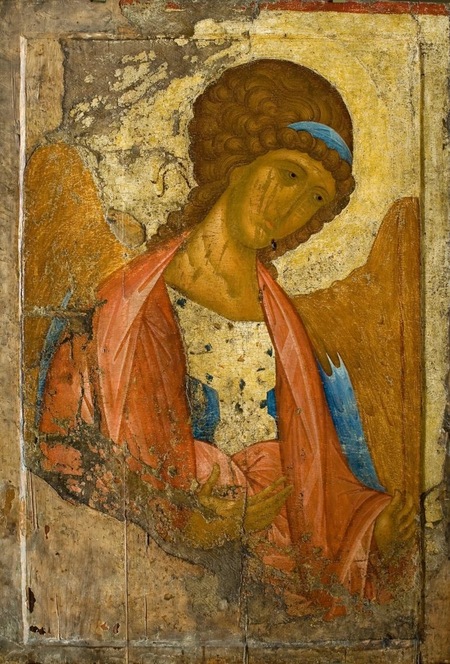
In the tradition of Orthodox icon painting, the artist long remained subordinate to the image created by their hands. The icon was perceived above all as a sacred artifact, not as the work of a specific artist. The creator’s task was to serve the image, not to showcase personal virtuosity. Anonymity was linked to the Christian ideal of humility: personal vanity should not supersede the spiritual content of the work. (The photo features Andrei Rublev’s icon, «Archangel Michael»).
However, it is important to understand that this tradition was not absolute. The names of early Russian icon painters are known—for instance, Andrei Rublev, Theophanes the Greek, and Dionysius. Signed icons also existed, although they appeared significantly less frequently. Before the 17th century, inscriptions naming the masters were more often commemorative or dedicatory. Gradually, particularly in the second half of the 17th century, the author’s name began to acquire a more independent significance.
II. Signature as an Act of Pride or Testimony of Labor
The signature could indicate:
— the iconographer — the date and place of creation — who commissioned the icon
During the 17th and 18th centuries, subscription icons became an integral part of iconographic study. Signed and dated icons provided specialists with information that was previously nearly impossible to obtain. For example, in the early 18th century, under the reforms of Peter I and the activities of the Holy Synod, there were mandates requiring masters to include information about themselves and the creation date of the work. The signature could be a professional responsibility—the master confirmed that they were the one who completed the work.
III. The Artist’s Name as Part of the Narrative
Before the 17th century, the name of an icon painter rarely appeared on the icons. However, the absence of a signature did not mean the artist left no «mark» on the work indicating their involvement. In medieval Rus', there were inscriptions that mentioned the artist’s name alongside the names of the patrons or donors. Such texts might have served as memorial records rather than the conventional signature we recognize today.
Researcher Alexander Preobrazhensky, in his work «Inscriptions with the Names of Russian Icon Painters of the 13th–15th Centuries,» notes that inscriptions before the 17th century usually possessed a more complex structure and were often linked to a donation or dedication. In other words, the artist’s name could be incorporated into text describing who commissioned the work, who paid for its creation, and to whom it was intended.
III.I What does the emergence of a name change?
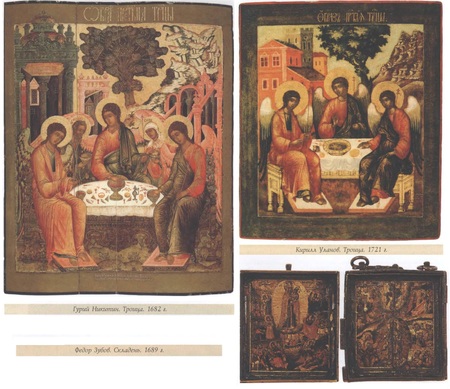
The signature transforms the icon into an object whose history can be traced through specific individuals. Through the image, the master, the commissioner, the workshop, and the circumstances of its creation are revealed. At the same time, the signature does not negate the icon’s sacred purpose. It simply adds a historical dimension to it. To put it simply, the master’s name is a small human detail within a work that is oriented toward the eternal. The signature preserves the memory of the person without claiming to replace the meaning of the depicted image.
III.II Signature as a Historical Source
Over time, inscriptions on icons became a crucial source of information for researchers. They allow one to learn who painted the icon, when it was created, and for whom it was intended. Works from the 17th century are particularly interesting in this regard, as signed icons appear more frequently during that period.
Simon Ushakov. «Christ Pantocrator,» 1663.
The icon depicts Christ, seated or presented frontally from the waist up. His right hand is raised in a gesture of blessing, and in his left is the Gospel. A halo encircles his head, signifying sanctity. Christ’s face is painted with meticulous attention to detail: the artist conveys the volume of the face, the soft transitions of light and shadow.
Particular importance is given to the inscription at the bottom of the icon. It names Simon Ushakov, the date of the artwork’s creation, and the patron—Vasily Semyonovich Volynsky.
This inscription allows us to learn not only the author but also the circumstances of the icon’s creation. Because of this, the work becomes not just a religious image for us, but also a historical testimony.
V. The Artist’s Individuality: Can You Recognize an Artist Without a Signature?
Icon painters worked according to specific rules known as the iconographic canon. This canon dictated how saints should be depicted, what objects should be placed near them, and which gestures and colors were to be used. At first glance, it might seem that these rules mandated uniformity across all icons. However, this is not entirely true. Even when two masters depicted the same saint, their works could differ. One artist might focus more on intricate details, while another might utilize simpler forms. Differences could appear in color palettes, figure proportions, the nuances of facial rendering, and background composition.
Thus, the icon painter could adhere to tradition while preserving his own artistic style.
V.I. Stroganovskaya School: Attention to Detail