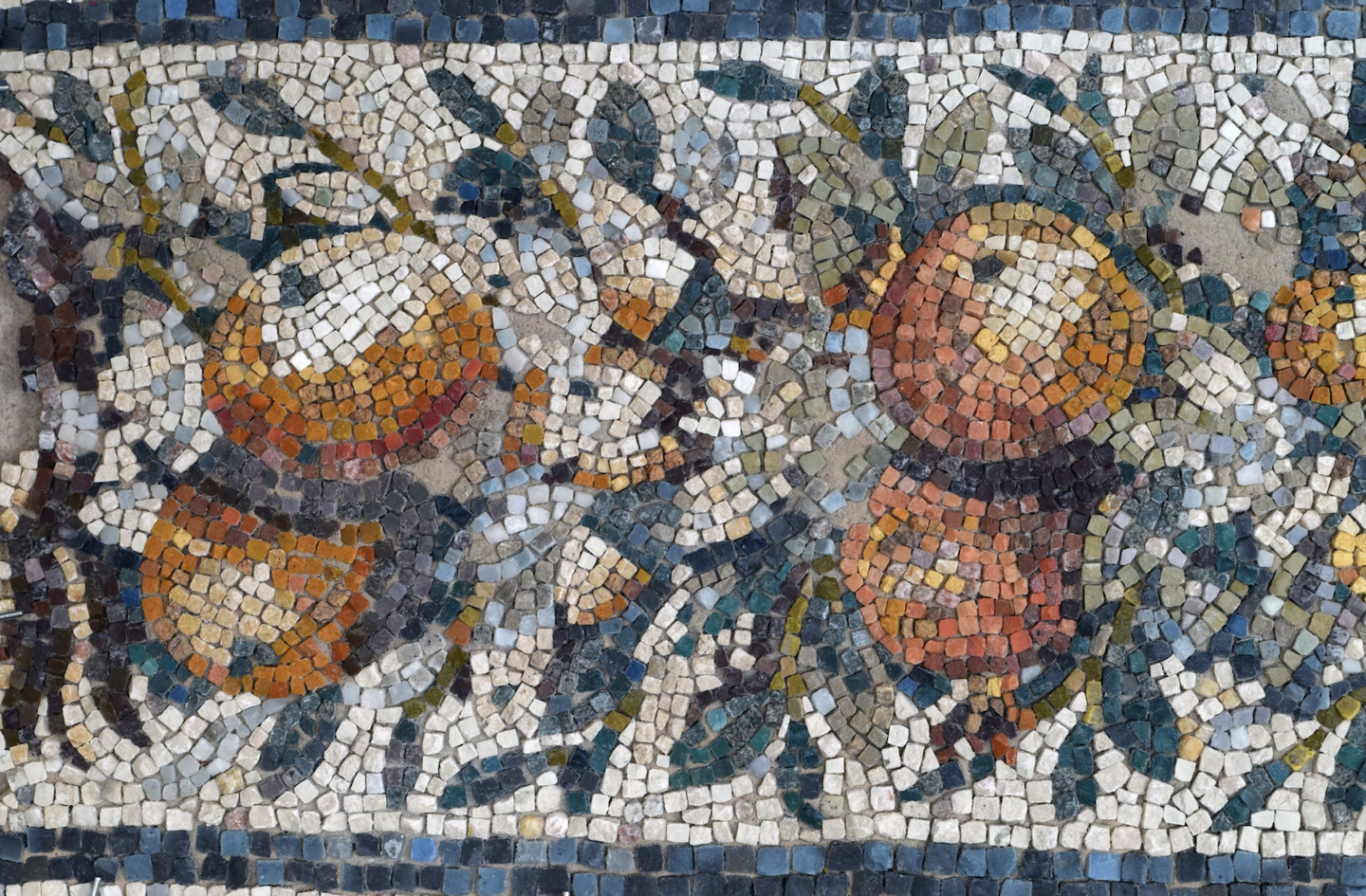
Concept:
Roman mosaic is an art form that developed from the 4th century BCE and reached its peak during the 1st and 2nd centuries CE. This concept involves creating compositions from small pieces of stone, glass (tesserae), and sometimes other materials. Such mosaics adorned architectural structures—palaces, temples, bathhouses, and even pavements. For the Romans, mosaic was not merely art to decorate floors or walls or facades; it served a functional role in storytelling, demonstrating wealth, and expressing religious beliefs. Most astonishingly, many mosaics created almost two thousand years ago have survived to this day. Thanks to them, we can literally see what the world looked like through the eyes of the residents of the Roman Empire.
Creating the mosaics demanded outstanding skill and meticulous labor, as each tile had to be placed precisely in its spot. The subjects were varied: they could range from pure abstractions to scenes holding historical or religious significance. This art form required exceptional mastery and painstaking work. This theme was chosen because of its artistic communication—for through the ornament, whether located on the floor or the wall, we gain insight into the methods of Roman communication, self-expression, the outlet of creative energy (the impulse to create), and the ways art was executed within the concepts of religion and learning.
Mosaic has almost always been an expensive and time-consuming art form: thousands of tesserae are used for a single square meter, and panels take months to complete. Yet, it endures buildings—many Roman floors and Byzantine vaults have survived in better condition than the walls surrounding them. This is why history reads so clearly in mosaics: each era has its own materials, its own module, and its own method of laying the rows. It is especially interesting to examine mosaic in the context of today, where visual information surrounds us everywhere. Similar to a digital image composed of countless individual pixels, Roman mosaic forms a unified image from small stone or glass elements. This creates an interesting parallel between ancient technology and contemporary digital culture.
This visual study will analyze the creation of mosaics from the Roman Empire, focusing on key aspects of their production. I will present several examples. First, I will examine the mythological origins and significance related to a specific mosaic. Second, I will explore the function of these mosaics in the floors or walls of buildings. Third, I will investigate the daily life of that era and how it was translated onto the canvas of the mosaic. Fourth, I will consider the various techniques and materials used in creating the mosaics.
Chapter 1. Technologies and Materials
To create the mosaic ornament, small cubes (tesserae) of materials with different shapes, colors, and textures were laid in a specific quantity and order. Typically, stone, glass, marble, pebbles, and tuff were used—these were placed on a base and secured with adhesive.
Mosaic Laying Techniques:
Opus tessellatum—a standard technique using square tesserae of uniform size, laid in straight rows. It is suitable for backgrounds, ornaments, and simple imagery.
Opus tessellatum, Roman mosaic copy
Opus vermiculatum (from vermis — worm) is a technique using tesserae laid along the contour of an image, mimicking its shape. It creates a sense of movement and is suitable for portraits, still lifes, and animals.
Cat with partridge, birds and fish. Mosaic. Pompeii.
Opus sectile — a technique using tesserae of various shapes and sizes, precisely cut to fit the design (not square blocks, but complex geometric forms). It is the most expressive and intricate technique. It is used on the expensive floors and walls of palaces.
Rome. Basilica Junii Bassi
Opus signinum — mosaic made from small ceramic shards embedded in cement mortar, used for durable floors.
Opus signinum
Chapter 2. Geometry and Symmetry
Geometry and symmetry play a key role in Roman mosaic art, transforming the decoration of floors and walls in homes, baths, and palaces into ordered architectural maps. The ancient Romans possessed a profound understanding of harmony. Their mosaics were a true symphony of form and color. They favored geometric patterns such as circles, squares, spirals, and meanders (the Greek key). Roman mosaics are not just art; they are a way to express philosophical and cultural ideas through geometric shapes. Their mosaics were not only aesthetically beautiful but also carried a practical element—they depicted the canvas in a language of symbols that concealed the true meaning of the image.
Here is what lay behind their geometry:
- Circles and spirals—symbols of eternity and cyclicity. A reminder: everything has its own rhythm. - Meanders (Greek key)—protection and continuity. This served as a protective amulet for the home, while also being visually beautiful. - Hexagons (honeycombs)—an ode to natural logic. They conveyed admiration for the harmony of nature. - Chessboard patterns—stability. They suggest that the homeowner has everything under control.
Geometric floor: meander, octagons, stars
Geometry, with its mathematical precision and elegance, is another cornerstone of mosaic design. By utilizing geometric shapes such as squares, triangles, hexagons, and octagons, artisans create intricate mosaics that form the building blocks of mosaic patterns. These repeating elements combine organically, forming cohesive compositions that captivate the eye and mind.
Roman masters did not merely create decoration; they conveyed philosophy. Even a simple ornament could become a manifesto of harmony and order.
Chapter 3. Daily Life
Roman mosaics depicted the daily lives of ancient people—Romans and others. Wealthy Romans, in particular, had mosaics featuring their banquets and feasts.
«Untidy Floor» Heraclitus
The Greek master Sos from Pergamum was the first to depict the remnants of a feast on the floor (bones, shells, husks), according to Pliny the Elder. A Roman copy inscribed with Heraclitus—featuring a mouse gnawing on a nut—is housed in the Vatican Museums.
Mosaics Mouse from Heraclitus’s «Untidied Floor»
Just the mouse Heraclitus depicted that rushed over to try the fallen walnut.