Concept
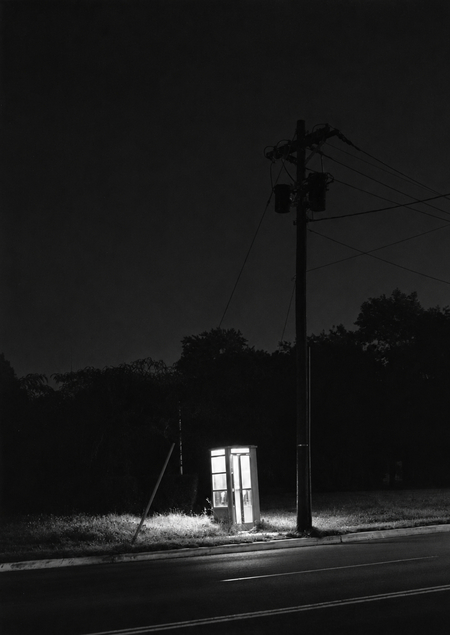
Throughout the 20th century, the nocturnal city became an independent subject in art photography. Artificial lighting, darkness, and limited visibility allowed photographers to create images of the urban environment distinct from its daytime perception. Meanwhile, the methods of depicting the night evolved—from painterly landscapes with blurred silhouettes to documentary scenes, color photographs of neon streets, and nearly deserted urban spaces.
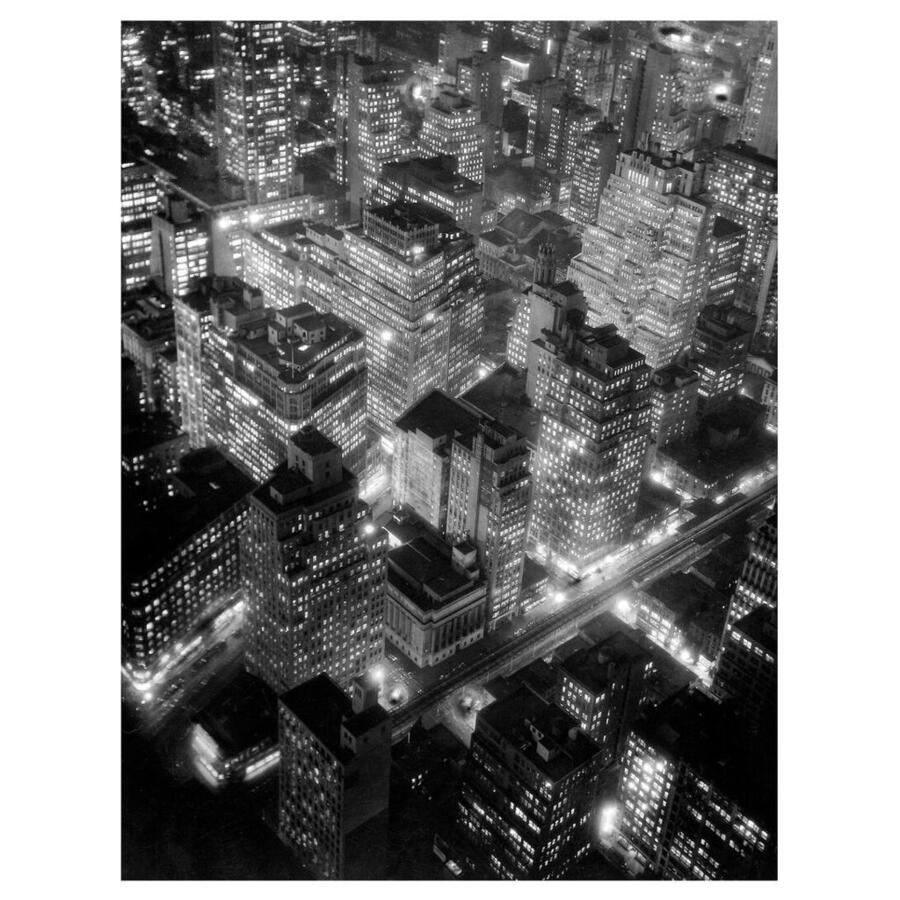
Berenice Abbott. «Night View of New York,» 1932.
The evolution of night photography was closely tied to the transformation of the urban environment. The widespread adoption of electric lighting revolutionized the appearance of streets, storefronts, and public spaces. As historian Wolfgang Schivelbusch notes, artificial light played a crucial role in the development of modern urban culture [1].
Research Question How did advancements in photographic technology and changes in the urban environment influence the depiction of the nighttime city in the 20th century?
Research Hypothesis Changes in night photography were connected not only to technical progress but also to new artistic approaches. Night gradually ceased to be solely a subject for landscape photography and became a means to portray the city’s daily life and the photographer’s personal perspective.
Late 19th — Early 20th Century
Early night photography required long exposures due to the low light sensitivity of the materials. This complicated capturing moving subjects, but it allowed for the conveyance of the soft light from streetlamps and its reflections on wet pavement. Consequently, photographers’ focus centered on the illumination, the architecture, and the atmosphere of the nocturnal streets.
Paul Martin. «Trafalgar Square on a Very Rainy Night, ” c. 1896.
Paul Martin. «Alhambra, London at Night, ” 1895.
In Paul Martin’s photographs, light becomes the primary element of the composition. On Trafalgar Square, lampposts reflect in the wet pavement, and in a shot of the Alhambra Theater, the illuminated facade stands out against the dark street. A long exposure smooths out movement, focusing the viewer’s attention on the contrast between light and shadow.
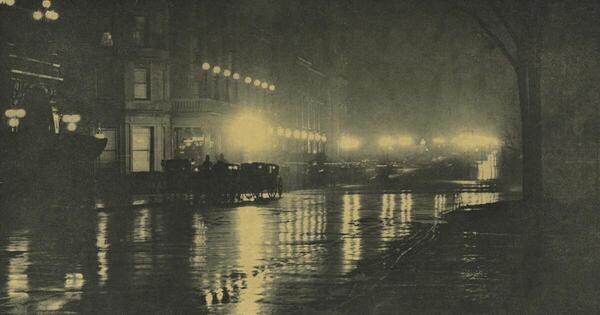
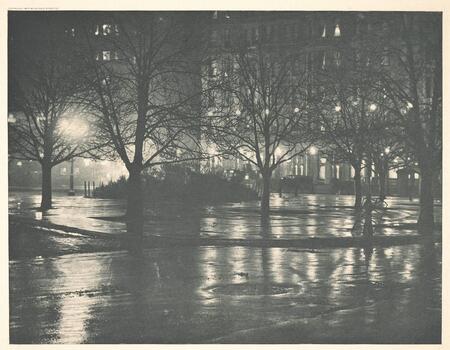
On the left is Alfred Stieglitz, «Night Glow — New York,» 1896; on the right is Alfred Stieglitz, «Reflections: Night — New York,» 1897.
In Stieglitz’s photographs, the nighttime city remains recognizable, yet the focus is primarily on the lighting. In «Glow of Night,» streetlamps recede into the depth of the street, their light reflecting on the wet pavement. In «Reflections,» the dark silhouettes of trees contrast with the illuminated square. Long exposures allow him to capture diffused light and unify disparate details into a cohesive composition.
Edward Steichen. «Flatiron, ” 1904
In «Flatiron, ” Stiichen almost dissolves the building into twilight. Dark silhouettes of trees and a passerby stand out against the sky, and the greenish hue lends the image a painterly quality. The color was added during printing, making the photograph reminiscent of James Whistler’s nocturnes. This approach is characteristic of Pictorialism, whose practitioners sought to emphasize photography’s artistic potential [13].
1920s–1930s
By the 1920s, electric lighting had significantly transformed the appearance of the nighttime city. Illuminated signs and billboards began to capture attention as compellingly as the architecture itself.
Knud Lønberg-Holm. «Billboards at Night, Detroit, ” 1924
In the photograph, a brightly lit billboard dominates the frame in the Lenberg-Holm area, with the surrounding buildings almost vanishing into the darkness.
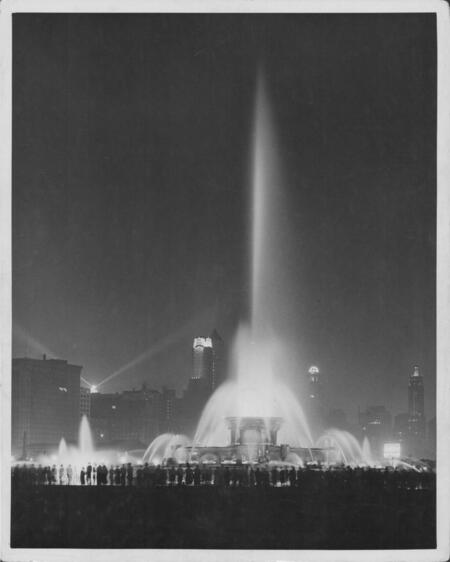
Left — Gordon Kosters. «Chicago. Night Impression, ” 1932. Right — Gordon Kosters. „Impressions of Chicago. Grant Park Lights, ” 1932.
Giuseppe Albegamo. «Light Weavings, ” 1939.
In Giuseppe Albegamo’s «Luminous Weavings,» the traces of zenith projectiles are captured in the night sky above Palermo. Due to the long exposure, their trajectories have transformed into intersecting lines of light. The photograph resembles an abstract composition, although it actually records the work of the anti-aircraft defense at the beginning of World War II [14].
Social Life of the Night City
In the 1930s, photographers increasingly turned their focus to the city’s nightlife. Brassaï documented not only the streets of Paris but also the bars, brothels, and their patrons. Ian Walker, in his study «City Gorged with Dreams,» links this fascination with the hidden aspects of everyday life to a surreal perspective on the city [2].
Brassai. «A Poster Column in the Fog, ” 1932. „View from under the Royal Bridge toward the Solferino Bridge, ” circa 1933. „Kenkampua Street and its hotels for short visits, ” circa 1932.
Brassai uses darkness to highlight individual details of nighttime Paris. A poster column emerges from the mist, and the bridge arch frames the illuminated river. In the third shot, the focus shifts to people—two figures stand out against the backdrop of a deserted street. This is how the photographer connects the atmosphere of the night city with the observation of its daily life.
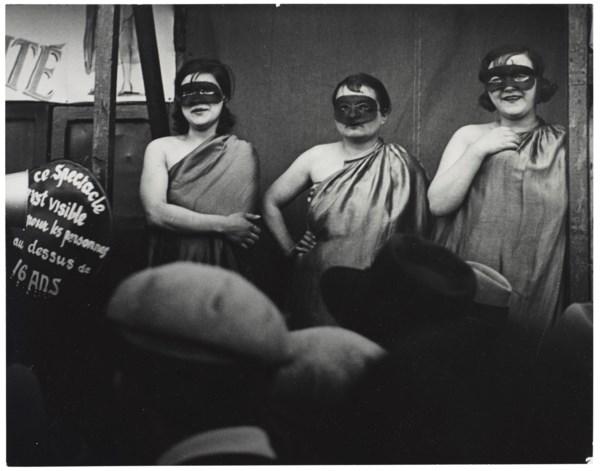
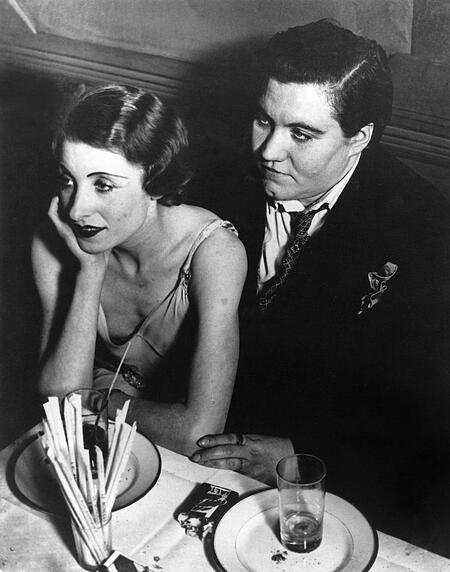
On the left is Brassaï. «Three women in masks before their pavilion on Boulevard Saint-Jacques, ” 1931. On the right is Brassaï. „A female couple in the Le Monocle bar, ” 1932.
In these photographs, Brassais turns his attention to the nightlife of Paris. At the fair, he photographs three masked women attracting visitors to a performance. The second photograph was taken at Le Monocle bar. Unlike the deserted streets, here the focus is on the people and their interactions. Night photography allows Brassais to show aspects of urban life rarely presented in official images of Paris.
Bill Brandt. «Soho Bedroom, ” 1936; „London Street Scene, ” 1936; „Bermondsey Streets, ” 1937.
In the photobook A Night in London (1938), Brande shows different facets of nighttime London—from private life to deserted alleys. His photographs have a documentary feel, although some scenes were staged. In «A Soho Bedroom, ” the photographer’s brother Rolf posed, and in „Street Scene, ” Rolf and his wife Esther were featured. Brande also used supplementary lighting to give the nocturnal episodes the necessary expressiveness. Thus, he combined documentary shooting with techniques of staged photography [3].
1930s–1940s
During the 1930s and 1940s, the flash allowed photographers to capture nocturnal events and quickly document motion. One of New York’s most renowned night photographers was Weegee. The harsh flash light separated people from the darkness, emphasized their gestures and facial expressions, lending a dramatic quality to everyday scenes.