Sections
1. Introduction
2. The Kiss as Reward
3. The Kiss as Payment
4. The Kiss as Script and Choice
5. The Kiss as Punishment and Obligation
6. The Kiss as Physical Trial
7. Conclusion
Introduction
The kiss is a conventional form of human interaction. Through it, people express love and affection, greet loved ones, and bid them farewell. Depending on the situation, this gesture can signify tenderness, respect, gratitude, reconciliation, or adherence to tradition. Its meaning is largely determined by the circumstances in which it occurs.
A kiss is not always spontaneous, nor does it necessarily convey personal feelings. It can be dictated by traditions or rules that define when, whom, and under what circumstances one should kiss. This is especially evident in play practices: the gesture becomes part of a predetermined scenario.
The kiss has been used in a wide variety of situations. It has expressed love and affection, served as a greeting or farewell, and symbolized respect and reconciliation. Another area where it has taken on a special role is in play.
In play, the kiss could function as a reward for victory, a payment, a condition for completing a task, or a component of the game’s narrative. Its significance depended on the rules—participants performed the gesture because it was stipulated by the course of play.
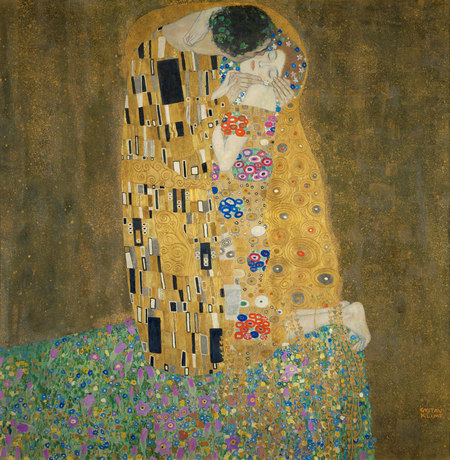
| Gustav Klimt «The Kiss» 1908–1909
This is not a sincere kiss of love, the kind that is given and received as such, but a kiss demanded by the rules of the game.
This observation is the foundation of my research. Bell distinguishes between a kiss as an expression of personal feeling and a kiss required by rules. In the latter case, participants may kiss not out of romantic affection, but because the game dictates it.
Why did the kiss become part of the game’s rules and what role did it fulfill within the game? I am primarily interested in the kiss’s function inside the game. Why was this specific gesture used as a reward, punishment, or task requirement? How did it influence participant interaction and the flow of the game itself? The research operates under the premise that the gaming situation alters the customary meaning of a kiss. Outside the game, it may express emotion, whereas within the gameplay, its function is determined by the established rules. In the game, the kiss can serve as a reward, a toll, a punishment, part of a role-playing scenario, or a physical challenge. Its significance is set by both the participants' actions and the game situation itself. It is hypothesized that incorporating the kiss into the rule system imbues it with additional social and game-specific functions.
To understand the role a kiss plays in various games, I divided the found gameplay practices into five categories:
- Kiss as Reward. The kiss serves as a prize for winning, successfully completing a task, or achieving a specific outcome.
- Kiss as Payment. It functions as a form of in-game currency that a participant must surrender to continue playing, gain an advantage, or avoid certain consequences.
- Kiss as Script. It becomes part of a predetermined storyline where participants are assigned roles and must follow a specific sequence of actions.
- Kiss as Punishment or Ransom. It is assigned to the loser or becomes a condition for being freed from an in-game obligation.
- Kiss as Physical Challenge. It is incorporated into tasks that require a certain level of agility, coordination, or interaction among participants.
This categorization helps track the role the kiss plays across different game mechanics.
Kate Greenaway’s Birthday book c. 1880 — Kate Greenaway (1846–1901)
The research material consisted of historical game practices from Europe and North America spanning the 18th through the 20th centuries. The focus is on pre-digital games where a kiss was directly incorporated into the rules or constituted an essential part of the gameplay process. The sources are primarily historical collections of games, archival materials, descriptions of play practices, and studies dedicated to social relations and daily culture. Special attention is given to games where the kiss functions not as a random occurrence but as a necessary condition for participant interaction within the established rules.
Throughout this project, I select games that incorporate kissing into their rules and categorize them according to five defined functions. For each game, I analyze its origins, the conditions for its play, the roles of the participants, and the significance of the kiss within the gameplay.
Additionally, I compare various rule variations of the same game to trace how the interaction parameters and the meaning of the kiss have evolved. I also examine visual evidence—illustrations, engravings, and other imagery—to convey the atmosphere and characteristics of these historical play practices.
The study treats kissing as an element of play culture. I trace how a common gesture transformed into an action governed by rules.
The play practices are grouped based on the function of the kiss. This allows for a comparative analysis of different situations, revealing how rules alter the meaning of the same gesture.
A Kiss as Reward
In competitive or chase-based games, a kiss could become a prize for completing a successful action. It would conclude the gameplay sequence, and the ability to win it depended primarily on the game’s outcome, not the participants' personal relationship.
Kiss in the Ring
«Kiss in the Ring”—a traditional English game whose name translates to „Kiss in the Circle.“ Participants form a circle, and the game is built on selection, pursuit, and role switching. A kiss becomes one of the possible outcomes of this interaction.
Kate Greenaway’s Book of Games (London: Routledge, 1889)
The players form a circle, and one participant begins walking around it, choosing whom to follow. After the selection, a chase begins: one player tries to catch the other as they move around the circle. In some descriptions, the action concludes with a kiss, after which the participants may switch roles.One of the earliest mentions of the game appears in William Howe’s The Every-Day Book, published in 1825. Later, collectors of English folklore, including J.S. Udal and Alice Bertha Gumm, documented the game. Their descriptions reveal how this folk game was preserved and adapted across different communities.
Here, a kiss follows the successful completion of a gameplay action. First, a participant selects another player and pursues them, and the kiss becomes a prescribed reward.
Blind Man’s Buff
Blind Man’s Buff — a traditional game known in various European countries. One participant is blindfolded and becomes the seeker. Their task is to catch another player by relying on sounds and movements around them. In some historical variations, the catch was accompanied by an additional action—a kiss.
Rosie M. M. Pitman | «Blind Man’s Buff»
The basic premise of the game is that the driver is blindfolded, and the other participants move around them, trying to avoid being caught. The driver must then identify or recognize the captured player. In one recorded Irish version, if the captured participant was of the opposite sex, they could be kissed.
Drop the Handkerchief
Drop the Handkerchief — a game of attention and reaction time. Participants form a circle, and the leader walks around them holding a handkerchief. Their task is to subtly drop the handkerchief behind one of the players. That player must notice it, stand up, and catch up to the leader before the leader occupies the vacated spot.
Kirk, Maria Louise, 1860–1938
In the descriptions of Drop the Handkerchief, there are variants where the game concludes without a kiss. However, in some local versions, this action was added to the core mechanics. Alice Bertha Groom noted the differences between the game variants and provided evidence that in certain places, the kiss became part of the finale. The material from Dorset county is particularly interesting: according to a recorded account, about thirty years before the 1890s recordings, the game was played there without a kiss. This demonstrates that the kiss was not necessarily an original part of the game’s mechanics.
The kiss does not change the core structure of the game, but it impacts its emotional and social meaning. The speed competition is complemented by physical interaction among the participants. In some variations, the kiss is integrated into the standard scenario; in others, it appears as a local addition.
In the games examined, a kiss appears as a possible outcome of a successful gameplay action. In Kiss in the Ring, it is connected to choice and pursuit; in Blind Man’s Buff, it is tied to capturing another participant; and in certain variants of Drop the Handkerchief, it becomes an additional game finale.
However, the kiss is not always a mandatory part of the rules. Comparing different records shows that its appearance or absence could depend on local tradition. The game thus does not simply use the kiss as a reward but also defines the circumstances under which it becomes part of the interaction between participants.
Kiss as Payment
Post Office