
Navigation
1. Introduction
2. Historical Context of Roman Italy in the 2nd–3rd Centuries
3. Visual Language of Iconography
4. Reproduction and Replication of Images
5. Analysis of the Mars Motif
6. Analysis of the Eros and Psyche Narrative
7. Analysis of the Tyche Motif
8. Comparison of Regional Iconographic Variations
9. Original and Copy: Similarities and Differences
10. Conclusion

1. Introduction
The subject of the study is Roman intaglios from the 2nd–3rd centuries CE, particularly those related to the empire’s eastern provinces. The research subject is the visual mechanisms of reproduction, copying, adaptation, and standardization of images. The chronological scope allows for a focus on the Roman period, when carved stones were widely used as decorations, seals, and amulets. This research examines how recognizable images were reproduced on small intaglios, how they changed when moving from one object to another, and how they maintained a connection to the overall visual tradition. An object like an intaglio could accompany a person in daily life—it is precisely this combination of artistic and practical functions that makes intaglios interesting for studying visual culture.
I am interested in the opportunity to view a broader system of visual connections behind a single object. The same character or narrative might appear on different gems, yet each instance retained a unique execution. The key research question is: how were images reproduced and disseminated on Roman intaglios from the 2nd–3rd centuries CE, and what visual markers allow us to trace the process of their reproduction?

The material for the study was selected based on several criteria. Primarily, Roman intaglios dating from the 2nd–3rd centuries CE were considered. Special attention was paid to gems featuring recurring themes, characters, and compositional solutions. The selection process accounted for the following: — The objects' consistency with the chosen historical period; — The presence of images that can be compared with one another; — The diversity of themes and execution methods; — The availability of scholarly publications describing the artifacts and providing visual materials; — The possibility of tracing similarities and differences between individual specimens.
The study was based on scholarly publications concerning the history of Roman intaglios, their iconography, production, and social functions. Additionally, images and descriptions of gems from academic publications and museum catalogs were utilized. When working with visual material, attention was paid not only to the subject matter but also to the stone’s form, the carving technique, compositional details, and the degree of similarity between images. Thus, the selection of sources aimed to view intaglios not merely as individual works of ancient art, but as part of a visual culture where images could be replicated, adapted, and acquire new characteristics.
Hypothesis: The spread of intaglios was accompanied by the formation of stable visual templates. Artisans reproduced recognizable compositions and individual iconographic elements, adapting them to the material, the size of the stone, and the buyers' demands. Repetition became the mechanism for disseminating visual culture, but it did not preclude the individuality of each piece.
Fig. 1 Mars with a sword and shield. Roman intaglio in sardonyx. 2nd–3rd centuries CE. Amgueddfa Cymru — Museum Wales, Cardiff, UK
2. Historical Context
The eastern provinces of the Roman Empire were a space where Greek, Roman, Near Eastern, and local cultural traditions intersected. Cities in Asia Minor, Syria, and Judea were integrated into trade and administrative networks. Along with goods, craft technologies, and people, artistic imagery traveled.
The intails feature Greek mythological subjects, Roman deities, local religious symbols, and combinations of cultural elements. This allows us to view visual culture as a result of exchange, rather than as the isolated development of individual regions. Creating intails required knowledge of stone properties and proficiency with specialized tools. Drills and abrasive substances were used for carving, while details could be refined with individual cutting instruments. The artisan had to adapt the composition to the small surface size.
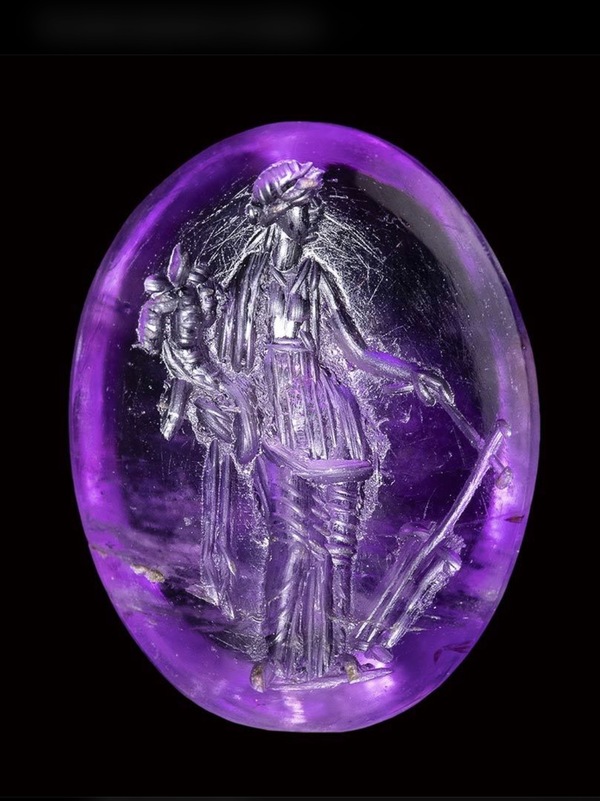
Fig. 2 Fortune with a Wheel. Roman intaglio carved from sardonyx. Roman period. Location: Naples, Italy. Princeton University Art Museum, Princeton, USA.
The image was not necessarily created from scratch. Examples could be drawn from sculpture, coins, painting, mosaics, ceramics, and other gems. Transferring a large artistic motif onto a small stone required selecting the most crucial elements: posture, attribute, direction of movement, and silhouette.
3. Visual Language of Iconography
When examining Roman intaglios, it is important to pay attention not only to who is depicted on the stone, but also to how the image achieves recognizability. On a small surface, the artisan had to convey the character through a limited number of visual cues. Therefore, the silhouette, body posture, gestures, and characteristic attributes became particularly significant.
On many gems, figures are depicted in profile or in a schematic rotation. This approach allows the character to be placed on the elongated oval surface while maintaining the readability of their silhouette. Even with significant simplification, the viewer can identify the hero by several details: their weapon, headwear, wings, or the object in their hands.
Fig. 3 Oval intaglio of red carnelian depicting Eros the Fisherman. Roman period, 1st–2nd centuries AD.
To compare the intaglios, I highlight several visual characteristics: — the figure’s position relative to the stone surface — the orientation of the head and torso — the placement of arms and legs — the presence and arrangement of attributes — the silhouette’s shape — the depth and character of the carving lines — the level of detail refinement. These specific features allow us to compare the images not only by subject matter but also by their visual structure.
The contrast between the overall composition and the execution method is particularly interesting. In some instances, the master meticulously renders the folds of clothing, anatomy, and fine details; in others, these elements are replaced with short lines and drilled depressions. Even so, the character remains recognizable. This suggests that an image’s recognizability doesn’t always depend on high levels of detail—sometimes preserving the core compositional characteristics is sufficient.
4. Reproduction and Replication of Images
The repetition in the Italians is manifested on several levels. Sometimes nearly the entire composition is reproduced; other times, only the character type or its signature pose is preserved. The visual similarity can be so strong that it suggests the use of a common template.
One illustrative example is the imagery of Mars. Orith Peleg-Barket notes that some gems featuring this deity have dozens of almost identical analogues. The researcher observes that this depiction of the deity is found not only on carved stones but also on coins from the time of Emperor Antoninus Pius (138–161 CE).
When comparing such objects, it is necessary to consider which elements remain unchanged and which undergo modification. For example, the pose of the figure and the direction of the weapon might be preserved, while the body proportions, the shape of the shield, or the clothing details may change. Such differences can be related to the peculiarities of the workshop, the size of the stone, or the sculptor’s skills.