Table of Contents
- Topic
- Chronology
- Geography
- Areas of Study
- Concept (Rationale for topic selection, material selection principle, categorization principle, source selection principle, key question, and hypothesis)
- List of Artifacts
- Visual Material with Commentary
- Conclusion
- List of Sources and Literature
- List of Image Sources
Topic
«Nefertiti’s Visual Revolution: The Female Image in the Amarna Royal Family»
Chronology
Amarna Period (1353–1336 BCE)
Geography
Ancient Egypt:
- Akhetaton
- Thebes
Areas of Study
- Egyptology
- Art History
- Iconography
- Gender History
- Visual Anthropology
- Religious Studies
- Cultural Studies
Concept
Rationale for Topic Selection
My father’s sister is a history teacher, and every time we meet, she shares fascinating insights into the past. During my school years, our conversation turned to Ancient Egypt—and that moment sparked my love for Egypt. I chose this topic to delve deeper into how Nefertiti transformed the image of women in Ancient Egypt and the ramifications of that change. The Amarna period is unique because it was the first time in Egyptian history that women moved beyond being merely shadows of men and gained distinct individuality. This topic captivated me because visual imagery has such a profound capacity to influence society. Previously, the pharaoh seemed unattainable, and the queen was an inconspicuous shadow of the ruler. Akhenaten, through art, managed to bridge the distance between the people and the divine, depicting the ruler and Nefertiti as equal partners who formed an ordinary family. This completely shifted human relationships. The Egyptians witnessed a new model of family and authority and consequently adopted its norms. In my research, I aim to demonstrate that during the Amarna period, art functioned as a powerful tool capable of altering interpersonal relationships.
Principle of Material Selection for Visual Research
For this research, I utilized online sources to find images of women from the Amarna Period in two main centers: Akhetaten—the new capital, also known as Amarna, where monuments of Amarna art were discovered—and Thebes, the former capital, where reliefs and frescoes have also been preserved.
What are the selection criteria?
- Presence of female figures
- New Amarna style (natural poses and emotionality)
- Availability of high-quality imagery
- Presence of academic descriptions
The Principle of Research Categorization
My research is unique because it proceeds by functional principle rather than chronology, which helps to focus on the female image.1. The Bust of Nefertiti: Iconography and Its Role 2. Nefertiti and Akhenaten: Ruler or Divine Couple? 3. Daughters: Children as a Political Argument
Principle of Selecting and Analyzing Textual Sources
My research is fundamentally based on an analysis of academic literature and museum catalogs. Key sources include:1. The exhibition catalog «The Royal Women of Amarna: Images of Beauty from Ancient Egypt» 2. K. M. Hilliard’s study, «Images of a Gendered Kingship» (University of North Texas, 2006) 3. D. S. Tumanian’s article, «The Image of Woman in Ancient Egyptian Art» (2023)These materials provide the necessary foundation for iconographic analysis. My objective is to utilize these texts to support my observations and arguments.
Key Question and Hypothesis of the Visual Study
Key Question
How did the female image change in Amarna culture, and what role did it play in Akhenaten’s visual code?
Hypothesis
In Amarna art, women ceased being mere complements to men and became active participants in religion. Their individualization served a politico-religious objective—to affirm a new religion and legitimize Akhenaten’s power.
List of artifacts used for analysis
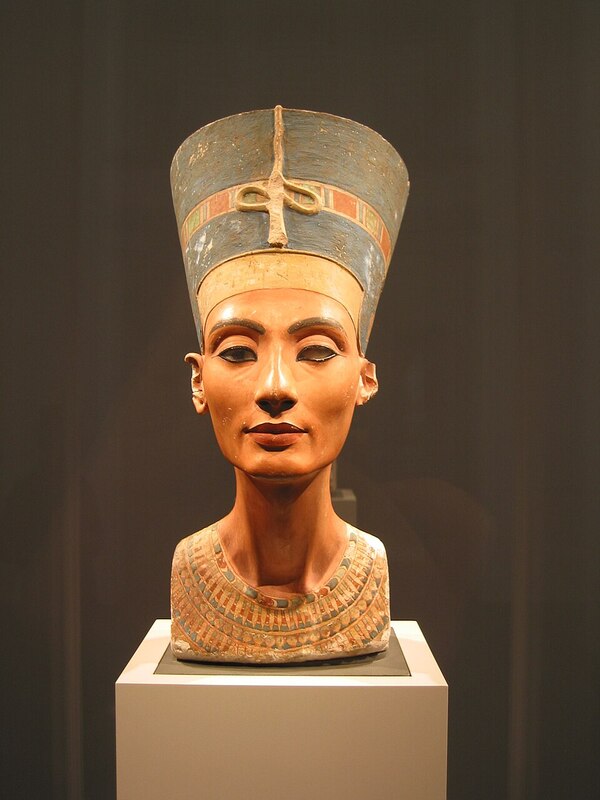
- Bust of Nefertiti — circa 1340 BCE. Limestone, painted. Egyptian Museum and Papyrus Collection, Berlin.
- «Home Altar» with Akhenaten, Nefertiti, and Daughters — circa 1351–1334 BCE. Limestone. Neues Museum, Berlin.
- Talatat: Princess Meritaten — circa 1350 BCE. Limestone. Museum of Fine Arts, Boston.
- Painted limestone statuette of Akhenaten and Nefertiti — circa 1350 BCE. Limestone, painted. Louvre, Paris.
Visuals: Women of Amarna
Section 1. Bust of Nefertiti