— Flattening of Space
— Conventionality of Space
— History Through Collage
— Limitations of Animation
— Imagery and Metaphor
For most people raised in the post-Soviet space, the works of Soyuzmultfilm studio are associated more with a pleasant childhood memory filled with fairy tales and necessary life lessons. This is precisely why the works of filmmakers such as Andrey Khrzhanovsky or Fyodor Khitruk hold a special interest for visual study. Despite censorship and the perception of animation as a low-brow product exclusively for children, these directors chose animation as a means of communicating timely and even tragic themes.
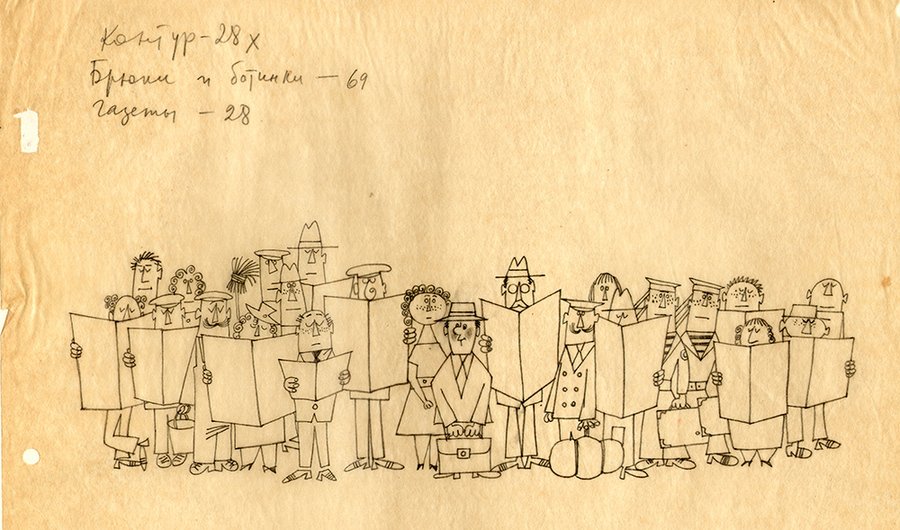
Production materials for the animated film «The Story of One Crime.» Dir. Fyodor Khitruk. 1962
The animated films created under the direction of Fyodor Khitruk are built upon a subtle paradox: extreme clarity and even playful formal convention coexist with a persistent feeling that something more complex and bittersweet lies behind the vibrant imagery. Beneath the external elegance and conciseness, a different intonation emerges—a restrained and ironic tone necessary for critiquing or even satirizing everyday life.
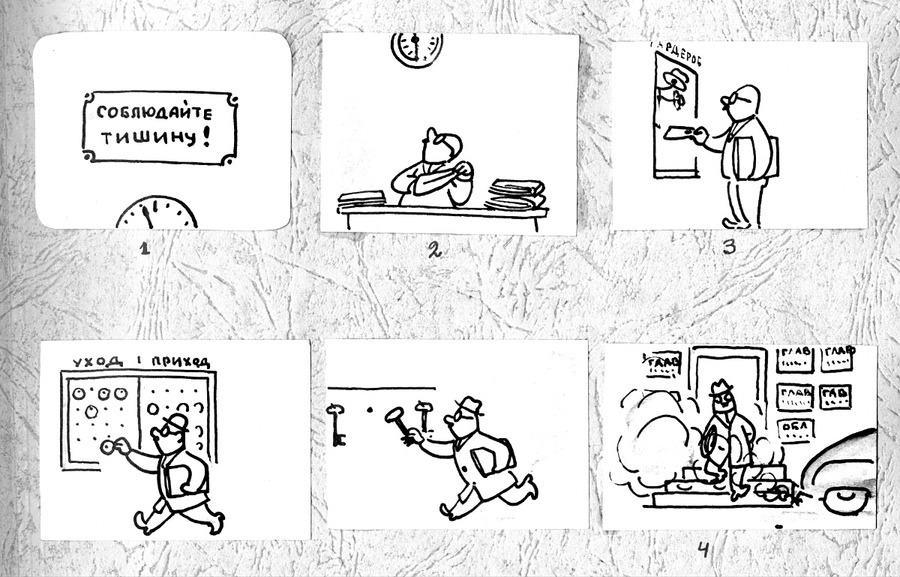
Storyboarding excerpt for «Neither Sleep Nor Rest» (working title: «The Story of One Crime»)
Hitruk manages to depict the everyday, slightly pulling it back from the viewer. This distance creates a new angle from which to view previously mundane subjects. The space in his cartoons becomes conventional, and the figures' plasticity and appearance are extremely expressive. Consequently, daily life ceases to be a simple backdrop for the plot; instead, it unfolds as a storyteller about characters living within their own realities (or frames). The world around looks simple yet recognizable, and within this recognizability, there is a constant, unresolved tension—much like in life.The laconic nature of the form can also be seen as a tool for creating a feeling teetering between humor and bitterness. This economy of means functions not just as simplification, but also as a way to expose human vulnerabilities. The less extraneous detail in the frame, the more clearly the layer of absurdity or comedy in the everyday situation manifests. The collages, the conventionality of the space, and the stylized plasticity make reality more visible and easily digestible for viewers of any age. Through visual devices, something familiar is presented as fragile due to an underlying, hidden tension.
It can be posited that the external lightness and wit are merely the surface layer of a more complex and even poignant picture. It is this multifaceted nature—where graphic clarity mixes with a barely perceptible melancholy—that lends depth to Hitruk’s work. In this visual investigation, I aim to examine the techniques through which the director manages to reveal several facets of a single animated film simultaneously.
Spatial Flattening
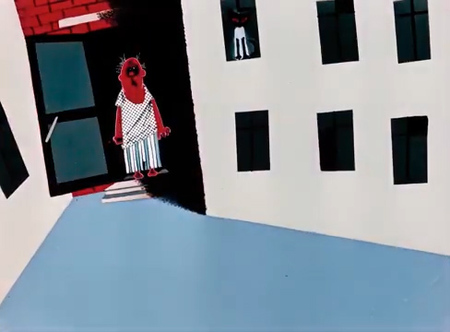
Perhaps the most defining characteristic of Fyodor Khitruk’s directorial work is his handling of space in his cartoons. In the best traditions of cartoon modernism, the production designers, collaborating with the master, move away from the «Disneyesque» and realistic rendering of backgrounds toward flat, expressive forms; sometimes, they even disregard these entirely, leaving the characters in a rather ascetic setting—in empty space with only a few objects nearby.In Khitruk’s debut directorial work, «The Story of a Crime, ” the vast majority of the backgrounds are rendered using a flattened technique. Houses, courtyards, and other cityscapes are stylized; they are conveyed through simple shapes, almost without any perspective or shadows. This technique helps direct the viewer’s attention, focusing instead on the characters and their emotional state rather than the environment.
«The Story of a Crime, ” directed by Fyodor Khitruk, 1962
«The History of a Crime, ” directed by Fyodor Khitruk, 1962
Episodes where the surroundings are given special artistic attention serve to immerse the viewer in the story’s context without needing to show extraneous details. Through graphic stylization, a sense of urban density is created—high-rise buildings stand almost pressed against one another, and people and vehicles merge into a single flow, only separating at crosswalks.It is notable that we barely see the sky in these episodes: for the character, right now, there is only their «working» reality, devoid of any spiritual fantasies. This visual emphasis on the mundane aspect of the animation prepares the viewer for the idea that this will be a local story (in this case, a story about overly loud neighbors, which is familiar to everyone).
«The History of One Crime,» directed by Fyodor Khitruk, 1962
The compression of space can also be seen in other directorial works by Fyodor Savelyevich. A similar sense of urban confinement is created in the animated film «Boniface’s Vacation.» However, the city here is more akin to something European and fairytale-like, as the story features a talking lion who goes on holiday. As soon as he makes this decision, the city «builds itself» into a pathway toward the hero’s specific goal, and the lines of perspective converge at a single point, guiding the viewer’s attention.
«Bonifacius' Holidays,» directed by Fedor Khitruk, 1965
«Bonifacation Holidays, ” directed by Fyodor Khitruk, 1965
The industrial landscapes of the station are similarly devoid of excessive detail, lending a certain magical flair to the events. We find ourselves in a slightly different fairy tale when Boniface arrives in his hometown. The strictness of the architectural forms gives way to the intricacy of the surrounding vegetation, further emphasizing the contrast between the cold houses and the warm African landscapes.
«Bonifacius’ Holidays, ” directed by Fyodor Khitruk, 1965
«Bonifaciation Holidays,» directed by Fyodor Khitruk, 1965
The Contingency of Space
A similarly memorable technique in Hitruk’s directorial work is the complete abandonment of spatial delineation in favor of emphasizing character performance and physicality. In «Bonifacius’s Vacation,» this is employed to place special emphasis on the opening performances. We understand that the action takes place in a circus, even if we do not see the ring or the audience in individual episodes. The circus itself is also shown quite abstractly—the focus is on the whimsical props rather than the entire setting.
«Bonifaciation Holidays, ” directed by Fedor Khitruk, 1965
«Bonifacation Holidays,» directed by Fedor Khitruk, 1965
The depiction of the audience hall is also quite graphic—it’s simply a mass of identical eyes fixed on the circus performers. Later, an interesting contrast is created between the urban and African audiences: when Bonifatius performs alongside the children, the viewer can notice subtle differences between them. Sometimes, next to a small audience in every sense, one can notice details of the surroundings: plants, the lake, and other landscape elements.These parallels make the story engaging not only for young viewers but also for adults, revealing that subtle bittersweet quality. A creative person, by vocation, always carries their work with them simply because they cannot live otherwise, and it doesn’t matter who they are: a circus performer, a musician, or an animator.
«Bonifacation Holidays, ” directed by Fyodor Khitruk, 1965
«Bonifacation Holidays,» directed by Fyodor Khitruk, 1965
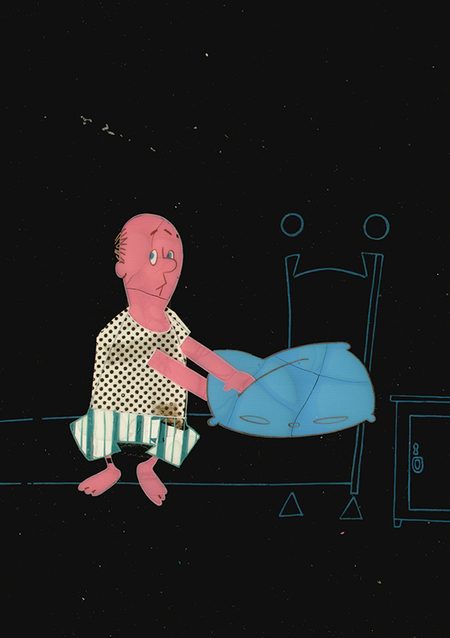
Space becomes relative in the moments of intense tension within the aforementioned «Story of a Crime.» In some episodes, we see nothing but the character and their bed framed in a solitary color frame. While the viewer cannot see the surroundings, they subconsciously feel the protagonist trapped in his small apartment, surrounded on all sides by noisy neighbors.
«The History of a Crime, ” directed by Fedor Khitruk, 1962
The space is interestingly conveyed even in the episode featuring the heating radiators. It concisely depicts, first, the multi-story nature of the building as it runs along the direction of the pipes; and second, this technique quite literally illustrates the annoying sound traveling from one apartment to another through the poor protagonist’s room.
«The Story of a Crime, ” directed by Fyodor Khitruk, 1962