Navigation
- Concept
- The Image Takes Shape: Batman 1939–1940
- The Adventurer: 1941–1963
- The «New Look»: Changes of 1964–1969
- The Return of the Night Hero: 1970–1985
- Weight and Age: Frank Miller’s Batman, 1986
- Conclusion
Concept
Batman first appeared in Detective Comics #27 in 1939. His image proved both recognizable and mutable: the mask, cloak, and emblem remained consistent, but artists depicted the hero’s physique, movement, and facial expression in diverse ways. This allows one to trace how a single character acquires different attributes through artistic rendering. The theme was chosen because Batman’s transformations are especially evident when images are compared directly. He can appear as a mysterious pursuer, a confident adventurer, or a heavy, aging fighter. This study examines what visual choices create these impressions and what ensures the character’s recognizability.
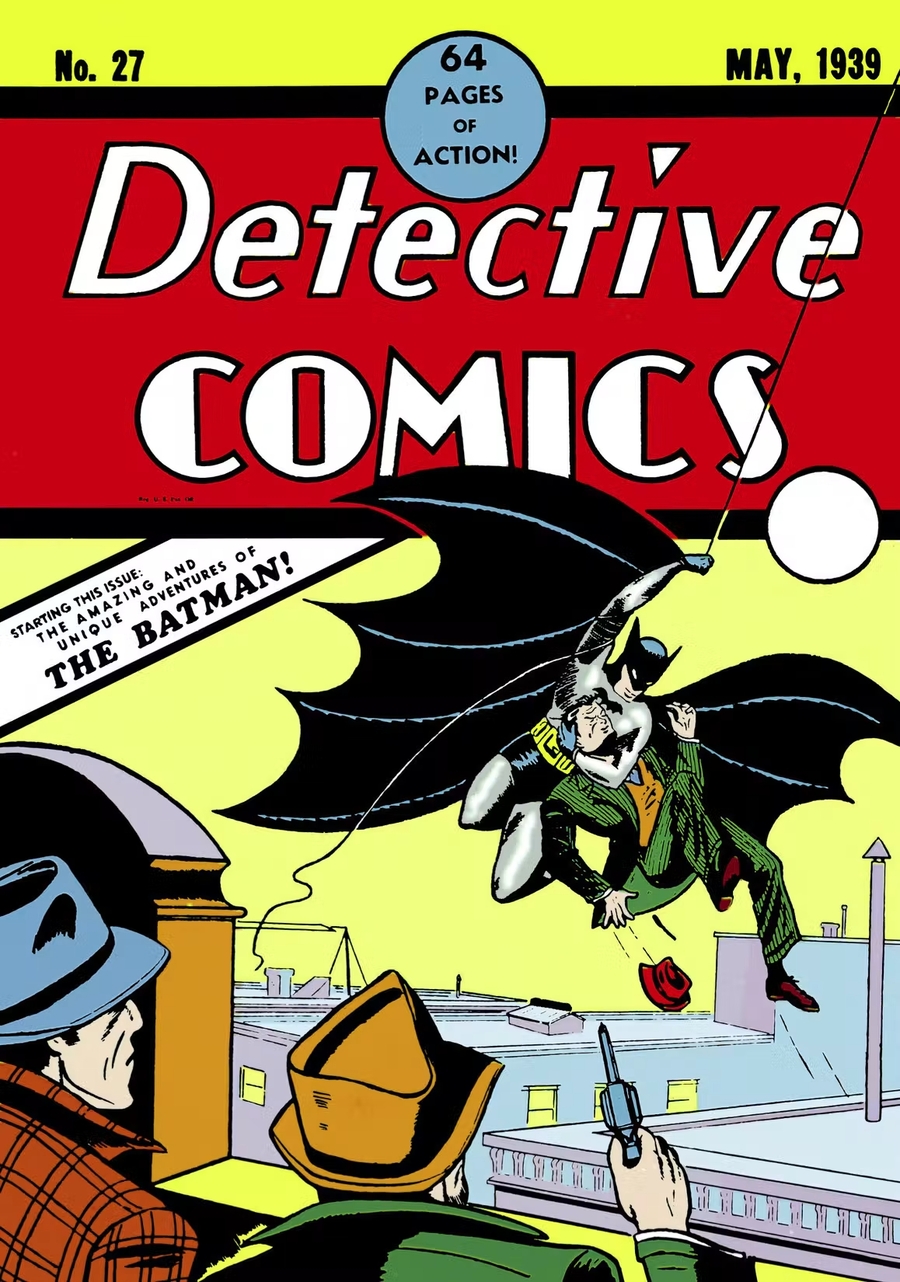
Bob Kane. Detective Comics No. 27. 1939. Cover.
The research covers American comic books from 1939 to 1986. The starting date is tied to the debut of Batman, and the ending date is marked by the release of The Dark Knight Returns by Frank Miller, Klaus Janson, and Lynn Varley. This miniseries is examined as a standalone iteration of the character, rather than as a necessary culmination of all stories featuring him.The core material will consist of covers and pages from Detective Comics, Batman, and The Dark Knight Returns. For analysis, images will be selected that clearly showcase the character’s figure, costume, posture, and interaction with the space. Film, television series, animation, and later reinterpretations will remain outside the scope of the visual analysis.The selection process is based on the comparability of examples. Covers will be compared primarily with other covers, and sequences of panels will be compared with other pages. This approach will help account for the difference between the commercial expressiveness of an individual image and the progression of action within the comic.
The central focus of the analysis is the Batman figure. We will compare body proportions, mask shape, ear length, emblem design, and cape structure. Special attention will be paid to poses: a stable stance, a jump, a strike, and movement within the page space.
The second level of analysis is graphic presentation. Line weight, solid black fills, color, and contrast can make the same figure appear light, tense, or massive. The hero’s placement within the frame is also important: does the reader see his face, view the silhouette from a distance, or look up at him from below?
These characteristics will be studied in combination. Long ears or a dark cape alone do not define the character of the image. The conclusion must be based on several elements that support the overall impression.
Neal Adams. Batman #251. 1973. Cover.
The work is structured chronologically and divided into five phases. These phases allow for a comparison of early Batman imagery, adventure versions, the 1964 update, the 1970–1985 works, and Frank Miller’s interpretation. Each section examines the same elements: costume, silhouette, pose, facial expression, and setting.The comics themselves serve as the primary source material. Information regarding the creators and dates is verified through publisher cards and catalogs. Historical publications are used to explain the context, while conclusions about composition and the impression of the hero are formulated based on the images. The chronological order does not imply that all artists transitioned from one style to another simultaneously.
Key Research Question: How does the perception of Batman change while retaining the essential elements of his costume?The hypothesis is that the character of the visual image is determined primarily by the method of rendering the figure. Body proportions, movement, line, and the distribution of light and shadow allow the recognizable character to be presented as a mysterious pursuer, an open hero of adventure, or a heavy fighter.To test this hypothesis, recurring attributes in the works of different artists will be compared. The research aims to determine which elements retain Batman’s identity and which ones alter his perception. The result will be a description of several visual models of the hero, rather than an evaluation of which one is «more correct» or better than the others.
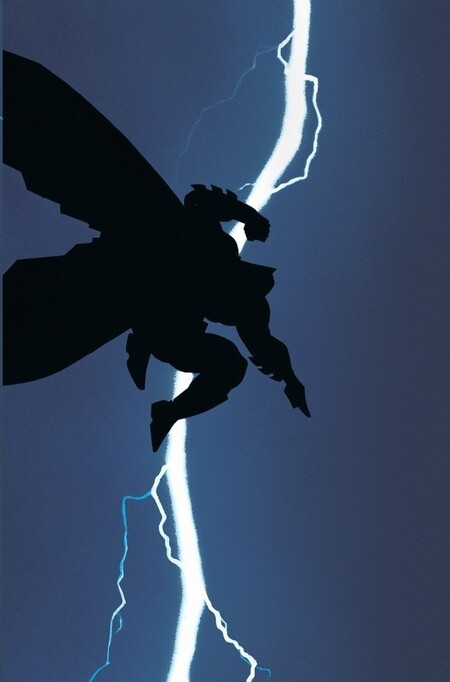
Frank Miller, Lynn Varley. Batman: The Dark Knight Returns #1. 1986.
The Birth of an Icon: Batman, 1939–1940
Batman first appeared in Detective Comics #27 in 1939. Bill Finger wrote the first story, and Bob Kane drew it. The main characteristics of the character are already visible on the cover: a mask with pointed ears, a cape, a bat emblem, and a utility belt.The hero is depicted in motion above the city. His face is almost obscured, and his spread cape enhances his silhouette. The introduction to the character begins through action and an unusual profile.
Bob Kane. Detective Comics #27. 1939. Cover details.
The mask conceals the upper portion of the face, leaving the mouth and chin exposed. Pointed ears disrupt the human contour of the head. The character remains human, yet acquires animalistic features.The cloak continues this transformation: its jagged edge resembles wings. Together, the mask and the cloak create a silhouette recognizable even without a detailed view of the face or emblem.
Bill Finger — script; Bob Kane — drawing. The story of Batman from Detective Comics #27. 1939. Page excerpt.
In the sequence shown, Batman initially appears motionless in front of the criminals, his arms crossed. This is followed by a strike, a grapple, and a throw. The contrast between his composed stance and the swift actions underscores his confidence.The shift in frames reveals what the cover conveys in a single image. The position of his hands, the rotation of his body, and the trajectory of the thrown opponent allow one to follow the action sequentially.
Bob Kane. Detective Comics #31. 1939. Cover.
On the cover of Detective Comics #31, Batman is presented in two scales. A large figure looms over the castle, while in the lower section, the hero is carrying a woman. The first figure creates a sense of mysterious presence, and the second depicts action.Compared to the cover of #27, the relationship between the hero and the space here is more complex. Batman simultaneously becomes the central symbolic image of the composition and a participant in the events.
Both covers use a mask and a cape, yet they evoke different impressions. In Issue 27, Batman is engaged in action—his posture relates to other figures and the city. In Issue 31, he becomes the primary compositional element, dictating the surrounding space.
As early as 1939, the recognizable costume allowed for various modes of presentation. A character’s expressiveness depends not only on his outward appearance but also on scale, pose, and relationship to the background.
Bob Kane, Jerry Robinson. Detective Comics #38. 1940. Cover.
In Detective Comics #38 in 1940, Robin makes his debut. His open face, short cape, and combination of red, green, and yellow create a contrast with Batman’s costume.On the cover, the new character is introduced independently. Beside him, Batman is perceived not just as a solitary, mysterious figure, but also as the senior partner in a duo. The relationship between the two characters becomes part of the visual identity.
Bob Kane, Jerry Robinson. Batman #1. 1940. Cover.
On the cover of Batman #1, Batman and Robin move side-by-side on ropes. The diagonal positioning of their bodies, the flowing capes, and the lines of movement unify them as an active pair. The yellow background separates the figures from the red silhouette of the city. Unlike the composition of Detective Comics #31, the primary impression here is created by the shared momentum of the two heroes.
In the selected images from 1939–1940, Batman’s recognizability is sustained by the mask with ears, the cape, and the emblem. Meanwhile, the composition allows him to be presented as a mysterious figure, a confident fighter, or a member of a heroic duo.
Robin’s appearance adds a new dimension to his characterization: Batman’s image is revealed through the contrast and interaction with his partner.
Adventure Hero: 1941–1963
In the 1940s, Batman’s image evolved the possibilities established after the introduction of Robin. The hero operates in a duo, interacts with allies, and finds himself in diverse adventures. Alongside danger, humor and engaging situations play a significant role.
In the 1950s, the surrounding world becomes even more varied: unusual transformations, robots, and fantastic adversaries emerge. Therefore, changes in Batman should be sought not only in his costume but also in the events and characters that surround him.
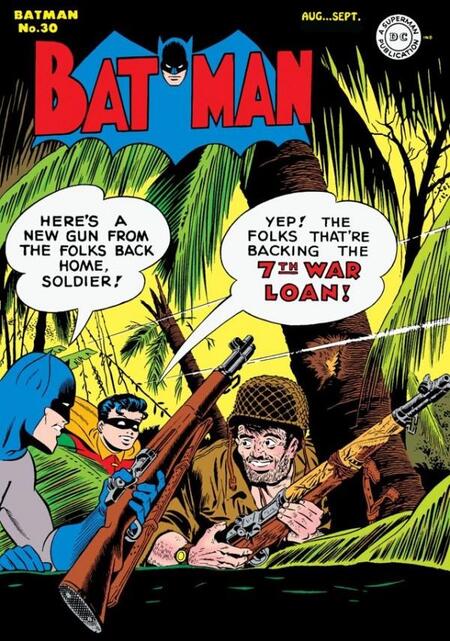
On the cover by Dick Sprang, Batman is shown alongside Robin and the soldier. His smile, open chin, and relaxed gesture make him appear to be part of a friendly interaction. The mask remains, but it no longer conveys a sense of alienation.
The scene is connected to supporting a war bond, which is directly stated in the dialogue. Here, Batman acts as a public ally: his recognizability is used to address the reader.
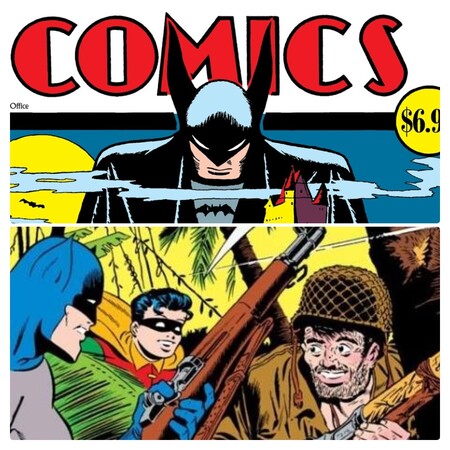
In both images, the face is partially obscured by a mask. However, on the 1939 cover, the gaze and stillness maintain a threatening impression. In Sprang’s version, the smile and turned head allow Batman to engage with other characters.The comparison highlights the importance of the visible facial features. Even with the mask remaining, the rendering of the mouth and chin helps to shift the character’s emotional tone.
Sheldon Moldoff. Detective Comics #241. 1957. Cover.