November 21 | Tuesday
Morning Russia, No. 267 Rumors of a Truce News has reached Petrograd that Bolshevik parliamentarians have begun truce negotiations and that a truce agreement has already been reached. The truce has been concluded for three months, with the opposing side conducting the negotiations on behalf of Germany, Austria, Bulgaria, and Turkey. The chief negotiator for the opposing side was Austrian Field Marshal Prince Rupprecht, the commander-in-chief of the Eastern Front. Under the terms of the truce, the fronts of Russia and the enemy must remain inviolable until a peace treaty is signed, meaning the Germans have no right to move their troops to another front. As for the question of a peace treaty, both sides have stated that they are not authorized to do so. Rumor has it that the Council of People’s Commissars has established a direct radio telegraph link between Berlin and Petrograd.
The Surrender of the Fortress and the Arrest of General Dukhonin According to the latest reports, the fortress has fallen to the Bolsheviks, with the condition of the surrender being the complete inviolability of General Dukhonin. Regarding the surrender of the fortress to the Bolsheviks, the following is being reported: Representatives of the army committees called upon certain units from various armies to help defend the fortress. However, this defense proved not to be in support of Dukhonin, but in support of the Bolsheviks. Information was received as early as November 19th that the Bolsheviks controlled Orsha, as the Cossack and other units stationed there had unexpectedly sided with the Bolsheviks. In connection with this, it was decided not to defend the fortress. Conflicting reports were received yesterday in Petrograd regarding the Bolsheviks arresting General Dukhonin…
Russian Word, No. 255 Money From the reporter. Today, on the sixth day of the siege of the State Bank, more than a million rubles have been withdrawn from a single savings bank branch. It is mainly the poor—residents from the outskirts—who are taking out the money… The demands from depositors have especially increased on market days, when a large number of peasants from neighboring villages come into the city. Today, the bank ran out of money… The situation in private banks, where there are no small depositors, is completely the opposite. Operations are proceeding correctly; there is no panic.
Raids on Banks From Saratov. …At one o’clock in the afternoon, detachments of soldiers and Red Guards simultaneously occupied all the banks… Employees were informed that they were arrested. Guards were posted at the vaults. Employees' desks and cabinets were searched. At five in the afternoon, Bolshevik Antonov, along with hairdresser Khvesin, toured all the banks and demanded information on the people who had opened deposits starting from October 28th, and on the owners of the remaining lockboxes, as well as on the banks' account status. This information was provided under threat of violence… The Executive Committee of the Soviet issued an illiterate appeal to the populace. The Executive Committee explains that «the bourgeoisie are transferring money to Kaledin with the goal of undermining the state’s finances.» The Committee threatens confiscation of the property of those who have not returned their deposits to the bank… In conclusion, the committee states that it is establishing control over the banks. The appeal was apparently written by hairdresser Khvesin.
Installation of Metropolitan Tikhon onto the Patriarchal Throne Today, after a solemn religious service and the rite of enthronement in the Assumption Cathedral, Patriarch Tikhon will make a grand procession around the Kremlin. The Patriarch will sprinkle the walls of the Kremlin with holy water… Starting today, the remembrance of the Patriarch in all churches across Russia will be conducted in the following manner: «Oh, our great Lord, the Most Holy Patriarch Tikhon»…
Moscow Exhibition «The Knave of Hearts»
O. Rozanova. Color: Suprematism
At Mikhailova’s art gallery, an exhibition by the «Boulevardier» Society opened. It presented the same mix of Cubist and various other modernist explorations, yet everything was either returning to naturalism or devolving into some kind of childish, primitive exercises in form and color selection. Nevertheless, among all the other bizarre nonsense going on, this was perhaps the most appropriate exhibition—one that shouts with its colors and reveals America in such a breathtaking way that you can only throw your hands up in wonder.
Take multicolored, vibrant paper, cut it into various strips, triangles, circles, and simple blobs, and then choose beautiful, outline-defining paints to adhere these triangles and strips onto white and black paper. What you have before you is the same «Suprematism» that fills the majority of the exhibition. If you use two colors of paper, it will be a two-color composition; if you use three, it will be a three-color one… This is how simple and accessible art is—while some Raphael and Leonardo da Vinci spent entire years on a single canvas! At the head of this primitive search for colorful harmonies stands Malevich—the very Malevich entrusted by the new revolutionary government with overseeing all Moscow’s arts and artistic values. Truly a post worthy of those who yesterday were leveling the historical sanctuaries of the Kremlin with cannons… Around Malevich surrounds a host of muses: Mrs. Rozanova, Davydova, Klyun, Simon, and others (though the last two muses appear to be male, not female). Also featured is one of the four «giants of the world"—Vasily Kamensky, the «song-warrior,» who drew a massive «Yu» and inscribed various derivatives of the word «Yunochka» (Young Girl) within it: Yunost (Youth), Yuna, Yunit’sya, etc. The alphabet of a good old time is being revived: Arap, Arapnik, Artikuly, etc. Mrs. Ekster also occupies an entire room with «compositions» made from multicolored spots and with costume designs for «Salome,» crafted seemingly from colored embossed tin. However, Mrs. Ekster’s costume designs possess a certain sharpness and style. Perhaps it is in such costumes that one could portray a Blok’s «Unknown Lady»… but the style in «Salome» is entirely foreign. You can’t help but sigh in relief when, after all this fuss, you approach the portraits by Mrs. Khodashevich. I am not a fan of her painting, but here there is a serious approach to her task and a tenacious search for a peculiar understanding—a specific conveyance of forms. The exhibition attracted very little public interest.Sergey Glagol
D. Burlyuk. Portrait of the Songbird Futurist Vasily Kamensky
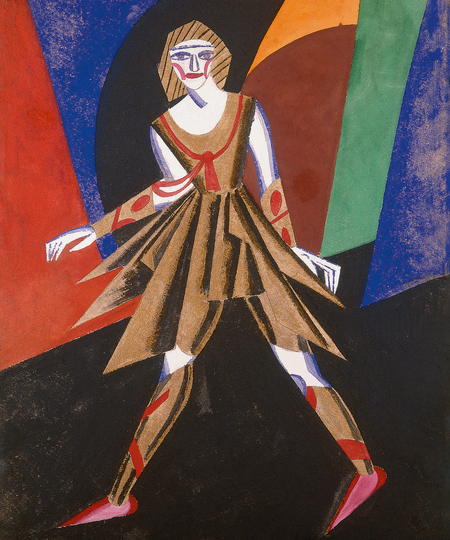
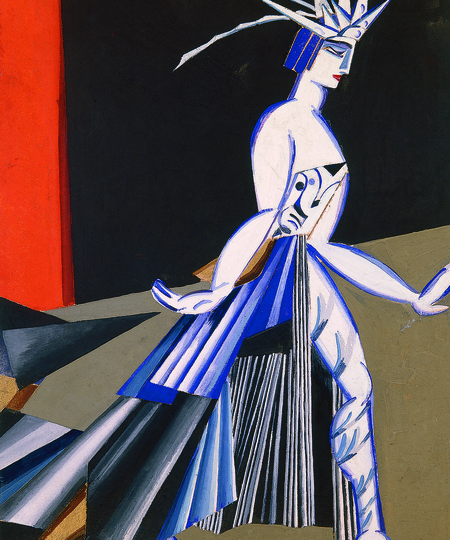
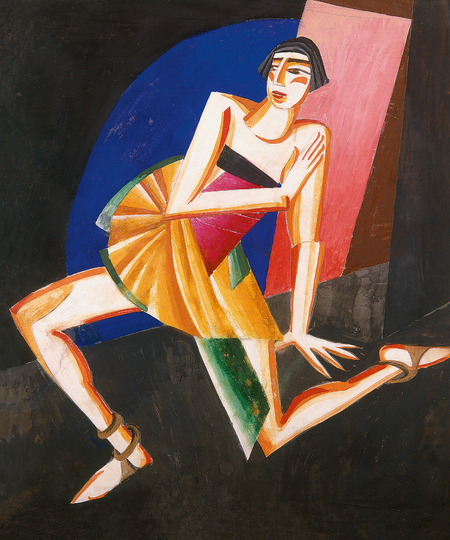
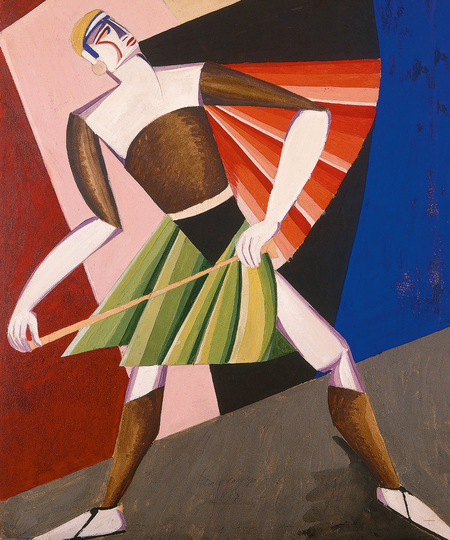
A. Exterior. Sketches for the play «Salome»
Print Meeting
From the drawings of high school and vocational school students
A printing rally held on Sunday at the Salamonsky Circus drew around 1,000 people. Attendees included journalists, printing industry professionals, and others.
It was intended that the assembly would adopt a protest resolution, but this proved impossible due to Bolshevik obstruction. …The lecture hall was buzzing. In the tight circle of shouting voices, a figure of a professor’s type appeared. From the Bolshevik boxes, they shouted: «Down with it! To hell with freedom of the press!» The gentleman took off his hat, raised his hand, and said: «I am an old clown… My name is Durov. You probably know me?» The circus responded with hearty applause… «I have long been fighting for freedom of speech, comrades! I was exiled from one city to another, from one provincial satrap to another, all for mocking the arbitrary power in a clownish joke… for ridiculing the dullness and idiocy of the mute people, while I silently preached social harmony and love. Yes, sirs, I did this, because I was carrying a wolf and a goat in the same cage!» The circus recalled its childhood and smiled. «And now, sirs, in my old age, an old, merry clown, I am afflicted by unbearable grief. My son was killed…» …When this madness began, when my boy came to me with a rifle in his hands, I pleaded with him not to fight against those who were my best friends: the simple and innocent people. But he answered me, «Dad, I fought on the lines for the people for three years because the people were weak and oppressed. Now I am going again to defend the weakest, because those sitting, dying of fear behind those dark windows… they are now the weakest of all…» And then they brought him. He had four wounds… «Down with the hats!» someone shouted, and the entire circus quietly and respectfully uncovered their heads. Only one of the Bolshevik leaders stood proudly in a white sheepskin cap. «Monster!» a female voice shrieked…
GRIF
Russkoe Slovo, No. 255 The Don Campaign Reports received by the Administration indicate that two military transports, equipped with machine guns, artillery, and ammunition to support the Bolsheviks in the fight against Cossacks, departed from Sevastopol for the Sea of Azov and have already crossed the Kerch Strait.
The War Between the Ingush and the Cossacks In the Kadikavian region. Following a brief lull, an armed clash erupted between the Ingush and the Cossacks of the Sunzhensky district… Nestrovskaya Stanitsa was attacked by the Ingush. Feldmarschalkskaya Stanitsa was attacked and burned. Neighboring stanitsas are also ablaze. The villages of Yandyrskoe and Plievo were partially destroyed by Cossack artillery. The number of casualties is unknown… The situation has become extremely acute…
The Fruits of the Agrarian Decree In Skopin, Ryazan province. The local Military Revolutionary Committee and the Soviet of Peasant Deputies implemented Lenin’s land decree in the Skopin district. All estates have been plundered and partially burned. Forest materials, firewood, and a massive amount of fodder previously allocated for the army have been distributed by the peasants. The Huzyakov and Myasnikov estates, which held rare artistic treasures, perished in the flames…
Ryazan. In the Ryazan district, near the village of Lvovo, Sokolov’s estate was devastated. Both stone and wooden structures have been dismantled and looted. All that remains of the vast park are two cedar trees, left in memory of two slain strongmen. Vast areas of forest are being cleared and aristocratic inventory is being plundered in various parts of the district. Workers and servants are being driven out…
Tambov. Major unrest is occurring in the Usman district… A total of 18 estates have already been looted. The destruction began at the most culturally significant estates of the slain Prince Vyazemsky and the Veliaminovs, which were already being looted…
Nov 22 | Wednesday
Official Announcement from Headquarters
At 10:00 AM on November 20th, Supreme Commander Krylenko, accompanied by his personal staff, entered Mogilev. In the premises of the V.-Revolutionary Committee, T. Krylenko was greeted with the «Marseillaise» by a choir of trumpeters from the George Cavalry and by various delegations. After exchanging greetings, the Supreme Commander proceeded to the Headquarters, whose officers had been placed under house arrest the previous day…
Izvestiya of the Central Index Commission and the Petrograd Council of Workers' and Soldiers' Deputies, No. 232
The night before, General Kornilov, having learned that the vanguard of revolutionary troops was enveloping Mogilev from the south, fled from Bykhovo with four escorts of Tekintses, who rode south… Upon arriving at the Stavka, the Commander-in-Chief, accompanied by the acting chief of staff Shneur, went to the quartermaster’s department to formally take office and restore normal operations at the Stavka. During this time, a regrettable incident occurred, darkening the celebration of democracy’s victory. News arrived from the station that an agitated crowd had surrounded the Commander-in-Chief’s carriage, where General Dukhonin had been brought for his personal security and was guarded by a reliable detachment of Aurora sailors, demanding his release. Immediately, the Commander-in-Chief Krylenko, along with his staff, went to the station, resolutely broke through to the surrounded carriage, and delivered a fiery speech against vigilantism. The crowd, swayed by the arguments, dispersed, but half an hour later, agitated groups of sailors and soldiers gathered near the carriage… Krylenko and the officers of his personal staff, who had shielded General Dukhonin with their bodies at great risk, were overwhelmed, disarmed, pushed back. General Dukhonin was dragged out by the enraged mob and killed. In the evening, the officers of the Stavka staff, who had been under house arrest at the Bristol Hotel, were released and returned to their duties… …The department heads of the Stavka and its entire staff were presented to the new Commander-in-Chief and unanimously promised to work for the benefit of the army. The conflict must be considered resolved. All further internecine strife within the army has been eliminated. Cossack delegations at the Stavka expressed their wishes to the new Commander-in-Chief and received attentive consideration for the voice of the laboring Cossacks. Foreign officers who had left the Stavka the night of its fall, awaiting the resolution of the conflict five versts away, departed toward Kyiv after the victory of democracy. Delegations from units across all fronts are arriving continuously.
11/23 | Thursday
Assassination of Gen. Dukhonin
Russian Word, No. 256
Two days before his tragic death, General Dukhonin said: «I know what awaits me!» He thought he would meet the fate of many other generals: arrested, imprisoned in the Peter and Paul Fortress, and tried by the Bolshevik courts… …Soon a crowd of armed men appeared, dressed in sailor greatcoats, but wearing ragged caps of various colors. I wondered: who were these people? By chance, a sailor I knew from a staff division was among the onlookers. He explained, «These are the Red Guards! Look at them!» Yes, the sight of these men inspired fear… …It was clear that Krylenko did not control his crowd. Its rage surpassed any respect for him. Perhaps there was no respect for him at all. What respect could there be for a man in an anarchist mob who himself had stoked its anarchist instincts? And how could he, such a small person in every regard, restrain those animalistic impulses?… …I watch—the train car is again crowded with Red Guards. Some have already burst into the car. The rest stood with distorted faces, croaking: «We won’t give him up to anyone! Give us Dukhonin! He is ours!…» At this time, a scene unfolded inside the car. Several Red Guards suddenly jumped in. One approached Dukhonin and unfolded a white placard that read: «Military-Revolutionary Tribunal.» This placard had been prepared back in Petrograd. Another handed the general a paper. Dukhonin read it and understood that death had arrived. Scrawled across the paper in hurried script was his death sentence…
Not all of the sailors were aligned with the vigilantes. It would have been possible to lock Dukhonin in a carriage and move the train. However, Krylenko evidently assessed the situation: the passions were so inflamed that any intervention on his part risked his own death… The Red Guards began pulling Dukhonin out of the carriage. I witnessed that scene. The general was being held by his shoulders and arms. He stood on the platform. He managed to wrench free his right arm and raised it, signaling that he wanted to speak. But at that moment, a sailor leaped onto a step and pressed a revolver to his throat. Two short, dry shots rang out… As the general’s body, unsupported by anyone, fell onto the platform, the crowd let out a triumphant military cry of «Hooray—ah-a-a”— Bayonets, truncheons, sabers, boots—they charged. The wild, insane crowd tore the general’s corpse to pieces and kept shouting, „Hooray! Hooray! Hooray!“… The murderers disappeared immediately, and those who remained seemed to sober up, standing embarrassed. The sailors and Krylenko’s entourage stood bewildered. They felt unbearable shame for what they had done… The onlookers broke the circle. Instead of the general, I saw a blood-black mass… Night was falling…Alexander Rossov
Morning Russia, No. 268
The Rada Against the Bolsheviks Kyiv (Own Correspondent). Yesterday, the military congress of the Southwest Front passed a resolution recognizing the Rada and the General Secretariat as the supreme authority in Ukraine and the Southwest Front. The same information is coming from the Romanian Front. Impressed by all of this, the Rada—which had not dared to respond directly to queries regarding the attitude toward the Bolsheviks just three days prior—has now done so via a telegraphic directive… not to recognize Bolshevik commissars and to order that their directives not be executed…
Closure of Newspapers …The printing houses of the newspapers «Birzhevye Vedomosti» and «Novoye Vremya» have been definitively requisitioned. The printing house of the newspaper «Rech» will also be requisitioned. Yesterday in Petrograd, besides Bolshevik newspapers, only «Delo Naroda» and «Petrogradsky Listok» were published; the latter was published under the name «Petrogradsky Vestnik.» The other newspapers were prevented from being published because armed Red Guard detachments arrived at the editorial offices late at night and presented an order from the Military Revolutionary Committee to shut down the newspapers. No motives were provided in the order for this violence against the press…
11/24 | Friday
Moskovsky Listok, No. 255 In the Council of Soldier and Worker Deputies Yesterday, under the chairmanship of N. M. Pokrovsky, a general meeting of the Council of Soldier and Worker Deputies took place. The representative of the presidium, Lomov, reported to the assembly. First and foremost, he voiced a complaint about the sabotage perpetrated by the bourgeoisie. This greatly complicates Bolshevik creativity. However, regarding the main point—the peace treaty—no one can stop it. Russian democracy put forward two conditions for the armistice: troops remain in their current positions; the Monsoon Islands must be cleared by the Germans. The Bolsheviks are confident that the ceasefire will spread to all fronts with spontaneous speed. The mood regarding the sabotage by workers for the Bolsheviks is optimistic. «They do not plan to shoot the workers,» said N. M. Pokrovsky, «we do not have enough guns for that. But we hope to break some and bring others to submission.»
Ration Sales From November 25th through the November-December food ration, the following items will be sold: 1 pound of Norwegian herring for 26 coupons, 2 eggs for 14 coupons, ¼ pound of butter for 11 coupons, and ½ pound of meat or a pound of salted lamb or pork for 6 coupons. The retail price for an egg is 24 kopecks each; herring is 1 ruble 25 kopecks per pound; butter is 4 rubles per pound.
The Murder of a Priest A few days ago, the body of Father Mikhail Alekseevich Shiryayev—the dean of the Zvenigorod district and the rector of the village of Karinskoye—was lowered into the grave at the Donskoy Monastery cemetery. He was killed by parishioners during a vigilante act. The priest had served in the village of Karinskoye for 17 years and was highly respected for his energy and exemplary dedication to his pastoral duties. A year prior, he had established a cooperative society in the village and served as its chairman. Recently, the cooperative was supposed to receive sugar for distribution to the peasants, but for some reason, it was delayed by members of the cooperative. The peasants, gathering in a crowd, began demanding that Father Mikhail give them the sugar; when Father Mikhail stated that he did not have any sugar, shouts rang out: «Beat him—he sold the sugar but didn’t give it to us…» The pastor was pelted with blows; he fell and begged for mercy, but they paid him no heed. Wounded, he lost consciousness and was sent to the Zvenigorod hospital, but he died on the way. The perpetrators looted all of the victim’s property. Later it was discovered that the priest did not have the sugar; other members of the cooperative had detained it. The peasants realized their mistake and began to apologize to his widow, promising to compensate her fully and place a monument on his grave.
Morning Russia, No. 269 The Hunt for Kerensky Several Kerenskys are delivered to Smolny daily under heavy escort. It turns out a large reward has been promised for Kerensky’s capture—a reward that will only be issued if Kerensky is delivered before the Constituent Assembly convenes.
Theater Review, No. 3594
I have written before about the production of the Moscow film studio «Alfa.» Its repertoire has always demonstrated only that its management strives to extract maximum profit from minimal resources, and the thicker the profit margin, the more sensational the advertising, and the more obscure the methods for attracting clientele. This is why the studio’s claim regarding a scheme perpetrated against its interests is so strange. We present this letter, which is typical of a certain segment of our quasi-filmmaking operators. «Let us expose, ” write the bosses of „Kino-Alfa,“ „the glaring fact of plagiarism by Mr. Kollaus, a co-owner of the firm „Minerva.“ As early as April of last year, we released a film in two parts titled „From Gilded Uniforms to Prisoner’s Smocks (Tsarist Oprichniki),“ which we sold throughout all districts, except for the Moscow District, which we operate ourselves. In the latest issue of „Kino-Zhurnal,“ an advertisement appeared from some Belousov offering to rent a film with the same title in the Moscow District. Knowing that we had not sold any such film to anyone in the Moscow District, we inquired how a film with our title came into Belousov’s possession. Upon our request, we learned that he bought the film from Kollaus and, to give it a more promotional character, he used our title, thereby misleading Belousov, who knew nothing of our film. He placed both him and us in an extremely awkward position, especially the clientele, since the film acquired by Belousov is only 400 meters long, whereas ours is 2400 meters. Some Alekseev, who knew all of this but concealed it from Belousov, dragged Mr. Belousov into this entire disadvantageous deal.» Certainly, Mr. Kollaus and Mr. Alekseev behaved badly, and holding them accountable is not out of the question. This would serve as an extra lesson for others. But the fact that «Kino-Alfa"—who, perhaps, is equally willing to release a sensational action film under someone else’s title—is the accuser in such a case evokes an involuntary smile.