This project is an academic assignment from a student of the HSE Art and Design School or a research project from a faculty member of the School. This project is not commercial and serves educational purposes.
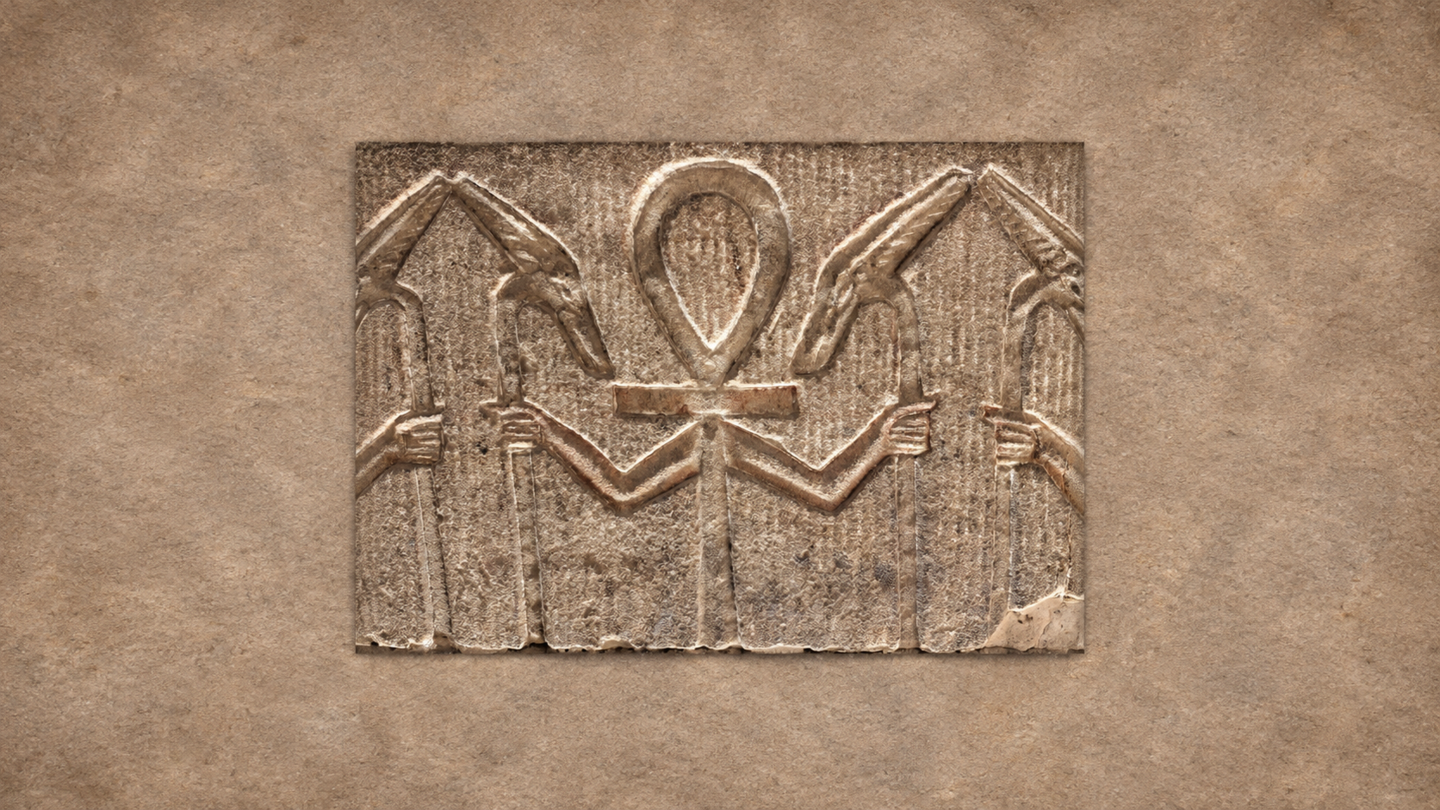
The Ankh is one of the most recognizable symbols of Ancient Egypt. Its shape resembles a cross, topped by a closed loop. Despite the simplicity of its form, this symbol embodies the ancient Egyptians' complex concepts of life, death, immortality, and the human connection to the divine world.
CONCEPT
I became interested in how such a simple graphic form became a symbol for one of the most complex concepts of human existence. Life cannot be depicted as a discrete object, yet the ancient Egyptians were able to give it a specific and recognizable form. I want to understand how this sign is structured and why its meaning is so clearly revealed through imagery. The origin of the ankh is still debated. Its form might have stemmed from a loop or a tied ribbon. The connection between its form and the unity of opposites, the birth of life, and natural cycles can only be viewed as a visual association, not an established historical meaning. However, the exact initial meaning of each element remains undetermined. Therefore, I am more interested in avoiding a romanticized legend and instead comparing various ancient artifacts to see what meaning the sign acquired within them. The libation vessel from the First Dynasty is particularly important: already at the turn of the 4th–3rd millennia BCE, the loop and knot form the sign of life, which becomes part of the object itself [22, 30, 35]. I want to focus my research particularly on the structure of the symbol. Its upper part is a closed, rounded form, while the lower part consists of straight lines. This combination can be perceived as a contrast between motion and stability. The closed line suggests continuity, while the vertical element provides the shape with support. This is my visual association, not a decryption of an ancient hieroglyph. To test this observation, I compare the proportions, silhouettes, line thickness, and the shape of the loop across different artifacts. Equally interesting is how the ankh interacts with the human body. In reliefs, deities hold it in their hands and bring it close to the ruler’s face. Life in these depictions appears as something that can be conveyed. This idea is especially vivid in the art of the Amarna period: the solar rays of Aten terminate in hands that bring the symbol up to the queen’s face. On another monument, dating to the Roman period, the stream of purifying water is composed of hieroglyphs of life and power. Here, one meaning is revealed through various natural phenomena—breath, light, and water [4, 5, 24].
Another important aspect is the presence of the ankh in funerary art. At first glance, it seems contradictory that the symbol of life appears among objects intended for the deceased. However, Egyptian funerary beliefs posited a continuation of existence after death. In this context, the ankh expresses hope for the renewal of life. Comparing ceremonial objects from the tomb of Thutmose IV with a small seal from a woman’s burial, we can see that the desire for life was not limited to royal art [2, 3, 10, 32]. I am also interested in how the symbol’s meaning is revealed through material, color, and scale. Ankhs were carved from wood and stone, crafted from blue faience, and their silhouette was used for gilded mirror cases. Egyptian blue-green amulets were associated with renewal and life, but this does not mean that every shade necessarily had its own specific interpretation. The proximity of the ankh to symbols of stability, power, protection, and rebirth also plays a vital role [1, 2, 8, 25, 26, 32, 33]. For this research, I selected monuments spanning from the Early Kingdom to Roman Egypt. Instead of a chronological listing of eras, the material is divided by meaning: origin, writing and form, the gift of life, immortality, object and color, and combination of signs. Finally, I refer to the Late Antique Coptic cross with a loop as an example of the transformation of the religious context of a similar outline. All monuments date from a time well before the 18th century [21, 49]. My main hypothesis is that the longevity of the ankh is connected both to its religious significance and the universality of its visual form. Because of its simplicity, it maintains recognizability across different materials and scales. However, the meaning is determined by who holds the symbol, where it is placed, what the object is intended for, and what other images are nearby. As a result, the ankh becomes an example of how an abstract concept acquires a material form and transforms into a crucial element of culture.
WHAT DOES ANKH REPRESENT?
In Egyptian script, the ankh conveyed the concepts of «life, ” „to live, ” and „living.“ In art, this meaning expanded: the symbol could represent a wish for a long life, divine protection, and continued existence after death. [30, 31]
Wooden model of an ankh. Middle Kingdom, 12th Dynasty, c. 1981–1802 BCE; wood; 15,8 × 16 cm; Metropolitan Museum of Art, No. 12.182.66.
ORIGINS AND MEANING: HOW DID THE ANKH SHAPE EMERGE?
There is no definitive answer yet. Ancient images show a loop and something resembling a band, but a single contour is insufficient to reconstruct the object that served as the prototype for the symbol. I am more interested in tracing how the form itself began to come to life in art. [30, 31] [67]
A noticeable similarity to a loop and tie is visible on the wooden ankh and the small gilded amulet. This raises the question: did the Egyptians depict an object familiar to them? There is no definitive answer. Therefore, I will rely not on speculation about its origin, but on how the symbol appears and is used in surviving artifacts. [30, 31, 67]
[67] Ankh amulet. Wood, gilding; 2,88 × 1,4 × 0.46 cm. Louvre, AF 13585. Dating is not specified in the card. Photo: Louvre.
The vessel from the First Dynasty demonstrates how long the ankh has been incorporated into Egyptian art. The sign of life is joined with the ka—the symbol of vital energy—to form the vessel’s very structure. Even in this early object, word and thing become intertwined. [22]
[22] Libation vessel shaped as the symbols of 'ka' and the ankh. Early Kingdom, 1st Dynasty, c. 3100–2900 BCE; granodiorite; 17,6 × 14,5 × 3.5 cm; Metropolitan Museum of Art, No. 19.2.16
Based on the ankh seal, it is positioned between two falcons, above the lion. It is perceived not as a standalone element, but as the central part of the composition. In this context, the wish for life can be associated with royal protection, even if the seal itself did not necessarily belong to a king. [52]
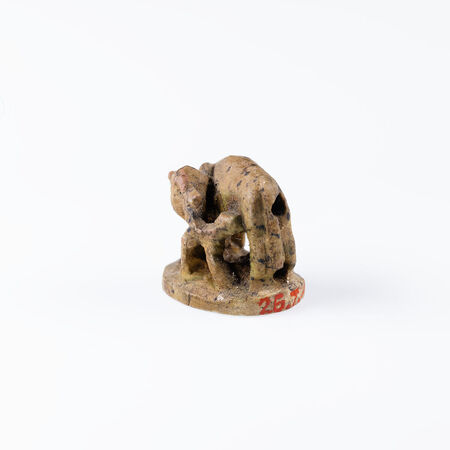
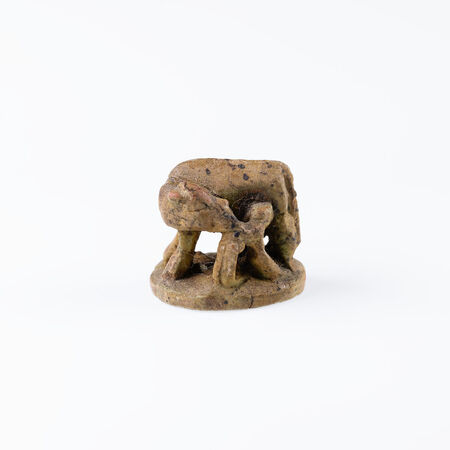
[52] A amulet-seal featuring a cow and calf on the reverse; the base shows the ankh between falcons above a lion. First transitional period, circa 2150–2100 BCE. Steatite. The Metropolitan Museum, No. 26.7.40. The photograph shows the base.
On the other seal, the composition is almost identical, but the central symbol museum tentatively identifies. The comparison shows why one cannot rely solely on external resemblance when studying ancient symbols. [39]
[39] Amulet-seal featuring two eagles flanking a sign, presumably an ankh. Early transition period, c. 2150–2010 BCE; serpentinite; Metropolitan Museum, No. 10.130.981
DETAIL SUGGESTING A WRAP
The blue faience ankh stands out with a slight thickening at the junction of the loop and
crossbar. It appears as if parts of the form are cinched together. This helps
suggest a possible prototype, but does not prove it. [53]
[53] Ankh amulet. New Kingdom. Faience. Egyptian Museum, Cairo, No. CG 24357.
Ankh and Isis Knot
When placed side-by-side, the similarity between these two objects becomes apparent: both begin with a loop. However, the sides of the tet are downward-pointing, while the ankh spreads horizontally. The tet is associated with Isis and the protection of the deceased, while the ankh symbolizes life; similar geometry does not imply identical meaning. [2, 23, 32]
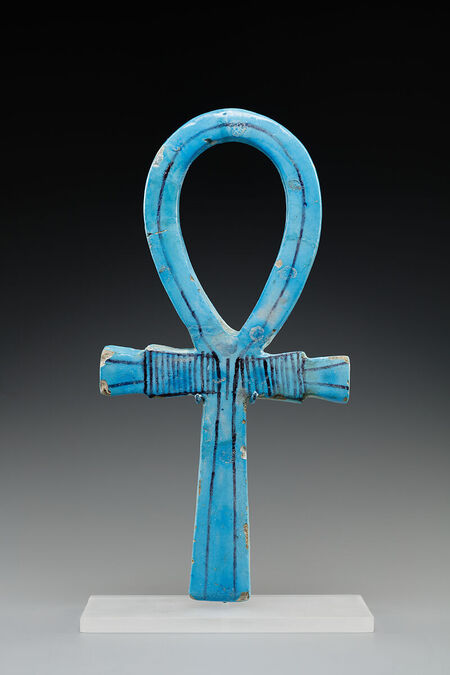
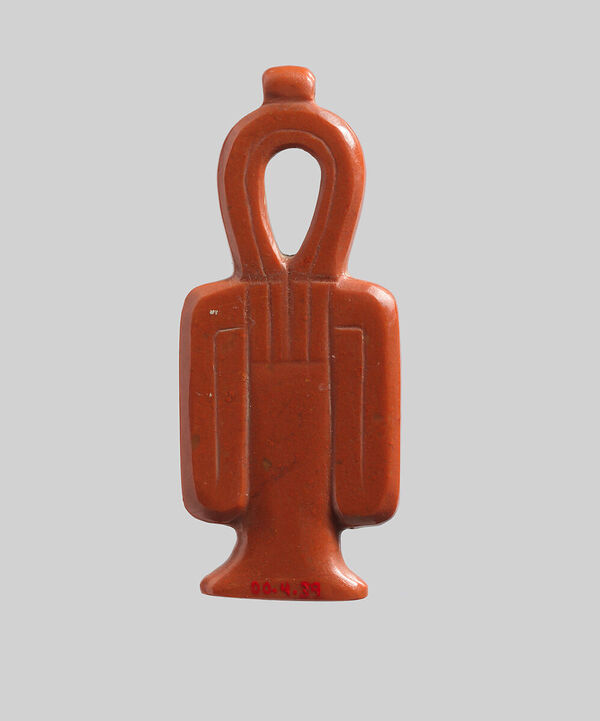
1. [2] Ceremonial object in the form of an ankh. New Kingdom, 18th Dynasty, reign of Thutmose IV, c. 1396–1386 BCE; faience; 27,7 × 14 × 2 cm; Metropolitan Museum, No. 30.8.29. 2. [23] Wedjat amulet (Eye of Isis knot). New Kingdom, c. 1550–1080 BCE; red jasper; 6,6 × 2,8 × 0.7 cm; Metropolitan Museum, No. 00.4.39.
What makes a sign recognizable? After comparing it with the tesserae, I wanted to check how freely the proportions of the Ankh could be altered. For this, I selected four small objects that differed noticeably in silhouette.
Four Variations on a Single Contour
The first amulet has attachment loops, while the others vary in the width of the crossbar and the contour of the loop. The black amulet even features an additional line inside the loop. Despite all the differences, the foundation remains constant—the loop, the crossbar, and the vertical element. This is what allows the symbol to be recognized. [68, 14, 54, 69]
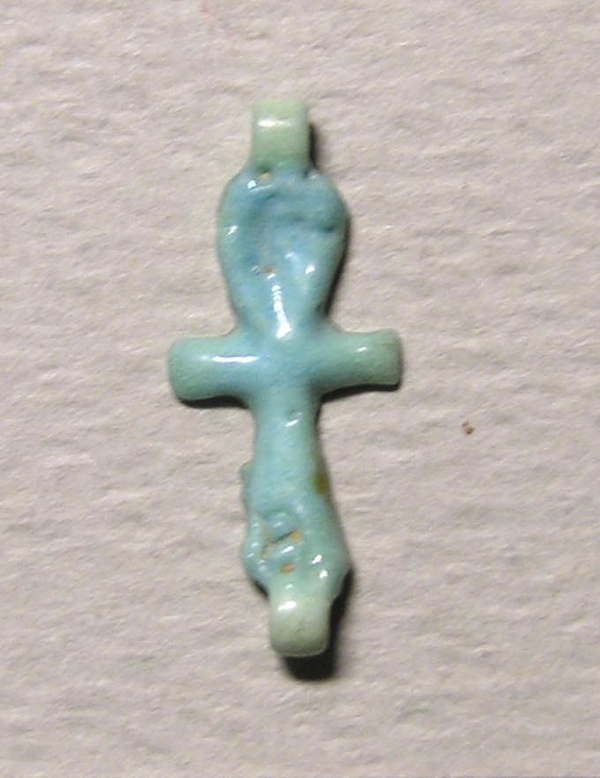
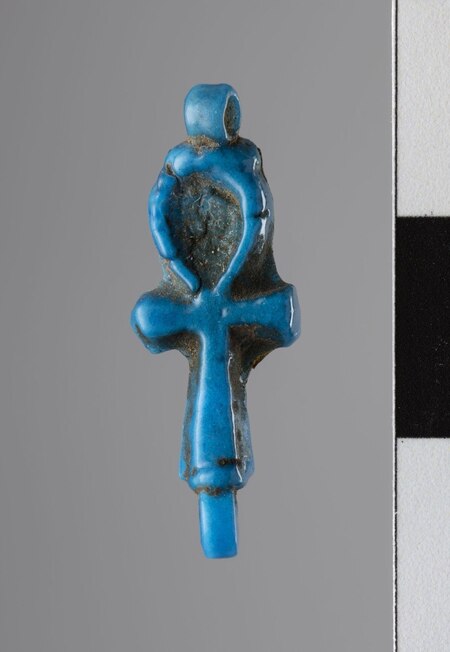
1. [68] Ankh amulet with two ears. New Kingdom, 1539–1069 BCE; light-blue faience; height 1.85 cm. Louvre, AF 10435. Photo: © 2013 Musée du Louvre / Département des Antiquités égyptiennes. 2. [14] Small ankh amulet. New Kingdom, 1540–1076 BCE; faience; Egyptian Museum, Turin, Provv. 1304.
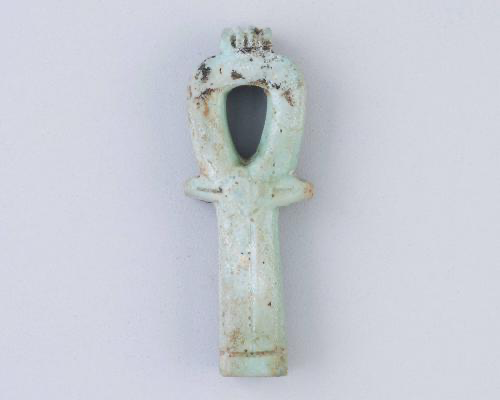
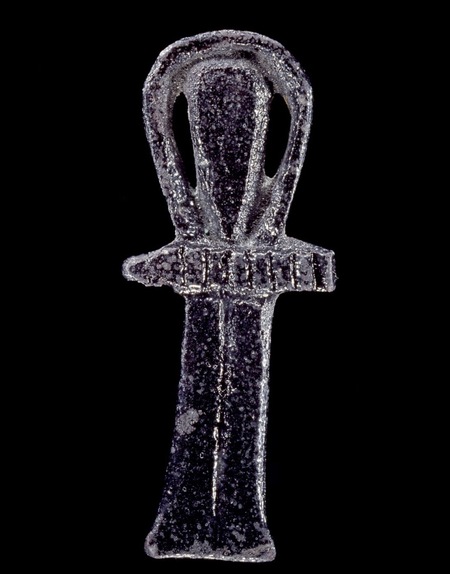
1. [54] Ankh amulet. Late Period, 26th Dynasty, 664–525 BCE. Faience, 5.3 cm high. Museo del Prado, No. 1906.65. 2. [69] Ankh amulet. Black faience; 3,6 × 1,46 × 0.54 cm. Louvre, AF 10701. Date not specified in the card. Photo: Louvre
In these examples, the rounded top complements the straight lines. It reminds me of the combination of movement and stability. However, the illustrations only prove the preservation of form, not that the Egyptians intended such meaning in every line.
When a symbol needs to be read
Previously, I viewed the ankh simply as an image. On the cowrie shell stamp, it functions as part of the written word for «life.» Here, the meaning is conveyed not only by the recognizable outline but also through the rules of writing. [10, 31]