RESEARCH DISSERTATION
Introduction
Architectural Context and First Impression 1.1. Multi-level structure of the western facade. 1.2. The effect of density and «overload» when viewed from a distance.
Compositional Center 2.1. The figure of King David as a semantic «keystone» and geometric center. 2.2. Symmetry and mirroring in David’s «deeds» (the composition with the lions).
The «Stone Carpet» 3.1. The abandonment of narrative in favor of rhythm. 3.2. The blurring of boundaries between the real beast and the fantastic ornament.
Structure: A Dialogue Between Carving and Architecture 4.1. The subordination of relief to the architectural framework (tympany, arches, consoles). 4.2. The role of chiaroscuro and stone texture.
Conclusion 5.1. The triumph of decorative logic: meaning achieved through repetition and symmetry.
CONCEPT
The Dmitrievsky Cathedral (1193–1197) possesses a rich history of its creation; however, I will focus on the visual elements of its western façade. It is counted among the most richly carved monuments of pre-Mongol Rus'. In literature, it has been examined from the perspectives of theology and architectural history. Of the massive quantity of reliefs—approximately 566—only 46 depict Christian themes. The remainder consists of creatures and ornamental patterns. This approach allows us to avoid delving into religious themes or the historical details of the church’s construction, instead examining it from an artistic and technical standpoint.
For my primary source material, I selected the western facade of a cathedral. The selection of images for analysis was guided by the following criteria: - Quality: Only high-resolution photographs were used—some were enhanced using AI to restore clarity, allowing for close examination of fragments. - Location: Reliefs situated in the tympanum, on the pilasters, and within the arcade-columned frieze of the western facade. - Motif Variety: I selected both central figural compositions (King David, warrior saints) and recurring «bestiary» elements (lions, griffins) to present a comprehensive overview.
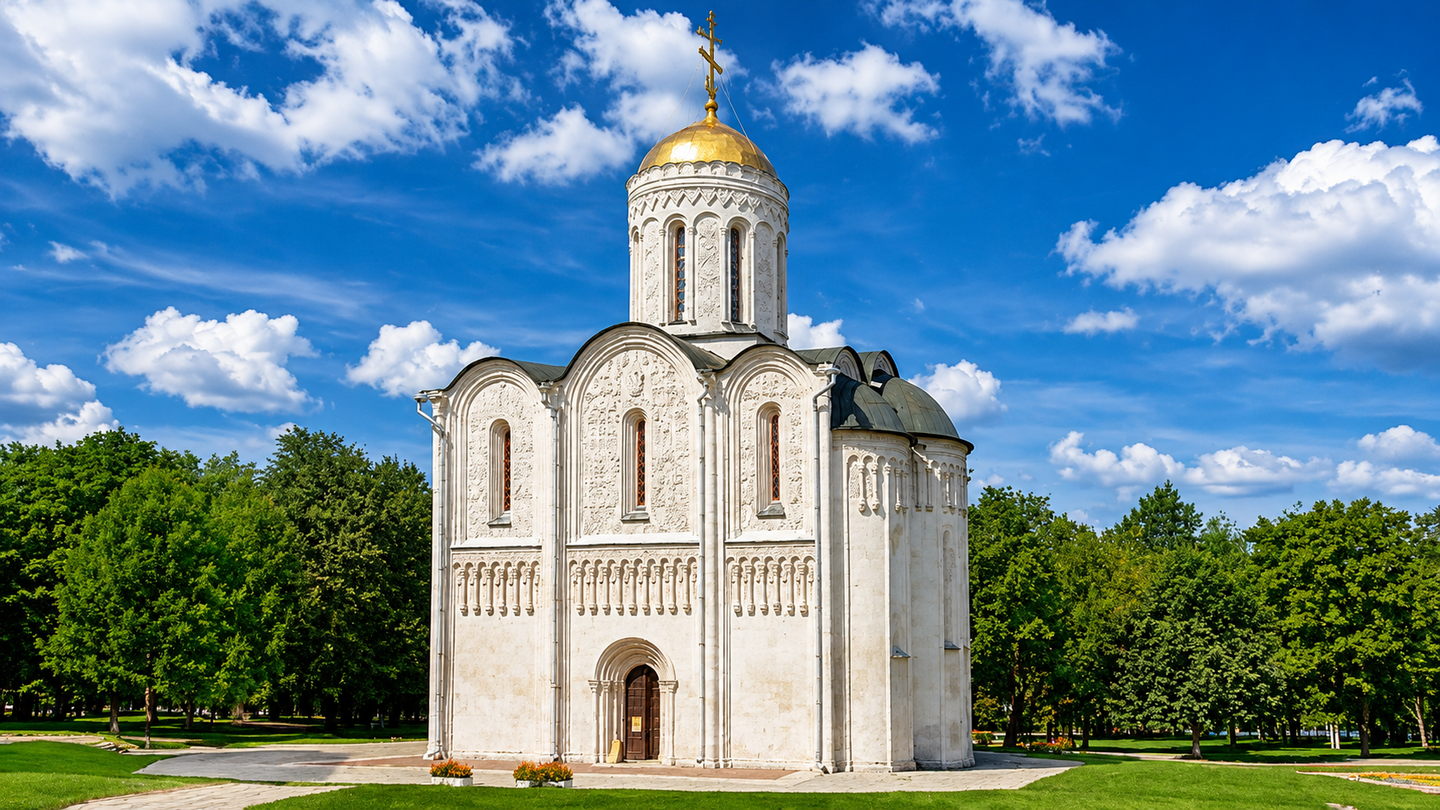
Dmitrievsky Cathedral in Vladimir, west facade, 1193–1197
The primary material is the imagery itself, which allows for a focus on details that might be overlooked in historical research or articles, rather than focusing solely on the concept of the temple’s construction.
I divided the research into blocks based on the visual logic of the facade, independent of chronology or history: — The semantics of the image of King David and his «deeds» (the composition with the lions). — Recurring animal and plant motifs in the «stone carpet.» — The interaction between the relief and the architectural forms (arches, columns, consoles).
Primary focus is given to art-historical work dedicated specifically to Vladimir-Suzdal carving, such as the research by G. K. Wagner and contemporary articles (particularly from official museum websites) concerning the symbology of the animal style. This text is not intended for retelling, but merely as a supplementary tool to «animate» the relief and enhance the individual perception of my conclusions.
The key question of my research is how the narrative logic prevails in the visual organization of the western façade of the Dmitrievsky Cathedral—is it a narrative logic where each relief illustrates a specific religious theme, or is it a decorative and ornamental one, where the images are integrated into the rhythm and structure of the architecture?
Dmitrievsky Cathedral in Vladimir, arrangement of reliefs
The hypothesis is that the Western facade adheres to a decorative-ornamental logic. The reliefs of animals and plant motifs function here as elements of a unified visual «carpet.» Repetitions, symmetry, and the architectural framing of the tympana, arches, and consoles establish its structure. The figure of David at the center serves as the semantic «key» to this composition. The other images do not so much tell a story as they create a rhythmic environment in which this center gains meaning.
THE BESTIARY OF DIMITRIYEVSKY CATHEDRAL: A VISUAL ANALYSIS OF THE RELIEFS ON THE WESTERN FACADE
The Dmitrievsky Cathedral (1193–1197) is among the most richly carved monuments of pre-Mongol Rus'. In literature, its ornamentation is typically examined from the perspective of theology or architectural history—as a complex text that must be deciphered. There are about 566 bas-reliefs, but only 46 depict Christian themes. The remainder consists of animals, birds, fantastic creatures, and vegetal ornamentation.
What predominates in the visual organization of the Western facade? Is it a narrative logic, where each relief illustrates a specific religious scene, or a decorative and ornamental logic, where images are embedded within the rhythm and structure of the architecture?
The material chosen is the western facade of the cathedral: this is the main entrance and the most representative decorative plane. We are examining the visual sequence and are not attempting to reconstruct the original intent of the architects. The focus is on the depth of the relief, the distribution of light and shadow, and how the forms are perceived from a distance.
ARCHITECTURAL CONTEXT
The western facade is a multi-tiered structure. At the lower level, there is a perspective portal leading into the sanctuary. Above this, there is an arcade-and-column belt—a row of small arches resting on columns with carved consoles. Above this belt begins the main field of carving, which rises in tiers toward the lunettes and the drum. This distribution establishes a rigid vertical and horizontal grid.
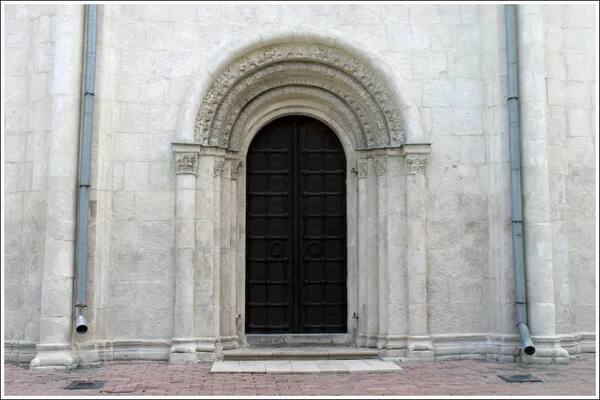
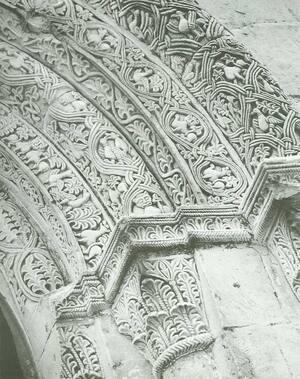
Dmitrievsky Cathedral in Vladimir, western facade, 1193–1197, fragment (portal).
FIRST IMPRESSION
When looking at the cathedral from a distance, what immediately strikes the eye is not a single narrative, but the overall density of the carving. The stone appears covered in a continuous tapestry, making it difficult to discern individual figures at first glance. This sense of «overload» is a crucial part of the visual experience.
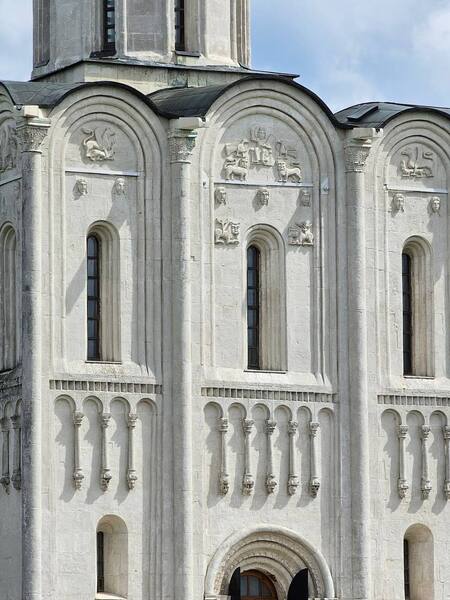
Dmitrievsky Cathedral in Vladimir, western facade, 1193–1197, wall fragment.
COMPOSITION CENTER
The main figure on the western façade is David. The hero sits on a throne, above him are flying angels and the Holy Spirit depicted as a dove. The scene illustrates a psalm, but the central figure also serves as the semantic «keystone» of the entire composition—the focal point around which the rest of the wall space is structured.
A closer look at how this scene is carved reveals that the lines of the nimbus, the folds of the garments, and the angels' wings are subservient to the form of the arch (the tympanum). David functions here more as a geometric and thematic center than as a character in a narrative; the rest of the carving revolves around him.
Dmitrievsky Cathedral in Vladimir, west facade, 1193–1197, fragment (King David).
Flanking the window are two paired scenes from «David’s Deeds.» On the left, David pursuing the lion (an older attribution of «Hercules and the Lion»), and on the right, David tearing the lion’s jaws apart (an older attribution of «Samson and the Lion»). They do not narrate a linear story, but rather create balance and support the central figure as symmetrical elements.
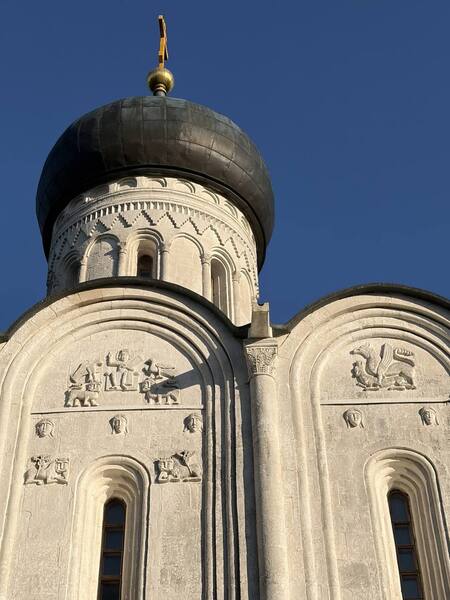
«STONE CARPET»