Concept
A niche media outlet about conceptual and avant-garde fashion, framing it as art—systematically, clearly, and without pretension.
Categories
«Avant-Garde Glossary» — one term explained simply «Archive of the Week» — one iconic collection: history and meaning «God in the Details» — a close-up on a single element with an explanation «The Market» — where to buy, how to verify, and market announcements «Runway Breakdown» — fresh showcases from avant-garde brands
Semester Thematic Plan
November 2026. «The Japanese Revolution»Concept: The genesis of modern avant-garde—Japanese designers in Paris in 1981.Vocabulary: «Hiroshima chic, ” asymmetry, „null color“ (black as a stance), „wabi-sabi“ in fashion. Archive of the Week: Comme des Garçons and Yohji Yamamoto in Paris 1981; CdG SS97 „Body Meets Dress“; Issey Miyake Pleats Please (1993); early collections by Junya Watanabe. Fashion in Focus: Wim Wenders' film „Notes on Clothes and Cities“ (1989) God in the Details: Raw edges, Miyake pleating, Yohji’s oversized silhouette. Market: Where to find Japanese archives, and the differences between CdG lines (Homme Plus, Play, Shirt). YouTube: „CdG SS97: Why Horns Became a Manifesto“; „Japanese Designers in Paris: How Three Designers Broke Fashion.“ Podcast: „Why Avant-Garde Wears Black.“ Event: Screening of Wenders' film with discussion.
December 2026. «The Belgian Code» + Year-End ReviewConcept: The second wave of the avant-garde—The Antwerp Six and Martin Margiela.Vocabulary: deconstruction, brand anonymity, upcycling, «artisan» line. Archive of the Week: The Antwerp Six in London (1986); the debut of Maison Martin Margiela (1988); Margiela at Hermès (1997–2003); Ann Demeulemeester. Fashion in Focus: A documentary about Margiela, exhibitions on Belgian fashion. God in the Details: white labels with four stitches, tabi boots, lining turned out. Market: Gifts for the Collector: books on the avant-garde, accessible archive entry. Year-End Review: Top 5 avant-garde shows of 2026, according to the editorial team and readers (poll). Event: New Year archive swap.
January 2027. «The Dark Side»
Idea: Men’s fashion weeks in Paris and the «dark avant-garde.»
Show Analysis: Key avant-garde presentations from Paris Men’s Fashion Week (Rick Owens, Yohji Yamamoto, Junya Watanabe, and others).
Vocabulary: «Darkwear,» layering, laboratory leather, «hand-dyeing.»
Week Archive: Rick Owens SS14 «Vicious» (show with step-teams); Carol Christian Poell; Boris Bidjan Saberi; Guidi footwear.
God in Detail: Hand-dyed leather; asymmetrical zippers; Guidi boot construction.
Marketplace: How to identify an original when purchasing archive leather and footwear.
YouTube: «Rick Owens: How the show is structured and where this aesthetic comes from.»
Event: Meeting of «dark avant-garde» collectors.
February 2027. «Body and Form»
Concept: How the avant-garde reinterprets the body and silhouette.
Vocabulary: silhouette, «second body, ” modular clothing, proportion.
Archive of the Week: CdG’s „Body Meets Dress“ and costumes for Mers Cunningham; Issey Miyake and fabric experimentation; Rick Owens SS16 (models carrying models); Iris van Herpen.
Fashion in Focus: Dance and performance in avant-garde fashion.
Detail of the Day: Linings and padding, pleating, 3D printing in clothing.
Market Spotlight: Local Russian brands in conceptual aesthetics.
Event: A talk/discussion with a professor of costume history.
March 2027. «Fashion Week + Women of the Avant-Garde»
Idea: A women’s fashion week in Paris and the women who changed fashion.
Runway Analysis: The major avant-garde shows from Paris Women’s Fashion Week.
Archive of the Week: Rei Kawakubo, Vivienne Westwood, Ann Demeulemeester—women who defined the avant-garde.
Glossary: «anti-fashion, ” „anti-glamour, ” punk as a precursor to the avant-garde.
Fashion in Focus: Documentary films about female designers.
Market: How to read seasonal codes on labels.
YouTube: „Rei Kawakubo: The designer who doesn’t explain her clothes.“
Event: Live stream viewing of a show with editorial commentary (online in the chat).
April 2027. «Archive and Market»
Idea: how to collect avant-garde thoughtfully—the final session of the course and the launch of a collectors’ club.
Vocabulary: «archive, ” „grail, ” deadstock, „season.“
Archive of the Week: the most sought-after items on the archive market and why they are valued.
God in the Details: how to determine the year of an item based on its details.
Market: a comprehensive guide on „How to Start Collecting Archives“; a map of Moscow resale projects and concept stores.
YouTube: „How to build an avant-garde wardrobe from scratch.“
Event: a large offline market for archival clothing featuring partners (concept stores, resale) and the launch of an exclusive collectors’ club.
Content Samples

Post from the «Archive of the Week» SectionWhat actually happened? Kawakubo asked a question that fashion usually avoids: why should clothing highlight the «ideal» body? Her dresses don’t cling to the figure; they invent a new one. The body ceases to be fixed—it can be reconstructed.A year later, these pieces hit the stage: choreographer Merce Cunningham used them as costumes for his piece, «Scenario.» The clothing, which was initially called «ugly, ” became scenography.Why this matters now: every time you see a strange volume or an „incorrect“ silhouette on the runway, you are looking at the inheritors of SS97.

Telegram Post, «Avant-Garde Glossary» Column
The term originates from the philosophy of Jacques Derrida, and in fashion, it signifies one thing: the object reveals how it was made.
How to recognize deconstruction: — visible seams and serging; — lining exposed over the main fabric; — unfinished, «raw» edges; — displaced details: a sleeve on the back, a pocket turned upside down; — the «kitchen» is visible: visible stitching, markings, and tags.
Key names include Martin Margiela, Rei Kawakubo, and Yohji Yamamoto.
Simply put: ordinary clothing conceals its construction. Deconstruction boasts about it.

Telegram post, column «God in the Details»Photo: a close-up of a tabi boot, side view, split toeThe split toe is one of the most recognizable details in fashion history. Margiela borrowed the shape from traditional Japanese tabi socks worn with traditional footwear and debuted the first tabi boots during the house’s debut show in 1988.The most fascinating part is the story of the show. The soles of the shoes were dipped in red paint, and the models left marks on the white canvas that covered the runway. This fabric, bearing those impressions, later went into production and became part of the next collection. The footwear literally «painted» the clothes.Why this detail has lived for nearly forty years: the tabi is simultaneously strange and recognizable. It’s a password shoe—if you know, you know.

Telegram Post, «Fashion in the Frame» Column
In 1989, Wim Wenders shot a documentary about Yohji Yamamoto for the Centre Pompidou. Wenders admitted that initially, he didn’t understand why the director wanted a film about fashion, but later, he saw a kindred spirit in Yamamoto: both of them create their own language from fragments of reality.
What to note in the film: — Wenders shoots the film on both film and video—the film itself becomes a conversation about the copy and the original; — Yamamoto reflects on old photographs and clothes in which «life has been lived»; — Tokyo and Paris are presented as two poles between which his clothing is born.
Who is this for: For those who want to understand that Japanese avant-garde is not about «weird things, ” but about an attitude toward time.
We are showing the film at a club meeting in November. Registration is in the pinned messages.

Telegram Post, «Market» Section
The antique market is rife with fakes and «almost originals.» Before you transfer money, ask the seller these questions:
Close-up photos of the tags. The main tag, and the tag detailing composition and care—from both sides. Compare the font and stitching against originals from trusted sources.
Season. An honest seller knows which collection the item belongs to. If the answer is, «old, definitely original”—that’s a reason to be suspicious.
Photos of the seams and the reverse side. The quality of construction from avant-garde brands is visible from the inside.
Photos taken in daylight. The color and condition of the fabric aren’t hidden behind a filter.
History of the item. Where did it come from: from a boutique, from a collection, or from resale?
Price. If the item is priced drastically lower than market rate, the question isn’t „did I get lucky,“ but „what is wrong with it?“
Save this post, and in the club chat, you can ask collectors to evaluate the item before you buy.

Telegram Post: Offline Event Announcement & Poll
We are gathering in December to swap items you no longer wear but deserve a second life.
How it works: — Bring up to 5 pieces from avant-garde and conceptual brands. — Each item receives a token. — You exchange tokens for other people’s items. — Items that do not find an owner can optionally be donated to charity.
Bonus: A short lecture from the editorial team on «How to Care for Archive Clothing» and tea.
Date and location — [date], [address]. Registration — [link], limited to [N] spots.
Poll: What will you bring?
Japanese (CdG, Yohji, Miyake) Belgian (Margiela, Demeulemeester) Dark Avant-Garde (Rick Owens and company) Local Conceptual Brands Just to look
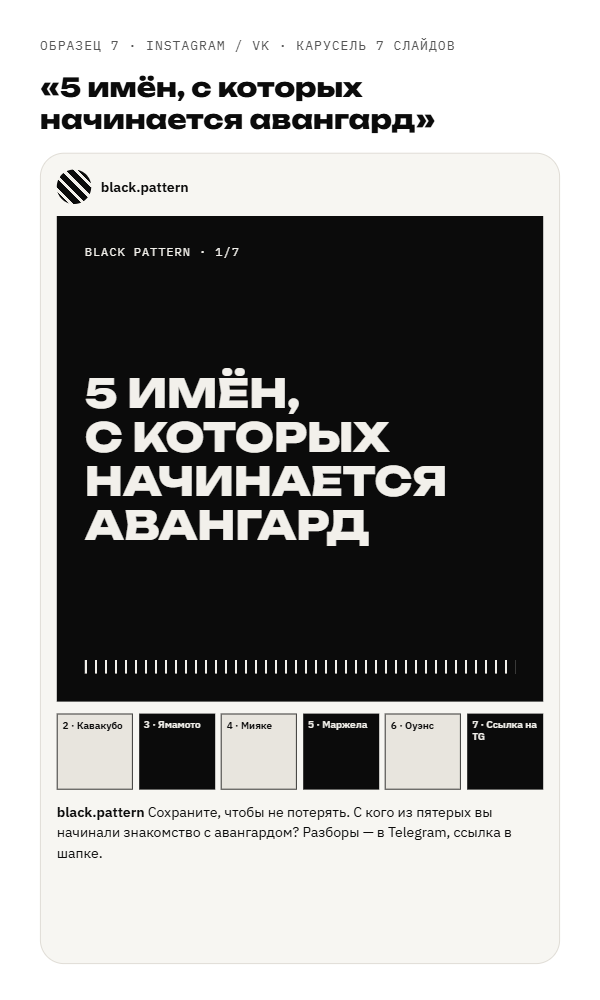
Instagram Carousel Topic: «5 Names That Define the Avant-Garde»Rei Kawakubo. Founder of Comme des Garçons. Creates clothing that questions the body and beautyYohji Yamamoto. Made black the defining color of the avant-garde. Oversize, asymmetry, the poetry of cutIssey Miyake. Transformed fabric into technology. Pleating that resists wrinkles and moves with the bodyMartin Margiela. The anonymous designer who revealed how clothing is constructedRick Owens. The dark, monumental, theatrical avant-garde of our time

Reels, Script (Video, 45 seconds)Topic: «Why Japanese Designers Were Called 'Hiroshima Chic'»0–3 sec Host in black looks into the camera, quick zoom «In 1981, Paris dubbed these designers 'Hiroshima chic.' And it wasn’t a compliment.» 3–10 sec Archival footage of CdG and Yohji shows from the early 80s «Rei Kawakubo and Yohji Yamamoto brought black, ripped, asymmetrical clothing to Paris.» 10–20 sec Montage: glossy early 80s looks (bright colors, shoulders) versus the dark volumes of the Japanese designers «Around them were bright colors, sharp shoulders, and sheen. And here—holes, unfinished edges, slouchy silhouettes.» 20–30 sec Host against a background of racks of black clothing «Critics saw the image of catastrophe in these pieces. This is where the negative moniker came from.» 30–40 sec Shots of contemporary shows with a similar aesthetic «But it was precisely these pieces that changed fashion. Today, everyone copies their aesthetic—from luxury houses to mass market.» 40–45 sec Black Pattern logo, pattern «The full breakdown is on our Telegram. Link in bio.»

YouTube Video, Script (Video, 12–15 Minutes)Topic: «Rick Owens: How the Show Works and Where This Aesthetic Comes From»Structure and Key Shots:Hook (0:00–0:40). Shot: Rick Owens SS16 show, where models carry other models. Voiceover: «Models carrying other models. Is this a provocation, a performance, or clothing? We’ll figure out why even those who will never buy his pieces watch Rick Owens shows.» Who is Rick Owens (0:40–3:00). Shots: Archival photos, 90s Los Angeles, Paris. Voiceover: He is from California; he started in Los Angeles and has lived and worked in Paris since 2003. His collaborator and muse is Michelle Lamy. Aesthetics: «Gloom» and Monumentality (3:00–6:00). Shots: Close-ups: draping, elongated silhouettes, massive footwear, gray-black palette. Voiceover: An analysis of key techniques: layering, draping, «architectural» silhouettes, the feeling of a temple and ruins simultaneously. The Show as Performance (6:00–10:00). Shots: SS14 «Vicious» with step crews; SS16 with «living backpacks.» Voiceover: Why Owens uses the runway as a stage: a discussion about the body, strength, care, and beauty that defies standards. How to Wear It (10:00–12:30). Shots: Editor trying on pieces in the concept store (sponsored project). Voiceover: Where to begin, what brand lines exist, what to look for when buying on the resale market. Finale (12:30–13:00). Shot: Host in the studio. Voiceover: «If you want an analysis of another show—comment below, and in our Telegram channel, we publish the ‘Archive of the Week’ every week.»
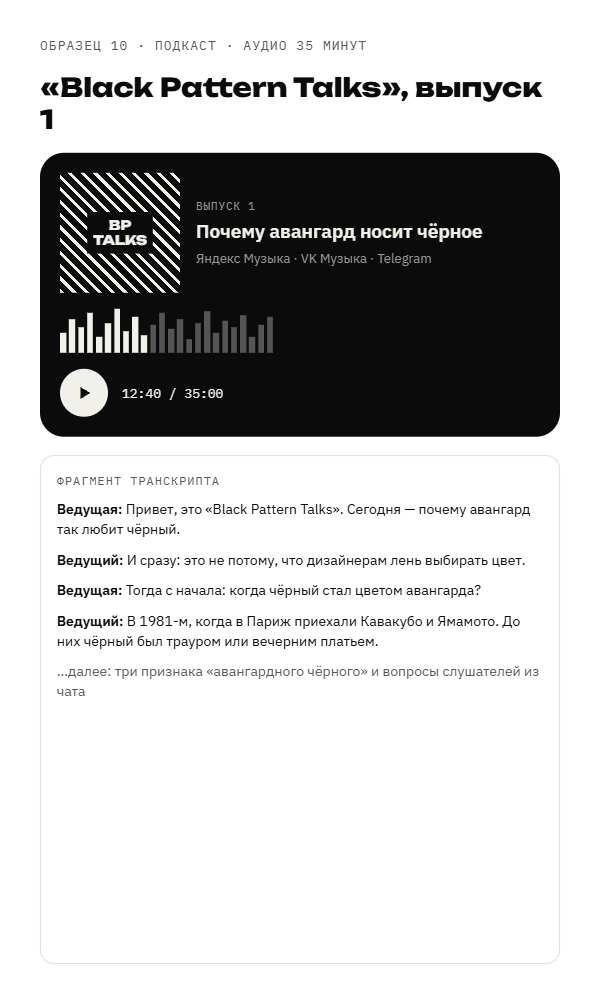
Podcast «Black Pattern Talks, ” transcript excerpt (audio)Episode 1. „Why Does Avant-Garde Wear Black?“ (Episode duration: 35 minutes, excerpt from the beginning below)Host 1: Hello, this is „Black Pattern Talks.“ Today’s topic was practically inevitable given our title: why does the avant-garde love black so much?Host 2: Let me say this right away: it’s not because designers are lazy and too tired to choose a color.Host 1: (laughs) Though that’s a nice take. Let’s start at the beginning: when did black become the „color of the avant-garde“?Host 2: In short—in 1981, when Rei Kawakubo and Yohji Yamamoto arrived in Paris. Before that, black in fashion was either associated with mourning or evening wear. But they made it everyday and central.Host 1: And that was a challenge, because the 80s were all about bright colors, shine, and huge shoulders.Host 2: Yes. And then these pieces appeared—pieces with no color, no shine, and no emphasized silhouette. Yamamoto has explained in interviews many times that black, for him, is a color that is simultaneously modest and daring: it doesn’t demand attention, but it also won’t let you ignore it.Host 1: I also like this idea: in black, only the form is visible. The color doesn’t distract, and you finally notice the cut, the volume, the draping.Host 2: That’s why black is like a black-and-white photograph for clothing. You remove the color—and what remains is the structure.Host 1: Okay, now a question from a listener in our chat: „If everyone wears black, how do you tell the avant-garde apart from just plain black clothes?“ Let’s break that down…