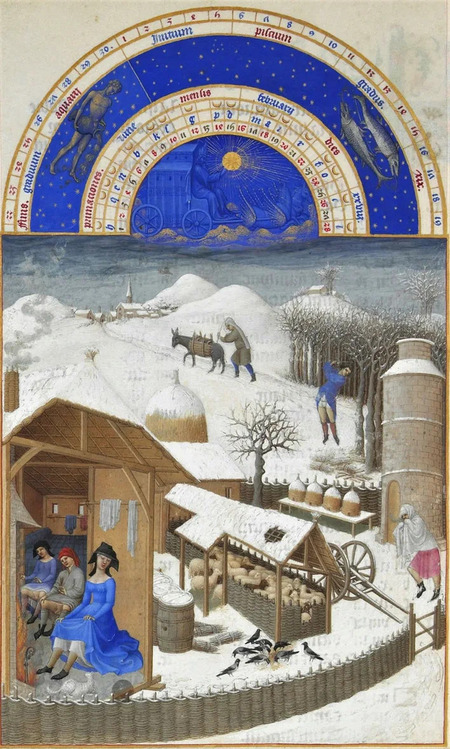
Concept
In medieval art, the seasons were depicted not only through natural phenomena but also through people’s daily lives. Seasonal changes influenced people’s activities, clothing, and way of life; consequently, artists could convey the specifics of a particular season through familiar actions and objects. This is particularly interesting in depictions of winter: instead of snowy landscapes and frozen bodies of water, scenes are often found where people are warming themselves by a fire, drying clothes, or engaged in labor characteristic of the cold season.
I became interested in why winter was not always depicted directly through snow and cold in medieval calendars. At first glance, it might seem that showing snowy ground or a person in warm clothing is sufficient to designate winter. However, calendar illustrations from the 13th–14th centuries demonstrate a more diverse approach. The viewer could determine the season based on the person’s posture, their activity, the objects surrounding them, or even the image’s placement within the overall sequence of months.

Calendar cycles hold a special place in this tradition, with each month corresponding to a specific scene from daily life. These images are traditionally called «Labours of the Months.» They appear in medieval manuscripts, horologes, and architectural decoration. Often, zodiac signs are placed alongside the monthly images, allowing the calendar cycle to connect human daily activity with a broader concept of temporal order.
However, the content of these calendar scenes was not uniform. The same month could be depicted differently depending on where the work was created, the manuscript’s intended purpose, and local artistic traditions. For instance, February might be shown in some calendars as a person warming themselves by a hearth, while in others it might depict a religious rite or seasonal labor. Therefore, it is important to view these images not as illustrations of a single set of rules, but as varied representations of the passage of the year.
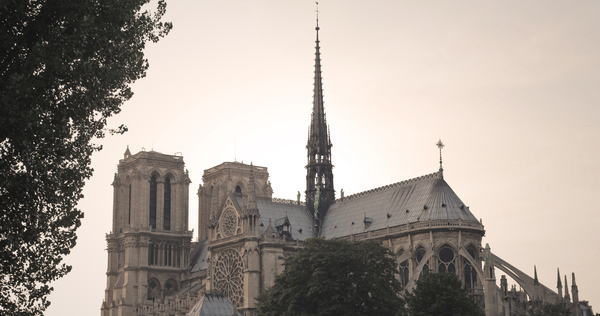
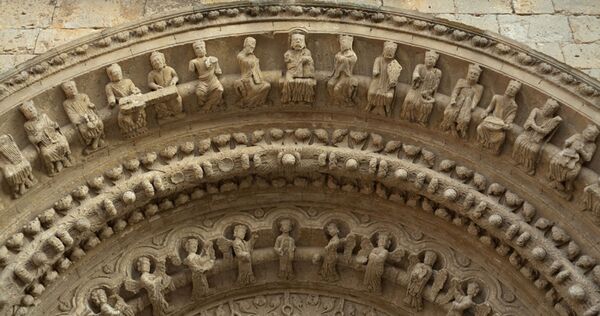
For this study, works from the 13th–14th centuries were selected to trace various modes of depicting winter. The core material consists of calendar miniatures from English, French, and Italian manuscripts. Additionally, the analysis includes architectural sculpture from the Chartres Cathedral and allegorical depictions of winter in Sienese painting. This combination allows for a comparison between images of specific months and a more generalized representation of winter as a season.
The study covers monuments from Western Europe (primarily England and France) with select Italian examples—the selection is determined by their preservation and accessibility, but it does not claim to exhaust the scope of medieval calendar iconography. The material allows us to trace how motifs depicting the image of winter recur and transform.
The analysis considers not only the narrative but also the artistic devices: the positioning of figures, clothing, interior details, the depiction of fire, zodiac signs, and allegorical figures—these help identify the season and move toward a generalized concept of the time of year.
Sources include scholarly publications, museum and library catalogs, as well as the works of E. V. Zotova, Carol Styr, and Timothy Hyman.
The work examines three aspects of the image of winter: daily activities as a seasonal marker, the artistic means of its creation, and the place of winter within the calendar system—from depicting a month to becoming an independent allegorical figure.
The objective of the research is to demonstrate how the recognizable image of winter developed in European art during the 13th–14th centuries: through details of human daily life, rather than through depictions of nature; in allegorical works, winter attains a more autonomous embodiment.
Winter in everyday life
One of the most common ways of depicting winter in medieval calendars is the scene of warming by the fire. Instead of directly illustrating the cold, the artist shows how people adapt to it. The hearth in these miniatures becomes not just part of the interior, but a significant element that helps define the season.