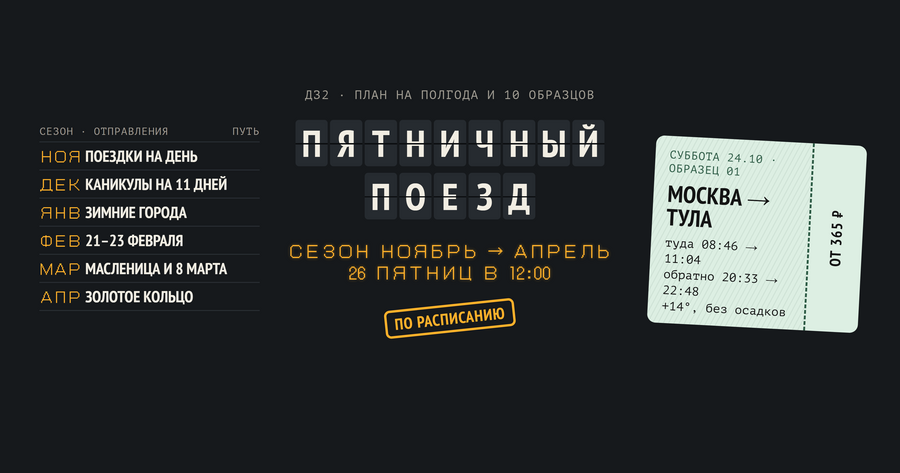
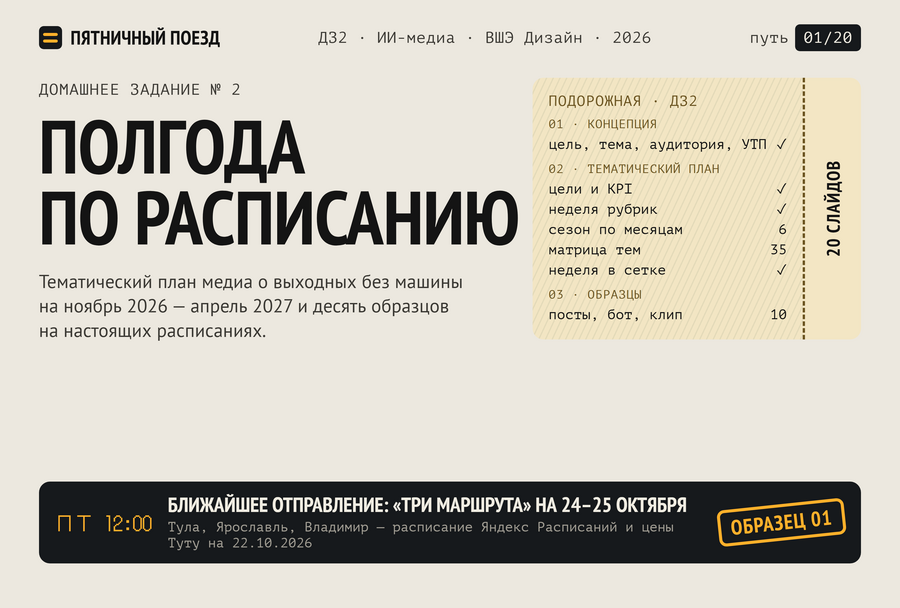
This is the second media assignment for «Friday Train”—a media concept focused on weekend trips outside the city without a car. It consists of three parts: the media concept, a six-month thematic plan running from November 2026 to April 2027, and ten content samples: posts, bot interfaces, a clip, and a pinned piece. The train schedules in the samples are sourced from Yandex Schedules for October 24–25, 2026, ticket prices are from Tutu for October 22, and the weather data comes from the Open-Meteo forecast.
1. Media Concept
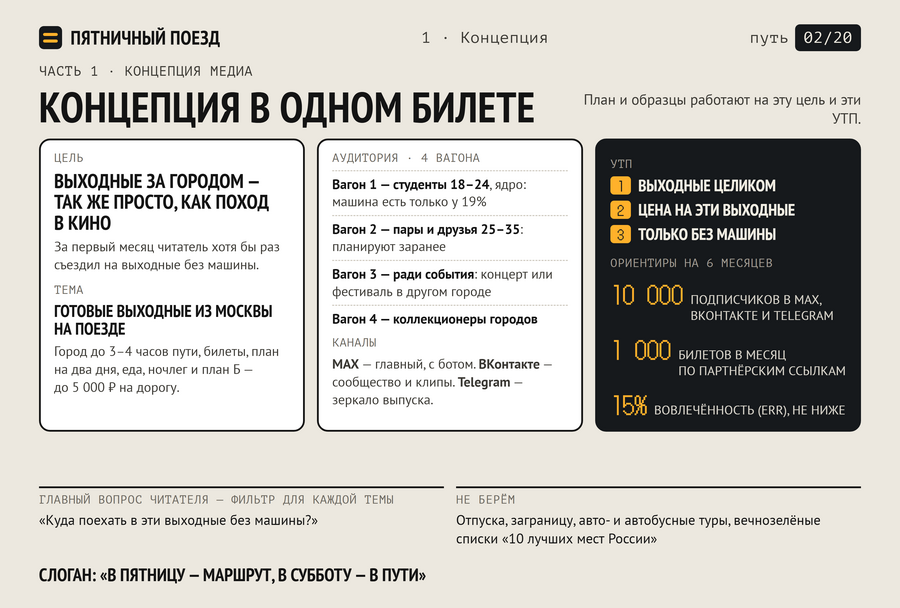
Media Concept. The goal is to make weekend trips outside the city as easy as going to the movies: within the first month, the reader should have made at least one trip for the weekend without a car. The theme is ready-made weekends from Moscow by train: cities within 3–4 hours' travel, tickets, a two-day itinerary, food, lodging, and a Plan B, all for under 5,000 ₽ for transport. The reader’s main question is, «Where should I go this weekend without a car?» and we verify every plan topic for them.
The audience is comprised of four «carriages»: students aged 18–24 (the core group), couples and friends aged 25–35, those who attend for the event itself, and city collectors. The primary channel is MAX, featuring the «Where to Go?» bot; VKontakte serves as a community and video hub; and Telegram mirrors the event’s release. The unique selling proposition (USP) is a full weekend experience, a specific price for that weekend, and the convenience of traveling without a car. Six-month goals: 10,000 followers, 1,000 ticket sales per month via affiliate links, and engagement rate no lower than 15%.
2. Half-Year Thematic Plan
We built the plan step-by-step, based on the content marketing lecture: goals and metrics, audience, formats and topics, frequency, KPIs, creation and distribution, and analysis. Each goal has a checkpoint at the end of the month: subscribers grow from 1,500 in November to 10,000 in April; tickets via affiliate links increase from 100 to 1,000 per month; and the bot reaches 2,500 users by April. We check in on the last day of the month: if we fall behind by more than 20%, we change the topic, release time, or focus area—not the goal itself.
The content guides the reader through a funnel: the VK Clips series, «Route in 30 Seconds,» introduces media; the «Three Routes» feature on Fridays and «Ticket Radar» on Tuesdays provide utility; «Fellow Traveler Reports» and city stamps drive engagement, and the bot drives conversions. Revenue starts with the first issue: affiliate links for tickets—Tutu pays 7,5%, Yandex Travel offers 5% (Travelpayouts).
Segments—those are scheduled releases, and each answers a specific question: on Tuesday at 10:00, «Ticket Radar» tells you when to grab tickets before prices rise; on Wednesday at 7:00 PM, «Weekly Train» covers if you can do it for one day and for less money; on Thursday at 6:00 PM, «City in 24 Hours» suggests what to do beyond the Kremlin; on Friday at 12:00 PM, the main feature «Three Routes» suggests where to go this weekend; and on Sunday at 8:00 PM, it’s «Fellow Traveler Reports.» VK Clips drop on Mondays and Thursdays, and the bot operates 24/7. Over half a year, this amounts to 26 Friday editions, 104 posts from other segments, and 52 clips.
The theme of each month is taken from the calendar. November is dedicated to day trips: by the end of the month, there are less than eight hours of daylight, so we focus on cities within a two-hour drive. Additionally, November 4th is a Wednesday holiday. December centers on preparations for the holidays, running from December 31st to January 10th. Ticket prices increase starting December 1st, and RZHD offers tour trains such as the «Pereslavy Express, ” „Winter Fairy Tale, ” and „New Year’s Eve Night.“ January features winter cities and Tatiana’s Day. February focuses on the long weekend of February 21–23; February 20th is a working Saturday, and booking numbers for February holidays have increased by 53% compared to last year. March celebrates March 8th and Maslenitsa (March 8–14, with celebrations on March 13–14). April is dedicated to trips along the „Golden Ring“ every week, plus a look ahead to the May holidays.
Content Matrix — following the lecture method: seven columns horizontally and five rows vertically—Vladimir and Suzdal, Yaroslavl and Kostroma, Tver and Torzhok, Tula, Kaluga, and Ryazan, holidays and tourist trains—the working title is at the intersection. This yielded 35 topics—enough for half a year. Ten cells in a black frame—finished samples from the third section.
Here is how one week of the schedule looks—November 9–15—presented in a «channels × days» grid. MAX features everything; VKontakte receives the main content and discussion; Telegram mirrors the Friday release; and VKontakte clips bring in new readers. This week’s highlights include the techno festival «Earth—Moon, Kaluga—Mars» in Kaluga on November 12–13, and the «Kuzminki» event in Vitoslavlitsy in Veliky Novgorod on November 14.
Creation and Distribution. On Thursdays at 6:00 PM, the robot collects data: schedules from the Yandex Schedules API, prices from the Tutu partner API, weather from Open-Meteo, and events from the open data of the Ministry of Culture and KudaGo. At 8:00 PM, the AI dispatcher selects three routes based on specific rules: travel time of up to 3–4 hours, a return train on Sunday evening, budget travel, a trip duration of 6–8 hours, and no rain. At 10:00 PM, the AI editor drafts a two-day itinerary. On Fridays at 10:00 AM, a human verifies prices, seating, and links—the publication cannot go live without this check—and at 12:00 PM, the publication is released on MAX, VKontakte, and Telegram. The editorial team spends about 9 hours per week on this process.
3. Ten Content Samples
Example 1. «Three Routes, ” Friday, October 23, 12:00 PM — main departure based on real-time data. Tula for Saturday: „Lastochka“ 8:46 AM → 11:04 AM; return on the last „Lastochka“ 8:33 PM → 10:48 PM; tickets starting from 365 ₽. Yaroslavl with an overnight stay: there on Saturday 6:30 AM → 9:27 AM, from 649 ₽; return on Sunday on the last train 9:28 PM → 12:32 AM, from 2,156 ₽. Vladimir for Sunday: 7:07 AM → 8:48 AM, from 660 ₽; return 7:17 PM → 10:06 PM, from 1,440 ₽. The weekend weather is dry, with temperatures between 12°C and 14°C during the day… Train schedules are from Yandex Schedules, prices are from Tutu for October 22, and the weather forecast is from Open-Meteo.
Example 2. «Ticket Radar,» Tuesday, October 27, 10:00 AM. Since there are no long weekends on November 4—Wednesday, the radar suggests a one-day trip. Tula starts from ₽365 in the coming days, but on November 4 it is from ₽922—2.5 times more expensive—and spots sell out first, so the advice is to book now. What to do: a concert in Yasnaya Polyana on November 4 for ₽600. Or, if your November 3 evening is free, there is «Night of Arts» at the Museum of Cosmonautics History in Kaluga, from 6:00 PM to 10:00 PM, free of charge.
Sample 3. «Train of the Week, ” Wednesday, October 28th, 7:00 PM. Starting October 25th, the Central Passenger Railway transitioned to its winter schedule, which changed three things for weekend trips: the Moscow—Tula express now stops at Tsaritsyno, the Moscow—Kaluga express 6155/6156 departs 29 minutes later, and the summer „country cottage“ commuter trains have been canceled until spring. Our advice—check the schedule in the app before you leave. This is the Plan B of the media concept: reliability is also content.
Sample 4. «City in 24 Hours,» Thursday, October 29, 6:00 PM. Suzdal: there are no trains there, so the «Lastochka» to Vladimir is 1 hour 41 minutes, followed by a bus ride of about an hour. Saturday’s hourly plan: the Kremlin and the Nativity Cathedral, the Trading Rows and lunch, the Museum of Wooden Architecture, the Pokrov Monastery and the Kamenka bank, the Spaso-Evfimiev Monastery—on October 31 and November 1 there will be spiritual chants. Suzdal is a city for short trips: 67% of bookings there are short stays (Bronevik, 1st Half of 2026).