Между образом и смыслом: символика и аллегория в творчестве Иеронима Босха
Concept
The research is dedicated to the artistic language of Hieronymus Bosch and the methods he employed to create hidden meanings in his works. Concealed behind the unusual nature of his painting is a complex system of metaphors, allegories, symbols, and visual puns through which the artist conveys religious beliefs, moral ideas, and reflections on human nature.
Particular attention is paid to specific figures and details that acquire additional meaning and transcend their literal depiction. Familiar objects, animals, plants, and fantastic creatures become vehicles for expressing human vices, bodily desires, earthly temptations, and spiritual states.
Of special interest is how Bosch merges the real with the fantastic, employs grotesquerie, mixes human, animal, and plant forms, and transforms verbal expressions and popular concepts into visual imagery. The significance of individual details is revealed not only in isolation but also through their interaction with the surrounding elements of the composition.
To interpret the works, the research draws upon the historical context of the era: medieval literature, bestiaries, Christian iconography, folk beliefs, and linguistic expressions. Comparing the images with written sources and the works of art historians allows for the examination of potential meanings of the figures, acknowledging that some remain subjects of academic debate.
The goal of this research is to identify and analyze the primary methods Bosch used to create metaphorical, allegorical, and symbolic imagery, and to demonstrate how familiar objects and fantastic forms are transformed into complex semantic structures.
Thus, the study views Bosch’s painting as a distinct artistic language in which the image becomes a mode of idea transmission, and the viewer becomes not merely an observer, but an interpreter of a multifaceted visual narrative.
Garden of Earthly Delights
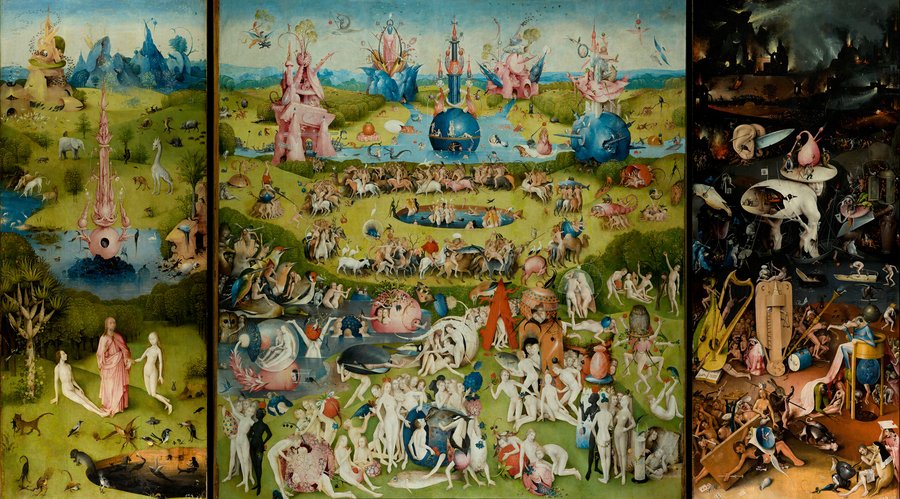
Hieronymus Bosch, Triptych, «The Garden of Earthly Delights, ” c. 1490–1510.
Left Panel
Omen of Sin
In the foreground, a spotted cat carries a small rodent in its mouth. Researcher Eric de Breuil compares this scene to Albrecht Dürer’s engraving «Adam and Eve» from 1504. In Dürer’s work, the cat and mouse are at the feet of the first humans at the moment of temptation. In Bosch’s, however, the prey has already been caught. The researcher suggests reading the scene as a prefiguration of the fall from grace. Within the context of the entire triptych, it resonates with the right wing, where a human is already in the predator’s mouth.
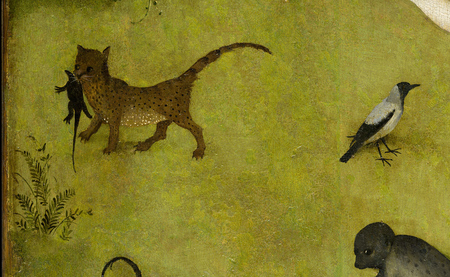
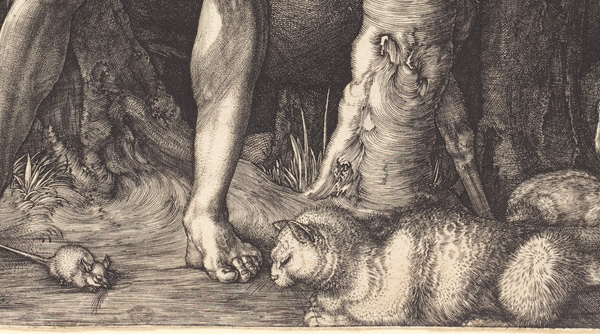
Hieronymus Bosch, triptych, «The Garden of Earthly Delights,» c. 1490–1510, left panel, fragment Albrecht Dürer, engraving, «Adam and Eve,» 1504, fragment
Thus, the small episode with the animals acquires a broader significance: it becomes a sort of premonition of the future disruption of the harmony of the Edenic Garden. The juxtaposition of predator and prey can be perceived as an image of the loss of original innocence and the emergence of relationships of violence and subjugation. A seemingly inconspicuous detail is connected to the overall theme of the triptych—the consequences of human desires and sins that ultimately lead to the destruction of the initial order.
Symbol of Darkness
An owl perches in a dark aperture of a pink fountain—it is positioned almost exactly at the geometric center of the panel. Art historian Paul van den Broek references the medieval motif of diurnal birds attacking, symbolizing righteous people and divine light, against an owl, which was considered a symbol of darkness, sin, heresy, or false teachings in the Middle Ages. He presents an allegory: just as the owl is blinded by daylight and cannot withstand the attack of other birds, false teachings cannot withstand confrontation with truth, suggesting that this represents a troubling sign within Eden.
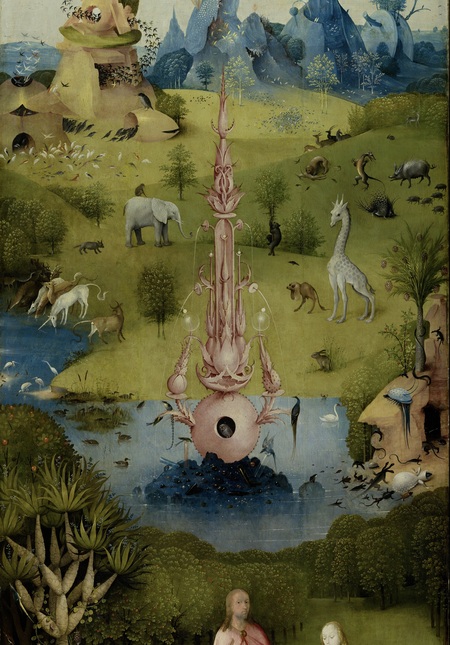
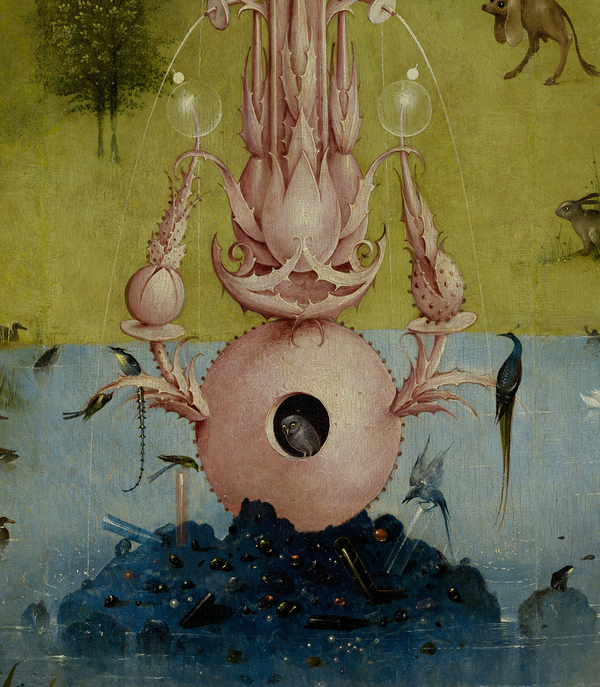
Hieronymus Bosch, triptych, «The Garden of Earthly Delights,» c. 1490–1510, left panel, fragment
Center Door Panel
The Seduction Trap
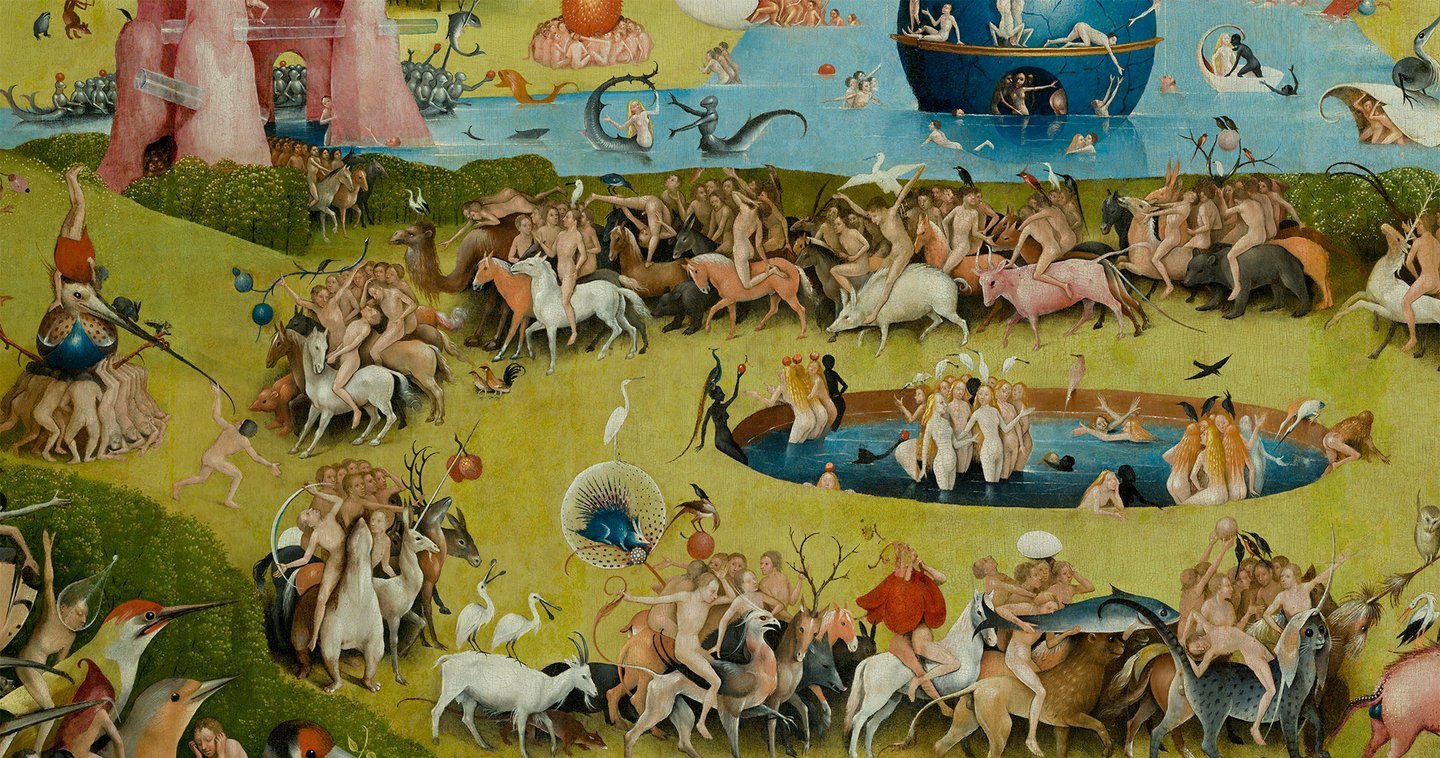
The fragment depicts a blue spherical structure, resembling a fountain, which, according to the interpretation offered by the Museo del Prado, housing the painting, evokes an alchemical flask—an image expressing Bosch’s skeptical attitude toward the «quest for the philosopher’s stone» and the vanity of earthly desires, given that alchemy aroused suspicion in the Church during the Middle Ages. However, instead of the owl featured on the left wing of the triptych, human figures—naked men and women indulging in carnal pleasure—are situated within the flask’s opening. This scene, like the entire central wing of the triptych, illustrates the mingling of humans, animals, and fantastic creatures in a chaotic procession, signifying the illusoriness and ephemerality of worldly pleasures—a trap into which humanity falls: the endless pursuit of gratification without spiritual understanding and the danger of blindly following base instincts.
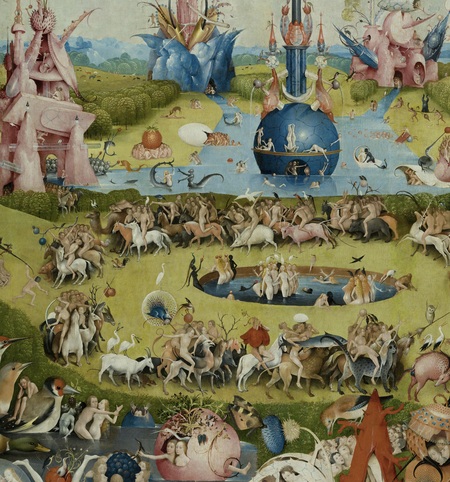
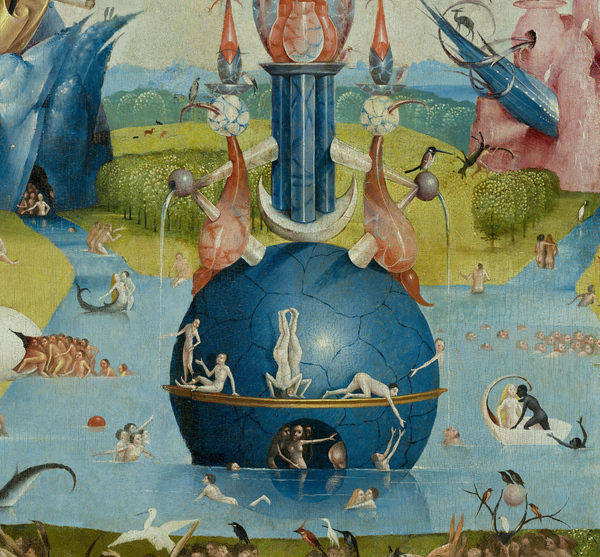
Hieronymus Bosch, Triptych, «The Garden of Earthly Delights, ” c. 1490–1510, central panel, fragment
The left and central panels of the triptych share a similar form, and the substitution of characters helps develop the painting’s narrative. Another technique employed by the artist is the use of comparisons and parallels drawn across the same canvas between adjacent panels. Thus, the recurring form serves as a connecting element between the two parts of the triptych, yet its meaning shifts depending on the content depicted. If the opening on the left panel relates to the image of an owl and the symbolism of darkness, it transforms in the central section into a space of human desires and physical pleasures. Bosch utilizes visual similarity as a means of juxtaposing different meanings, allowing the viewer to discover the connection between the images independently. This device strengthens the sense of sequence between the panels and illustrates how the original harmony of Eden gives way to a world of earthly temptations.
Temptation Berries
Naked figures reach for the berries, and some even climb inside them. The berries, because they do not satisfy, and their flavor and aroma are fleeting, become a symbol of empty illusions and momentary, superficial pleasures lacking substance within the context of Christian morality, which condemned idleness and yielding to carnal desires. In Bosch’s works, strawberries could have symbolized temptation, and at times death; cherries—fertility and eroticism; blackberries—love and the purity of the Virgin Mary; and wild strawberries—righteousness and diligence. However, the scene depicting people succumbing to sin and idleness reflects the allegory of the transience and ephemerality of pleasure itself—they beckon, yet they not only fail to satisfy the soul but also lead to spiritual decline.
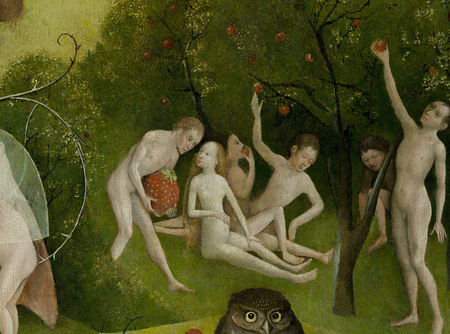
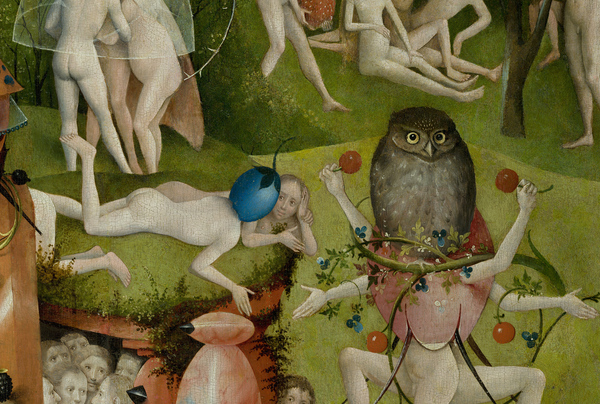
Hieronymus Bosch, triptych, «The Garden of Earthly Delights, ” circa 1490–1510, central panel, fragment
Art historian Walter Gibson, drawing upon the work of Dirk Bax, draws a parallel suggesting that the phrase «to pluck a fruit» (or «to pluck a flower») might have denoted sexual intimacy. A more contentious example is the figure whose head is replaced by a blue fruit—in Bax’s interpretation, the man hid his head within the casing of a berry; however, De Breoins critiques this hypothesis, offering his own reading: the grape is simultaneously a sexual organ and a human head (in Middle Dutch, words for grape and head could also signify the glans penis), and the leaves with the stem represent the foreskin. In support of an erotic interpretation, he also references Jan van Steeuwert’s collection «Collection of Refrains» (1524) and cites a poem about an unfaithful lover. In the third stanza, the man recalls once bringing to his lover’s altar «the most beautiful little berry from the bunch» (here, the berry is a sexual organ, Venus’s altar is the female genitalia, and offering the berry is sexual intimacy).
Scattered alongside the berries in the painting is a chicken eggshell. The image of the shell is interpreted as a symbol of false belief, licentiousness, and sin. Bosch, known for his critical stance against alchemy and other heresies, uses this image to illustrate how humans live in sin, resulting in a soul that is empty and godless.
Bosch references the characteristics of ordinary, familiar, and nature-made objects, comparing them to the desires and sins inherent in humanity.
Right Panel
Mirror of Sin
The woman’s face is reflected in a mirror situated on the demon’s thigh. Gibson interprets this as a punishment for pride, drawing a parallel to Geoffroy de la Tour Landry’s «Book of Counsel for Daughters» (1372)—in that text, the woman spends a long time beautifying herself, making others wait, only to be shown a demon’s thigh in the mirror. In Bosch’s painting, while the mirror reflects the woman’s face, it is affixed to the demon’s body—thus, an object meant for vanity becomes part of a degrading punishment.
A toad sits on the woman’s chest. In the Middle Ages, toads were associated with filth, carnal sins, and witchcraft; in church texts, the animal often symbolized lust—which is why Bosch places toads near the sinners: they sit on bodies, creep over people, and accompany scenes of punishment.
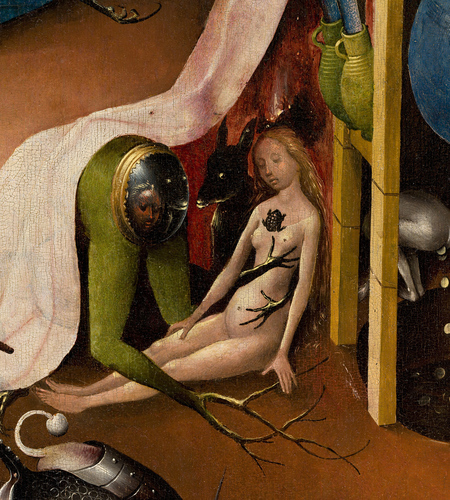
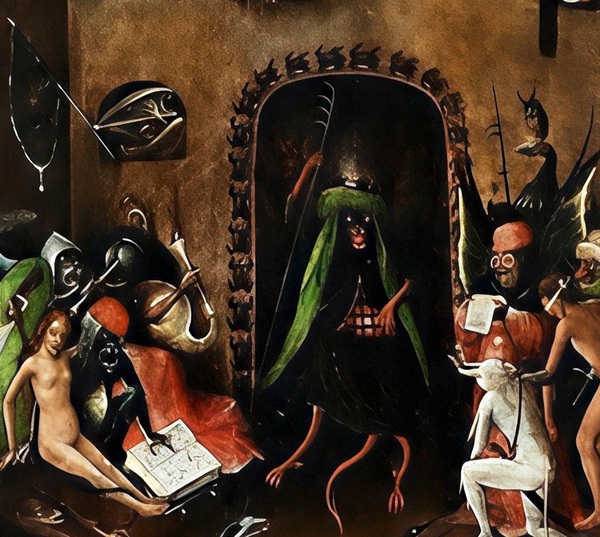
Hieronymus Bosch, Triptych, «The Garden of Earthly Delights, ” c. 1490–1510, right panel, fragment Hieronymus Bosch, Triptych, „The Last Judgment, ” c. 1490–1505, right panel, fragment
In Bruegel’s «Garden of Earthly Delights» and at the entrance to hell in «The Last Judgment,» the image of the frog performs different functions: in the first case, the animal serves as a direct symbol of carnal sin, accompanying the punishment for lust; in the second, it becomes part of the image of hellish space itself, emphasizing its connection to evil, danger, and eternal punishment. Thus, Bosch employs the same image to illustrate diverse semantic connections between human vices and their consequences.
Soul Devouring
Erik de Groot suggests that Bosch, in this fragment, alludes to the motif of «The Vision of Tundal”—a medieval religious text—but does not copy it literally; rather, he transforms it according to his own symbolic system. While the medieval text and miniature illustrate the punishment of souls through a monster that devours them and expels them onto the ice, Bosch gives this process a different visual form: a bird-headed demon consumes sinners, and the opening beneath his chair becomes a peculiar entryway into the realm of torment. By doing this, the artist does not merely reproduce a familiar narrative, but rather renders the mechanism of hellish punishment itself more visible and tangible.
Hieronymus Bosch, triptych, «The Garden of Earthly Delights, ” circa 1490–1510, right wing, fragment