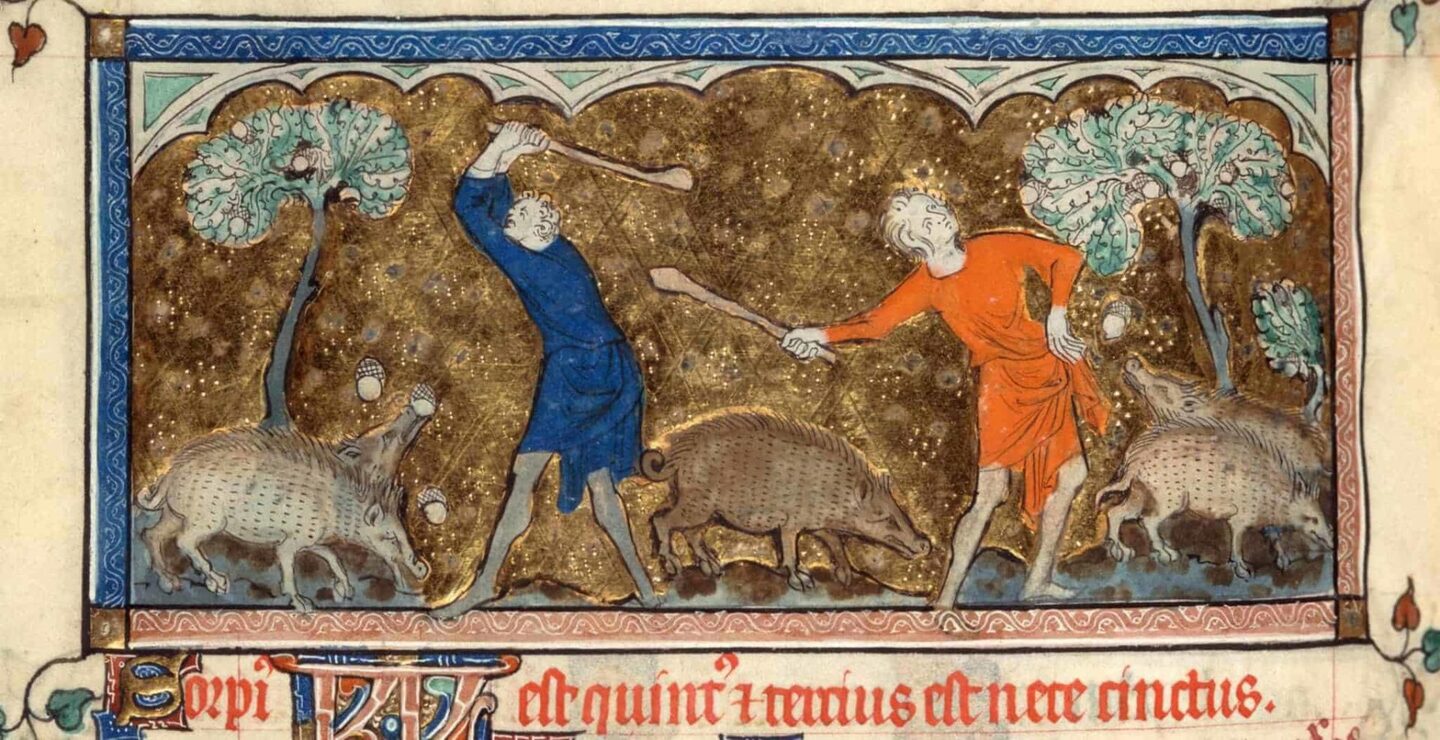
Мир наизнанку. Визуальная сатира и принципы конструирования маргиналий в английских псалтырях XIV века.
Table of Contents:
1. Introduction
2. Anatomical Constructor: Principles of Hybridization
3. The World Upside Down: Animal Satire
4. Life on the Fields: Interaction with Textual Architecture
5. The Apex of Visual Absurdity: Marginalia of the Smithfield Decrees
6. Conclusions
7. Sources
Introduction
Rationale for Topic Selection
The 14th century in England represents a unique period when illuminated manuscript art reached its apex, and the manuscript margins became a space of unprecedented creative freedom. The selection of this topic is driven by the need to shift the research focus from central religious narratives to the periphery of the page—to examine the marginalia (drolleries) not merely as amusing ornamentation, but as an independent, complex, and deeply symbolic visual language of Gothic art.
Objective, Key Question, and Hypothesis
The main research question (and the objective of this work) is formulated as follows: what function do absurd and satirical illustrations in the margins of sacred texts perform, and how do they interact with the official canon? The research hypothesis is that Gothic *drolleries* functioned as a systemic visual counterpoint to the strict architecture and dogma of the book leaf. They constructed a parallel, «carnivalesque» reality that, through humor, grotesque, and visual inversion, undermined the medieval social and spiritual hierarchy, providing the artist with a safe space for reflection.
Material Selection and Categorization Principles
The visual material selected consists of masterpieces of English illuminated manuscripts: the Psalter of Lattrell, the Gorleston Psalter, and the Maclefield Psalter. The research is based on a typological categorization principle: the material is divided into three thematic sections depending on the visual technique employed by the artists (anatomical construct, social inversion, or interaction with the text’s architecture). The theoretical foundation is drawn from the work of Umberto Eco and Maurizio Casturo.
Anatomical Constructor: Principles of Hybridization
The first and most common type of marginalia from the 14th century is the chimeras, created using the principle of visual collage. The artist deconstructs familiar forms of the human body, flora, and fauna to assemble them into impossible combinations. This technique strips the images of the stable form characteristic of classical art, creating visual absurdity.
Sir Geoffrey Luttrell at table Originally published/produced in England [East Anglia]; circa 1325–1335.
Nederlands: Luttrell Psalter fol 70v Anonymous author, circa 1325
Cat detail from the Lutrell Psalter commissioned by Sir Geoffrey Lutrell of Irnham. Ioreth, 1340
Dining room scene from the Luttrell Psalter, written and illustrated circa 1325–1335 by anonymous scribes and artists.
Folio 202v of the Luttrell Psalter, featuring part of Psalm 108 in Latin (Psalm 109 according to the Masoretic numbering). Anonymous author, second quarter of the 14th century
Scene from the Luttrell Psalter, written and illustrated circa 1325–1335 by anonymous scribes and artists.
Two Knights Jousting — Luttrell Psalter (c. 1325–1335)
Execution of Thomas Lancaster. The Psalter of Lattrell. (1320–1340). British Library
A hammock, as depicted in the medieval English Luttrell Psalter. The miniature in the margins of the Latin text proves the existence of hammocks in Europe prior to the discovery of the Americas by Columbus.
Commissioned by Geoffrey Luttrell, 1325–1340
Sir Geoffrey Luttrell, mounted, being assisted by his wife and daughter-in-law. Unknown author, 14th century
The World Reversed: Animal Satire
The second key principle in creating Drolleries is the inversion of social roles. Fourteenth-century marginalia frequently employed anthropomorphic animals to construct a satirical «upside-down world.» By endowing animals with human attributes of power, artists created a safe space for visual critique.
Gorleston Psalter (British Library Add Ms. 49622). «The fox carries a goose away in its mouth, and the goose says ‘queck’ (quack). The scene is probably from the tale of Reynard the fox.» Unknown author, 1310s
Gorleston Psalter (British Library Add Ms. 49622) Unknown author, 1310s
Image from the Gorleston Psalter, featuring medieval musicians. A variety of instruments are pictured (from left to right): clapper, harp, singer, rebec, citole, psaltery, and tambourine or drum. Anonymous author. Estimated creation date: 1310–1324.
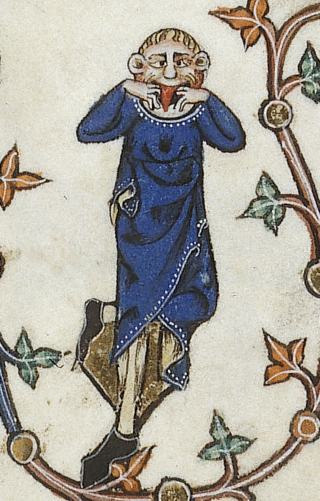
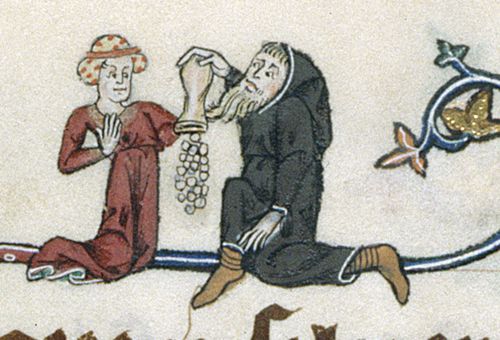
Marginalia Gorleston Psalter (British Library) Add. Ms 49622 British Library Gorleston Psalter (c. 1310–1324)
Gorleston Psalter (British Library Add Ms. 49622.) Unknown author, 1310s
Gorleston Psalter (British Library Add Ms. 49622.) Unknown author, 1310s
Gorleston Psalter (British Library Add Ms. 49622.) Unknown author, 1310s
Gorleston Psalter (British Library Add Ms. 49622.) Unknown author, 1310s
Life on the Fields: Physical Interaction with Page Architecture (McSfield Psalter)
The third typological group of marginalia reveals their unique spatial nature. Unlike miniatures confined within strict borders, the drolleries actively interact with the architecture of the text itself—they utilize the letterforms' ascenders as support or sprout from the initial letters.