Concept
A single portrait captures a person at a specific moment. A series of portraits allows one to compare different moments and observe changes that are not always apparent in a single photograph: changes in age, posture, facial expression, interpersonal relationships, or self-perception. Time within the series manifests not only through obvious shifts. It becomes noticeable also because of repetition—the subject returns before the camera, a similar angle is maintained, or a familiar location reappears.
A photobook does more than simply gather images; it dictates the order in which they are viewed. As the reader turns the pages, they compare the photographs, noticing similarities and differences, and imagining the spaces between them. Therefore, not only are the images themselves important, but their sequence is equally vital.
The study includes five photographic books by different authors and from various periods, selected based on the following criteria: each features a series of portraits connected by repeated shoots or extended observation; the sequence of photographs is essential to the book’s meaning rather than serving as a simple collection of individual portraits; the editions allow for an examination of the structure of the photobook—the order of images, repetitions, pauses, spreads, and the role of text—and the material covers diverse historical and cultural contexts: Rineke Dijkstra (Netherlands, 1994–2008), Zed Nelson (United Kingdom, since 1991), Nicholas Nixon (USA, 1975–2014), John Copland (United Kingdom/USA, 1978–2001), and Seiichi Furui (Japan, 1989–2006).
Contents
Introduction
- Rineke Dijkstra: The Human and the Changing Space
- Zed Nelson: Family Portrait in Longitudinal Observation
- Nicolas Nixon: Four Sisters, Forty Years
- John Coplans: Self-Portrait Without a Face
- Seiichi Furui: Christina, 1978–1988
Conclusion
Hypothesis
In the photobook, time becomes palpable through the dialogue between images. Recurring people, bodies, poses, or locations help highlight change, and the sequence of photographs transforms frame comparison into an experience of time—not just its chronological dimension, but also the memory of what has changed and what remains constant.
LARI SULTAN: HUMAN AND THE EVER-CHANGING SPACE
In the 1980s, Sultan returned to his parents' home in Southern California, photographing his father and mother over a decade: the father ages, the mother remains in the frame, and the house itself—kitchen, bedroom, pool, garage—changes alongside them. The book interweaves photographs, clips from amateur home movies, snippets of conversations, and the family archive.
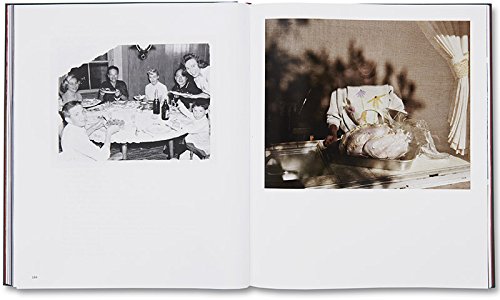
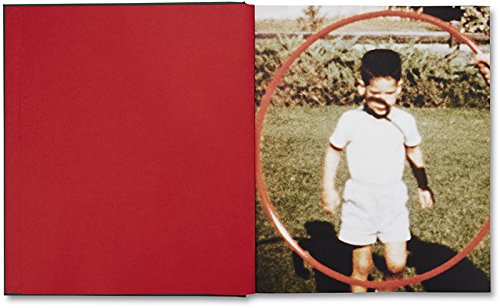
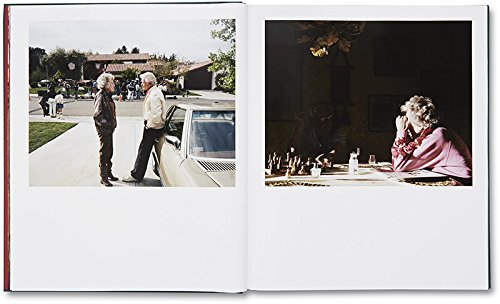
Sultan begins the book with a simple admission: «These are my parents. Everything else follows from this fact.» The house itself serves as the anchor: the kitchen where the same newspaper was read for forty years, the pool that alternates between being full and empty, the curtain behind which his mother hides. A person changes according to their own rhythm, and space changes according to its own, and the mismatch of these rhythms is the book’s subject—time is inscribed not only on faces but also on wallpaper, dishes, and furniture. This is the most evident case in the entire study—a model for all other books.