Visual Study. Pikulin Alexandr Artyomovich, Group B26UKI03. Course: «History and Theory of Communication Culture.»
TOPIC
The Tunic in the Roman Empire, 4th Century AD: A Visual Medium of Cultural and Social Differences
INDEX
1. Topic
2. Navigation
3. Concept
4. Introduction
5. Examples with Commentary
6. «The Language of Patches»
7. Conclusion
8. List of Textual Sources
9. List of Image Sources
Concept, rationale for topic selection, material selection principle, categorization principle, and principle for selecting and analyzing textual sources
Justification for Topic Selection. The tunic was the most ubiquitous garment in the wardrobe of the Roman Empire. Senators, officials, warriors, and servants, men, and women and monks all wore them. However, tunics were not uniform; they varied in length, fabric, color, striping, and insignia. Therefore, the most common piece of clothing allows us to trace how Romans displayed their status and group affiliation. The fourth century was chosen because the empire underwent rapid change during this period. Following Diocletian’s reforms, the bureaucracy and the court expanded, Christianity transitioned from a persecuted religion to an allowed one (the Edict of Toleration in 313 AD), and by the end of the century, it became the state religion (380 AD). Soldiers increasingly featured individuals from other ethnic groups. These changes are visible in the clothing: new motifs appear in the decoration, and formal attire takes on Eastern characteristics. I am interested in understanding how much societal information can be gleaned by carefully examining clothing.
Material Selection Principle. The work utilizes two groups of sources. The first consists of the tunics themselves and their fragments. These have largely survived in Egypt due to the arid climate, providing a view of the province rather than the entire empire. The second group comprises depictions of people wearing tunics: silver tableware, consular diptychs, mosaics, reliefs, and catacomb frescoes. Selection criteria include: dating to the 4th century (items from the transition of the 3rd–4th and 4th–5th centuries are acceptable if they convey the visual language of the 4th century); inclusion in a museum catalog or a scholarly article with a citation; clear visibility of the cut, stripes, and insignia; knowledge, if possible, of the owner’s or depicted person’s status; coverage of diverse roles: senator, official, warrior, citizen, servant, monk, woman, and «barbarian.» If a museum provides a broad date range for an object (e.g., «4th–7th centuries»), I explicitly state this in the commentary and avoid making conclusions about the specific time period.
Rubrication Principle. The research moves from the general to the particular and then returns to the general. After the introduction, I describe the basic tunic and the clavi stripes, then show how status is expressed through imperial and court attire. I analyze the formal cloak (the chlamys with its fibula), the warrior, and the «barbarian, ” the language of insignia, Christian symbols, women’s clothing, and servant attire. Finally, I synthesize a schema of the „language of insignia“ and test the hypothesis.
Principle of Selecting and Analyzing Textual Sources. Written sources are necessary so that we do not «read» clothing details blindly. The Edict of Diocletian on Prices (301 CE) demonstrates that fabrics and dyes had varying costs, and purple was particularly expensive. John Cassian describes the clothing of Egyptian monks. Writings by Church Fathers show how Christians were advised to dress. Scholarly literature (Croom 2010; Edmondson, Keith 2008; Harlow, Nosch 2014; Dunbabin 1999; Elsner 1998; Pritchard 2006; Volbach 1976; Kiilerich 1998; Safran 1993; Cameron 2016) is needed for attributing objects and drawing cautious conclusions. I determine color and material using museum passports, not black-and-white photographs of reliefs.
Hypothesis
Hypothesis: In the 4th century, the tunic was not only everyday wear but also a means of displaying an individual’s social standing. Stripes (clavi), patches (orbiculi, tabulae), color, and fabric material played a particularly important role—the higher the status, the more noticeable and costly the embellishments. In this research, I am investigating whether these characteristics form a coherent system and where that system breaks down: among monks, non-Roman warriors, and provincial imitations.
Key Question
Who in Roman society during the 4th century was considered «one of us» and worthy of respect, and how did they demonstrate this through their clothing?
Object, Subject, and Goals. Visual Analysis Scheme
Object—a tunic and its depictions in the Roman Empire, 4th century AD. Subject—the visual indicators by which the tunic conveyed a person’s status: length and cut, fabric and color, the clavi stripes, appliques (orbiculi, tabulae), and what was worn over the tunic (chlamys, fibulae, belt). Objectives: to gather tunics and images of people in tunics from museum catalogs; to describe each artifact using a unified schema; to identify recurring features across different groups (court officials, military, citizens, servants, monks, women); to cross-reference these findings with written sources; and to test the hypothesis to locate where the system breaks down.
Schema for Visual Analysis. I describe every object using the same criteria: 1) who is depicted and their role; 2) the length of the tunic and sleeve; 3) the clavi stripes—whether present, width, and color; 4) the appliques—shape, number, and placement on the garment; 5) the fabric and color (based only on museum documentation); 6) what is worn over the tunic—cloak, fibula, or belt; 7) the figure’s positioning in the composition; 8) context and dating. This allows artifacts of different materials to be compared with one another.
Introduction
The tunic was the foundation of Roman dress. It was sewn from linen or wool in the form of a simple, straight piece of cloth with a hole for the head; depending on status, age, and profession, it was made shorter or longer, with or without sleeves. Next, I will show you which details transformed this simple garment into a sign of status and belonging.
Basic tunic and clavi stripes: Unknown maker. Tunic. Byzantine Egypt (Kharga Oasis), 4th–7th centuries. Linen. Commentary. A simple tunic made of unbleached linen, woven in a plain, unstriped, and undecorated form. The museum describes it as typical of Roman tunics, which were woven crosswise, folded in half, and sewn together. It serves as a baseline—it shows what clothing looks like «without insignia.» The dating range is broad (4th–7th centuries), so the conclusion is based on the garment type rather than a specific time period. Metropolitan Museum of Art, inventory no. 33.10.48, 136 × 104 cm. Label. Unknown maker. Sleeveless children’s tunic. Byzantine Egypt (Kharga Oasis), 4th–7th centuries. Linen, wool. Commentary. According to the museum description, the clavi stripes run from the shoulders to the hem, with a horizontal neckline, a wide torso, and open side edges trimmed with fringe. The stripes are woven in purple-dyed wool onto a linen ground (the passport notes «purple-colored wool,» meaning color, not necessarily genuine Tyrian purple). The presence of stripes even on this children’s garment suggests they were not exclusive to the elite classes. Metropolitan Museum of Art, inventory no. 33.10.39, 50 × 45 cm
Emperor, Court, and Official
Signature. Unknown Master. The Missorium of Theodosius I. Probably Constantinople, 388 AD (traditional dating). Silver with gilding.
Commentary. A ceremonial dish with a diameter of 74 cm and a weight of 15.35 kg was found in 1847 near Almendralejo (Spain) and is housed in the Royal Academy of History in Madrid. It is traditionally associated with the tenth year of Theodosius I’s reign (388 AD), but the dating is debated: dates of 393 AD and even a connection to Theodosius II have been proposed. The hierarchy is depicted by the size and placement of the figures: the emperor is central and larger than the others, with smaller figures on the sides, and an allegory of Earth at the bottom. The color of the robes on the silver is not visible, so we cannot judge the «purple stripes» here.
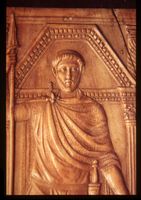
Signature. Unknown master. Diptych traditionally associated with Stylichon, his wife Serena, and their son Eucherius. Circa 395–400 CE. Ivory. Commentary. One panel depicts a soldier with a spear and shield, while the other features a noblewoman (based on A. Cameron’s description; see also regarding the depiction of the child). The diptych is housed in the Museum and treasury of the Basilica of Monza. The interpretation is debated: A. Cameron argues that the woman lacks imperial attributes, which calls into question the identification with Stylichon and the dating of 395/396 CE. Therefore, the diptych is used as an example of a formal image of high rank, rather than a document about a specific family. The costume is the most important element for the theme: according to scientific literature, the military commander is dressed in a tunic, a long, richly decorated chlamys fastened with an onion-shaped fibula, and tight, long trousers, while the boy is also in a chlamys with a fibula and holds a codicil (a letter of appointment). This means that the rank is conveyed not by the tunic itself, but by the cloak, the fibula, and the official insignia.
Caption. Unknown master. Diptych of Rufinus Probianus. Rome, c. 400. Ivory.
Commentary. The diptych is housed in the Berlin State Library (Ms. theol. lat. fol. 323), where its leaves serve as covers for an 11th-century manuscript. Probianus is depicted seated on both leaves: secretaries are recording his speech on wax tablets on either side, while orators in the lower row gesture toward him and hold scrolls; on the left leaf, Probianus holds a scroll inscribed with «Probiane floreas.» In literature, he is known as the vicar of Rome. The hierarchy is conveyed through the composition: the large central figure and the tiers of assistants. The details of the clothing in the photograph are minute, so I do not draw conclusions about embroidery from this piece.
Signature. Unknown master. Left panel of a Diptych by Lampadius. Early 5th century. Ivory.
Commentary. Only the left panel survives (Museum of San Giulio, Brescia). It is inappropriate to call it a consul; the BYZART catalog describes a man, likely Senator Lampadius, with a scepter and a mappa (a signaling cloth used to begin the games) between two officials; literature associates him with Lampadius, prefect of Rome in 398 AD. The lower register depicts a chariot race of four quadrigas around the back of the circus, featuring an obelisk. The panel allows for a comparison between the ceremonial costume of a magistrate and the short tunics of the drivers. The dating is early 5th century (BYZART lists 400–424 AD), so the piece serves as a transition point, illustrating how the formal image of the highest magistrate persisted at the beginning of the next century.
Chlamyd, Fibula, and Courtyard
In this section, I examine how by the end of the 4th century, the recognizable court rank no longer consisted of the tunic, but of what was worn over it: a long chlamys secured with a fibula on the right shoulder. Because it was not possible to reliably depict the Dalmatica (a long tunic with wide sleeves) in the assembled material, this section has been restructured around the chlamys. The court images depict ceremonial appearances, not daily life, and this limitation is considered in the conclusions.
Caption. Unknown master. Reliefs from the base of the Theodosian obelisk. Constantinople, 390 AD. Marble.
Commentary. On one of the reliefs, the emperor is seated in the hippodrome box (caisma) with a laurel wreath for the race winner, flanked by his sons Honorius and Arcadius, below whom are spectators and musicians playing a water organ. The compositional arrangement illustrates the hierarchy: the emperor is above and centered, the populace below. One separate relief shows defeated enemies bringing tribute. The base stands in the location of Sultanahmet Square in Istanbul (Kiilerich 1998; Safran 1993). Officials and guards stand on either side of the imperial box, allowing a comparison of the ceremonial attire of courtiers and soldiers on one relief.