07.08 | Monday
Evening News, No. 112 Moscow Notes The Bolshevik faction uncovered a certain glimmer of insight during the last meeting of the City Duma… The Duma majority was unwilling even to settle on a specific, uncomplicated proposal: To conduct an accurate inventory of all available premises. The housing crisis in Moscow has truly taken on a spontaneous character. After all, the city head Rudnev and the Duma chairman Minor, both having moved back to Moscow, are still without apartments, staying with relatives. The Moscow city head without an apartment! This sounds equivalent to: — Moscow without a head…
A new organization is emerging in Novogireyev: a cooperative association that will take charge of all the communal functions of the settlement… The cooperative association is being formed by dacha owners and tenants interested in maintaining an exemplary standard of living. The association will be fractional… The cooperative is taking over the responsibility for the water supply, sewerage, installation, and maintenance of sidewalks, and other aspects of the settlement’s infrastructure improvement… …The new cooperative association will operate in close contact with the settlement Duma, serving as a subordinate body to the Duma.
In the evenings, the guys from Kuskov shoot in the park and other areas, causing false alarms… As soon as one shot rings out, responses come from all sides of the dacha area… At any moment, a stray bullet could fly onto a terrace.
Homeless Individuals
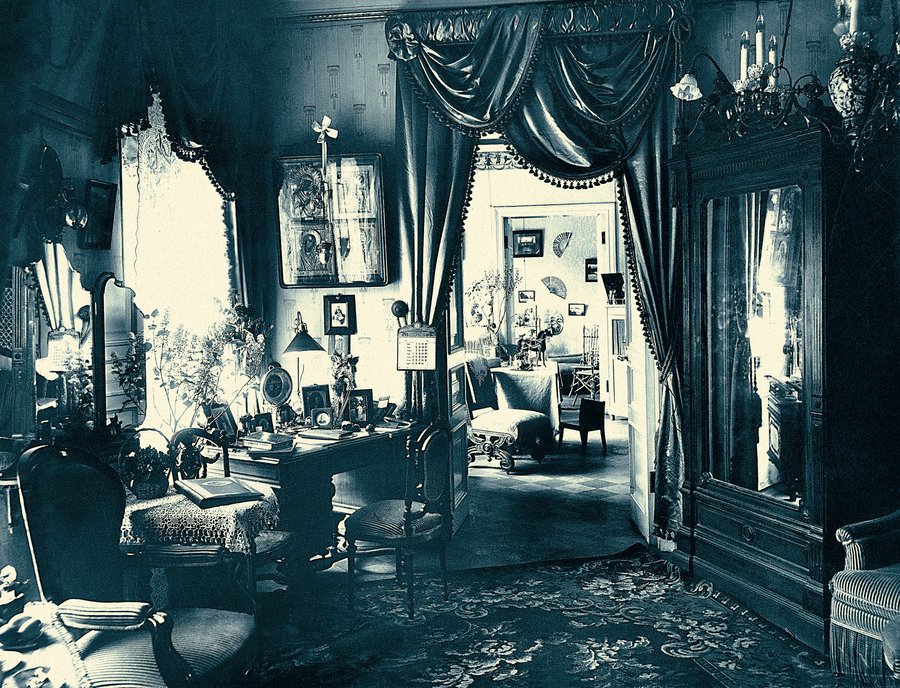
…Walking at night through the streets, boulevards, and squares of Moscow, you encounter human figurines huddled on benches at every turn… Rooms have grown to unbelievable sizes. It is almost impossible to find a room for less than 100 rubles per month. The high cost of housing and predatory speculation that has sprung from this soil—these are significant evils in themselves…
Early Morning, No. 180
But an even greater evil is the shortage and absence of housing—or rather, its uneven distribution. Already in Moscow, there is a significant population of «people without apartments,» comprised partly of newcomers who have not found shelter, and partly of local residents who have been evicted under one pretext or another.
This population is set to increase manifold. The «unloading of Petrograd» is proceeding at an accelerated pace… new waves of refugees may flood into Moscow. Furthermore, the autumn arrival of students is anticipated…
…The Duma considered only a petition to issue a decree prohibiting evictions from apartments and raising rent until a new housing law is enacted. But what about those who are already homeless? How can one reconcile the severe overcrowding in some apartments with the underpopulation of others?
The Duma was offered the introduction of a ration card system for housing…
It is highly probable that we will ultimately arrive at this system, just as we arrived at the rationing of sugar, bread, meat, etc.
MAG
08.08 | Tuesday
Russian Word, No. 180 The Fate of the Romanov Dynasty Grand Prince Pavel Alexandrovich petitioned the Finnish Governor-General, M. A. Stakhovich, requesting permission to settle in Sweden. The Grand Prince cited the excessive cost of living in Russia as the basis for his request. The Grand Prince’s petition was rejected. Pavel Alexandrovich was informed of the potential publication of a general decree permanently expelling the Romanov dynasty from Russian borders. This decree is expected to follow the proclamation by the republic’s constituent assembly. Until this time, the Prime Minister has deemed it impossible to grant individual members of the Romanov dynasty permission to leave Russian territory.
In Saratov Hospitals In the medical institutions of the Saratov Zemstvo, astonishing things are occurring. Cases of assaulting patients with broken ribs have been registered at the Zemstvo psychiatric colony. The colony’s patients—mentally ill people—roam unsupervised and participate in rallies, where one can expect outbursts of unrest and similar behavior every hour.
Without Bread Report. A session of the provincial food committee revealed that the state of food affairs in the province has taken on a catastrophic character. The province’s population, having no private harvests, is doomed to inevitable famine… It was expected that new bread would be available in August. Instructors were sent to the districts to procure grain, but in the very first district—Ranyenburg—it was discovered that all the landed estate grain had already been distributed and carried by the peasants to their communal stores. The peasants claim that they took the landed estate grain in an organized manner, meaning, in their view, rightfully. Delegates from the Council of Workers' and Soldiers' Deputies were sent to the Kharkov, Saratov, and Tambov provinces, and to Nizhny Novgorod, but they only secured 26 wagons, of which 2 wagons en route were intercepted and seized by local residents. Melenkov. The situation has now become even more tragic. Peasants in the grain-producing districts are preventing the tallying of the grain, and without an inventory of their own grain, they cannot petition to import grain from other provinces.
August 9 | Wednesday
In the airship
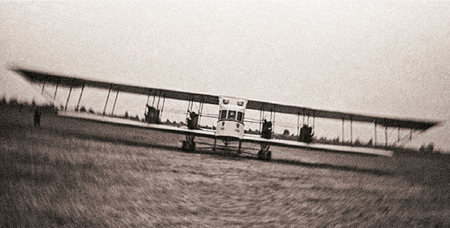
Yesterday, demonstration flights of the aerial vessel «Ilya Muromets» took place at the Commandant Airfield. This vessel is a powerful combat apparatus of our air fleet.
Petrogradsky Listok, No. 190
The demonstration flight began around 8 p.m. V. G. Ya. piloted the craft. Besides V. G. Ya., there was a mechanic and several passengers aboard. «We put on helmets and sat on folding chairs in the cabin…» We flew over the Strelka with its greenery and the mirrored water surface, over Nevsky Prospekt with barely discernible specks—crews—over the State Duma building and the Okhta River. The terrifying roar of the engines prevented us from exchanging impressions, so we exchanged only brief notes occasionally. The maximum altitude reached was 1,400 meters, and the speed was 95 kilometers per hour. Half an hour later, we were once again over the airfield… It is interesting that the craft is so stable that above 1,000 meters, V. G. Ya. would release the steering yoke, and it would nonetheless continue flying with the same stability…
Russian Word, No. 181 Awaiting the Church Council Today, September 9th, the first meeting of the Holy Synod, which has arrived in full assembly due to the imminent opening of the All-Russian Provincial Council, will take place in Moscow. This meeting can be deemed historical, as the annals of the Synod contain nothing like it—and ever did. It seemed that the provincial councils of the Russian Church had concluded their history, but history had merely paused. More than two hundred years after the last Moscow Council, a new council is gathering here, in Moscow, and today the Holy Synod will be reviewing various organizational matters related to its inauguration…Pavel Astrov
08/10 | Thursday
Bourse Gazette, No. 16381 (Evening Edition) The Bolsheviks' Preparation for a Second Revolution A pamphlet by a certain Bolshevik, N. L., titled «On Slogans, ” has been released. The conclusion drawn from it is this: „By peaceful means”—through peaceful accommodation of the developing anarchy—the Leninists have lost hope of achieving their dictatorship. And they are abandoning the peaceful path. They are casting aside their slogan—“All Power to the Soviets.“ In other words, N. L. is calling for a second revolution—a proletarian revolution—a revolution that must transfer power not to the majority of the population, but to its small minority. Such an attempt at revolution will not lead to the triumph of the proletariat and its goals, but to the defeat of the proletariat and the defeat of the revolution…»
08.11 | Friday
Around and about food
Forty percent of the capital’s population, lacking their own means of sustenance, ate in restaurants, taverns, kitchen eateries, and tea houses, but now the vast majority of these people are forced to subsist on lean fare. There were times when tables in establishments of all classes were filled during breakfast and lunch hours… And in June, restaurateurs, tavern keepers, and others made a handsome profit, while waiters were quite well-fed by the «tips.»
Petrogradskii Listok, No. 192
…But starting in June, the prices of groceries rose immediately, and suddenly the waiters began demanding the abolition of «tips,» deeming such a form of labor compensation shameful. In the end, the proprietors were forced to accept new terms of service for their waitstaff and began paying them a percentage of the turnover. All the increased food prices and the percentage payments on the turnover were completely passed on to the customers, and now we are seeing the results of this. A lunch at a second-rate restaurant costs 7–8 rubles; at a third-rate restaurant or tavern, it is five rubles. In other establishments, lunches have been entirely eliminated and replaced with individual-serving dishes. For a plate of broth with two portions of meat, they charge 1 ruble, and for a piece of fried meat or veal, 2 rubles. These lunches are so meager that one could easily eat a second meal an hour later, and the individual servings are extremely small. If you pay 7 rubles for a lunch, the waiter receives 1 ruble and 40 kopecks for serving it—more than double what the entire lunch cost three years ago. A waiter who served 8 tables at the beginning of his «constituency» earned 480 rubles per day, of which 96 rubles went into his pocket daily! It is clear that such bliss could not last long, and now we see emptiness not only in restaurants but also in taverns, kitchens, and tea rooms…
Over the last month alone, more than twenty Caucasian buffets have opened in Petrograd. Restaurateurs and waiters complain about poor business, while the owners of the Caucasian buffets are satisfied; yet, the prices for food at the Caucasian establishments are about 40 percent lower than in restaurants, and the quality of the provisions is beyond reproach—it is no less worthy than that of a restaurant. Rent from the Caucasians is not cheap, the staff is also paid on a commission basis, and their rights come with a cost. What is the secret? A mystery!
Semaphore
August 12 | Saturday
Novoye Vremya, No. 14851 Moscow Zemstvo Cathedral (Impressions of August 11) …On Kuznetsky Most, a flyer titled «Why is the Moscow meeting being held?» is being sold. People are tearing it up from the vendors. Printed at the top are the Assumption Cathedral (where the zemstvos met in 1613) and the State Bolshoi Theatre, Minin on the left, Kerensky on the right. The faceless crowd is also waiting in unbearable suffering—it also wants to believe. But believing is difficult… …Of course, you already read yesterday’s resolution from that preliminary meeting where all Russian society, from Plekhanov to Shulgin, united. «The Government must decisively and immediately break away from serving those socialist utopias that exert such a detrimental influence on its activities, ” and further: „The Government must become non-partisan.“ The local council adopted a resolution that states in stark terms that the current Government must steer to the left: uncompromising taxation (again!..), relentless implementation of land reforms (Chernovsky!..), abolition of the death penalty, and immediately. Kerensky’s measures, it seems, are not revolutionary enough. By the way, the cathedral itself is being held especially responsible. A split is inevitable. The two chairs Kerensky hoped to occupy will definitely crumble apart. He will have to choose…Al. Pilenko
On the Front Line …In the immediate rear, the village is packed with our supply wagons, lazarettos, parks, and various rear-echelon institutions. Mud and disorder—exceptional even for wartime… The villages look like Nevsky Prospect: dirty, covered in peeling paint, filled with gray figures. They wander sluggishly, tired, just as our soldier, consumed by a resentful contemplation, knows how to wander: «And what is the soldier suffering for?»… The rear does not save him from this thought—he has grown quite fond of it, and has become accustomed to it. …If they aren’t playing cards, they are talking about women. Endless, tedious conversations… This is where the women’s battalion was stationed; soldiers came and gathered in groups, staring blankly and meaninglessly at the «ladies.» «Let’s go see the ladies"—and a group of soldiers would follow; if the women started working, the soldiers would lie down on the ground, supporting their heads with their hands, staring for hours without uttering a word. Then they retreat to their tents, and fantastic memories, fairy tales, jokes, and hearty Ethiopian laughter begin. «Public figures» talk about committees and paperwork. Nobody is interested in them or their conversations anymore… Occasionally, the soldiers are diligent and serious—washing clothes, rummaging through their sacks, or looking for mushrooms in the woods—and gazing hopelessly at the rear areas, as if thinking: «How long will this drag on?»… And then they speak apathetically and dully: «Why won’t they end the war; the people are just milling about for nothing.»
August 12–15
State Council Meeting
August 12. Opening
The State Council meeting in Moscow opened with a speech by A. F. Kerensky: —The Provisional Government called this Council not for mutual disputes… The Provisional Government summoned the State Council to openly and frankly state the true reality of what awaits us and what our great, yet exhausted and wounded, homeland is going through. …No matter what ultimatums anyone demands of me, I will be able to submit them to the supreme authority, which is me, its supreme leader. For me, there is no homeland without freedom, and no freedom without a homeland… Any attempt by Bolshevism will find its limit in me…
A. F. Kerensky’s speech made a powerful impression. The right-wing and the far-left were displeased by his address.
Birzhevyye Vedomosti, No. 16385 (evening edition), No. 16386 (morning edition), No. 16390 (morning edition) | Evening News, No. 118 | Russkoye Slovo, No. 186 | Sovremennoye Slovo, No. 3410
In the Conference Hall Members of the State Council begin to gather at the Bolshoi Theatre starting at 12 p.m. The Bolshoi Theatre is heavily guarded. Soldiers are lined up in chains on Teatralnaya Ploshchad. Tickets are meticulously checked at the entrances by junior officers and regular officers. The entire square is filled with a crowd that is behaving completely peacefully and mostly consists of curious onlookers… By two p.m., the theatre hall is almost full… At 2:30 p.m., members of the Provisional Government arrive. They await A. F. Kerensky. …The mood is tense and slightly elevated.
August 13th. A complete split is looming.
A Day’s Impressions Meetings took place all day until late into the night. Some sessions lasted until morning, right up until the conference officially opened… Disputes were spirited. A complete rift. The main point of contention between bourgeois and socialist factions was the existence of the Council of Workers' Deputies. Some argued that the Councils' historical role was over and they should only perform professional tasks, while others insisted that the revolution was ongoing and that the Councils held high state significance…
Orators
Under the chairmanship of the Post and Telegraph Master, a meeting was held with the groups participating in the state council regarding the procedure for orators to present their remarks…